Grachtengordel in Amsterdam, North Holland, Netherlands — Northwestern Europe
Rik Henning
| — | Walk of Pride Amsterdam | — |
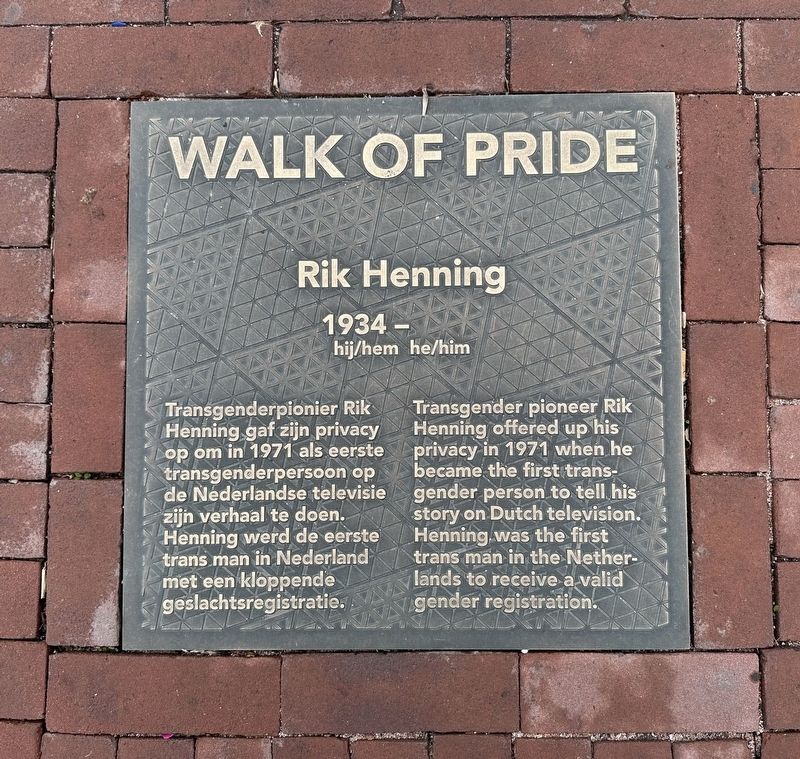
Photographed by Andrew Ruppenstein, August 31, 2026
1. Rik Henning Marker

1934-
hij/hem he/him
Erected 2026 by Walk of Pride Amsterdam. (Marker Number 27.)
Topics and series. This historical marker is listed in this topic list: Charity & Public Work. In addition, it is included in the Walk of Pride Amsterdam series list. A significant historical year for this entry is 1971.
Location. 52° 22.411′ N, 4° 53.229′ E. Marker is in Amsterdam, Noord-Holland (North Holland). It is in Grachtengordel. It is on Raadhuisstraat, on the right when traveling west. Touch for map. Marker is at or near this postal address: Raadhuisstraat 142, Amsterdam, Noord-Holland 1016 DG, Netherlands. Touch for directions.

Regionally,
this page online
Other nearby markers. At least 8 other markers are within walking distance of this marker: Georgina Beyer (here, next to this marker); Benno Premsela (here, next to this marker); Bessy Ferrera (a few steps from this marker); Albert Mol (a few steps from this marker); Janine Wegman (within shouting distance of this marker); Dirkje Kuik (within shouting distance of this marker); Anna Blaman (within shouting distance of this marker); Aaïcha Bergamin (within shouting distance of this marker). Touch for a list and map of all markers in Amsterdam.
Also see . . .
1. Rik Henning (Wikipedia, in Dutch). Excerpt (in translation):
Rik Henning (1934) was the first Dutch trans man to have his gender registration correctly recorded.(Submitted on October 8, 2026.)
Rik Henning was born in 1934. Due to hormonal fluctuations, he struggled significantly with excess weight at the age of sixteen. Testosterone treatment caused his body to become more masculine,leading him to realize that he was a man. Henning was the first person to draw media attention to the experiences of trans men. In 1971, Henning and his endocrinologist, Otto de Vaal, appeared on the program Een klein uur U, where he was interviewed by Koos Postema. In 1972, Henning was legally recognized as a man, making him the first trans man to have his gender registration accurately reflect his identity.Photographed by Andrew Ruppenstein, August 31, 20262. Rik Henning Marker - wide view
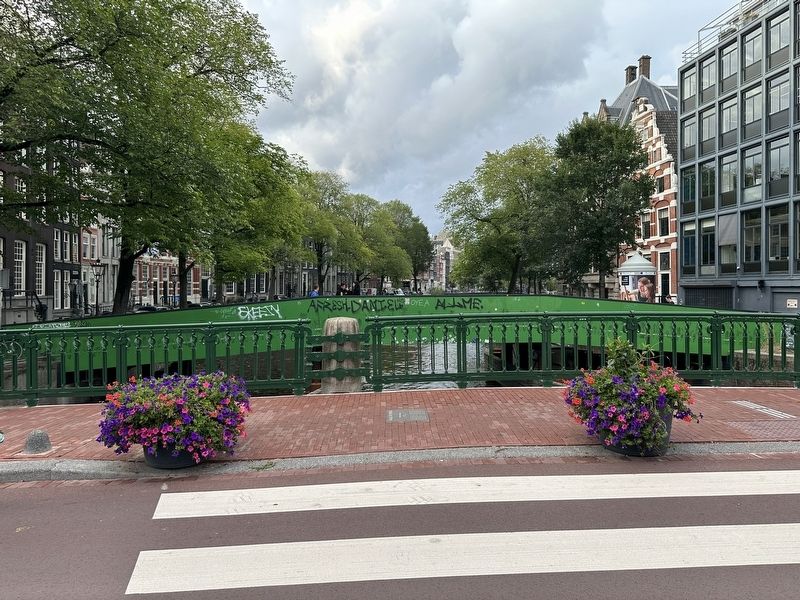
2. Rik Henning (Walk of Pride Amsterdam). Excerpt:
With the support of a team from the medical faculty in Rotterdam, Henning found the courage to seek legal recognition of his male identity. After several years of legal proceedings before the court in Breda, he finally succeeded in having his birth certificate amended at the end of 1972.(Submitted on October 8, 2026.)
Henning, then 38 years old, was henceforth legally recognized as a man. He became the first trans man in the Netherlands whose legal sex registration accurately reflected his gender.
To achieve this, his attorneys relied on the so-called “error provision” (now Article 1:24 of the Dutch Civil Code), which allowed mistakes in birth records to be corrected. In the early 1970s, Van der Reijt handled dozens of such cases, many of which were granted on grounds of equity.
In 1975, the Dutch Supreme Court prohibited the use of this provision to alter the sex registration of transgender individuals. A commission was subsequently appointed to consider whether a specific legal provision for transgender people should be introduced. It took another ten years before the so-called Transgender Act (Article 1:28 of the Dutch Civil Code) came into force in 1985. …
Additional keywords. tegel, lgbt, lgbtq
Credits. This page was last revised on October 8, 2026. It was originally submitted on October 8, 2026, by Andrew Ruppenstein of Lamorinda, California. This page has been viewed 9 times since then. Photos: 1, 2. submitted on October 8, 2026, by Andrew Ruppenstein of Lamorinda, California.
