Altstadt in Dinkelsbühl in Ansbach, Bavaria, Germany — Central Europe
Lange Gasse 19
700 Jahre Baugeschichte
⎯⎯⎯
700 Years of Architectural History
Photographed by James Hulse, September 14, 2026
1. Lange Gasse 19 Marker

700 Jahre Baugeschichte
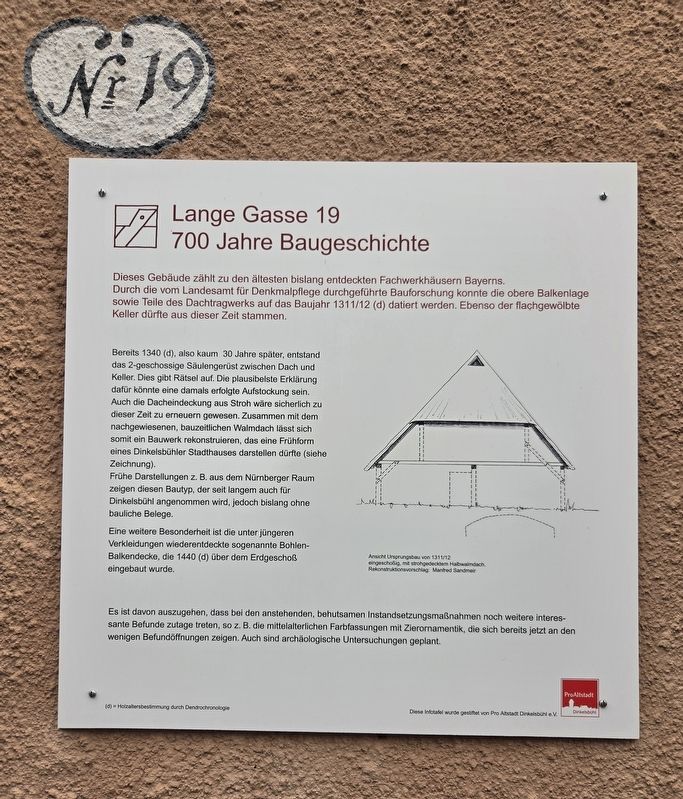
Dieses Gebäude zählt zu den ältesten bislang entdeckten Fachwerkhäusern Bayerns. Durch die vom Landesamt für Denkmalpflege durchgeführte Bauforschung konnte die obere Balkenlage sowie Teile des Dachtragwerks auf das Baujahr 1311/12 (d) datiert werden. Ebenso dürfte der flachgewölbte Keller aus dieser Zeit stammen.
Bereits 1340 (d), also kaum 30 Jahre später, entstand das zweigeschossige Säulengerüst zwischen Dach und Keller. Dies gibt Rätsel auf. Die plausibelste Erklärung dafür könnte eine damals erfolgte Aufstockung sein. Auch die Dacheindeckung aus Stroh wäre sicherlich zu dieser Zeit zu erneuern gewesen. Zusammen mit dem nachgewiesenen bauzeitlichen Walmdach lässt sich somit ein Bauwerk rekonstruieren, das eine Frühform eines Dinkelsbühler Stadthauses darstellen dürfte.
Frühe Darstellungen, zum Beispiel aus dem Nürnberger Raum, zeigen diesen Bautyp, der seit Langem auch für Dinkelsbühl angenommen wird, jedoch bislang ohne bauliche Belege.
Eine weitere Besonderheit ist die unter jüngeren Verkleidungen wiederentdeckte sogenannte Bohlen-Balkendecke, die 1440 (d) über
this page online
Es ist davon auszugehen, dass bei den anstehenden, behutsamen Instandsetzungsmaßnahmen noch weitere interessante Befunde zutage treten, so zum Beispiel die mittelalterlichen Farbfassungen mit Zierornamentik, die sich bereits jetzt an den wenigen Befundöffnungen zeigen. Auch sind archäologische Untersuchungen geplant.
Ansicht des Ursprungsbaus von 1311/12: eingeschossig, mit strohgedecktem Halbwalmdach.
Rekonstruktionsvorschlag: Manfred Sandmeir.
(d) = Holzalterbestimmung durch Dendrochronologie.
19 Lange Gasse
700 Years of Architectural History
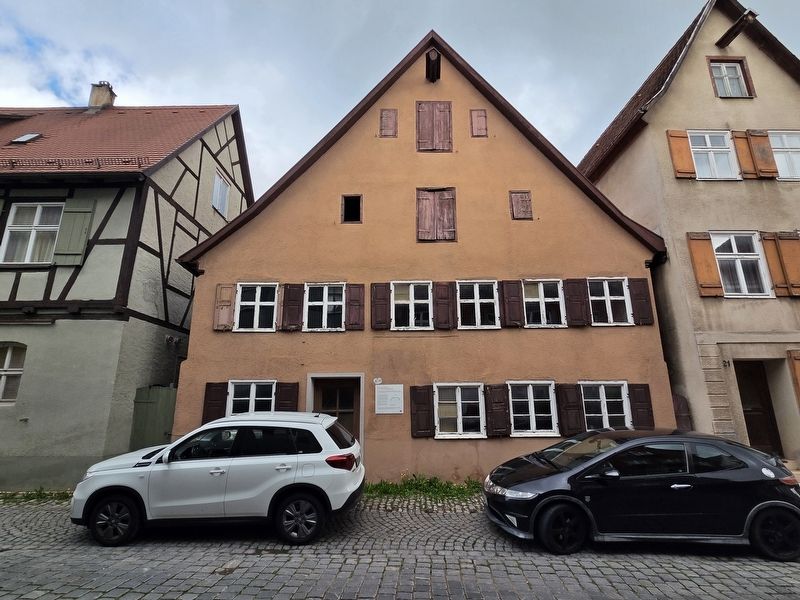
This building is one of the oldest timber-framed houses so far discovered in Bavaria. Architectural research conducted by the State Office for Monument Preservation dated the upper beam structure and parts of the roof framework to 1311–1312 through dendrochronological analysis. The shallow-vaulted cellar probably also dates from this period.
As early as 1340, less than 30 years later, the two-story column framework between the roof and cellar was constructed. This presents a puzzle. The most plausible explanation is that an additional
Photographed by James Hulse, September 14, 2026
2. Lange Gasse 19 Marker
Early illustrations, including examples from the Nuremberg region, show this type of building. Its presence in Dinkelsbühl has long been assumed, but until now there had been no structural evidence.
Another special feature is the plank-and-beam ceiling rediscovered beneath later coverings. It was installed above the ground floor in 1440.
It is expected that the forthcoming careful restoration work will reveal additional interesting evidence. This could include the medieval painted decorations already visible through the few investigative openings. Archaeological examinations are also planned.
Reconstruction of the original 1311–1312 building: single-story structure with a thatched half-hipped roof.
Reconstruction proposal: Manfred Sandmeir.
(d) = Dating of the timber through dendrochronology.
Erected by Pro Altstadt Dinkelsbühl e.V.
Topics. This historical marker is listed in this topic list: Architecture. A significant historical year for this entry is 1340.
Location. 49° 4.074′ N, 10° 19.148′ E. Marker is in Dinkelsbühl, Bayern (Bavaria), in Ansbach. It is in Altstadt. It is on Lange Gasse just east of Turmgasse, on the right when traveling west. Touch for map. Marker is at or near this postal address: Lange G 19, Dinkelsbühl BY 91550, Germany. Touch for directions.

Regionally, this marker is in German Franconia and on the Romantic Road. Globally, it is in Europe, the European Union, Atlantic Europe, Central Europe, the Schengen Area, Western Europe, and the Western World. Historically, it finds itself in what was once the Holy Roman Empire and also the former West Germany.
Other nearby markers. At least 8 other markers are within walking distance of this marker: Louise Hamburger (a few steps from this marker); Klara Gutmann (within shouting distance of this marker); Moritz Hamburger (within shouting distance of this marker); Kläre Hamburger (within shouting distance of this marker); Adolf Hamburger (within shouting distance of this marker); Martha Hamburger (within shouting distance of this marker); Deutschordensschloß/ Teutonic Order Castle (within shouting distance of this marker); Sarah Levite (about 90 meters away, measured in a direct line). Touch for a list and map of all markers in Dinkelsbühl.
Credits. This page was last revised on October 9, 2026. It was originally submitted on October 9, 2026, by James Hulse of Medina, Texas. This page has been viewed 6 times since then. Photos: 1, 2. submitted on October 9, 2026, by James Hulse of Medina, Texas.
