Lansingburgh in Troy in Rensselaer County, New York — The American Northeast (Mid-Atlantic)
Lion Factory
Photographed by Trudi Jacobson, October 10, 2026
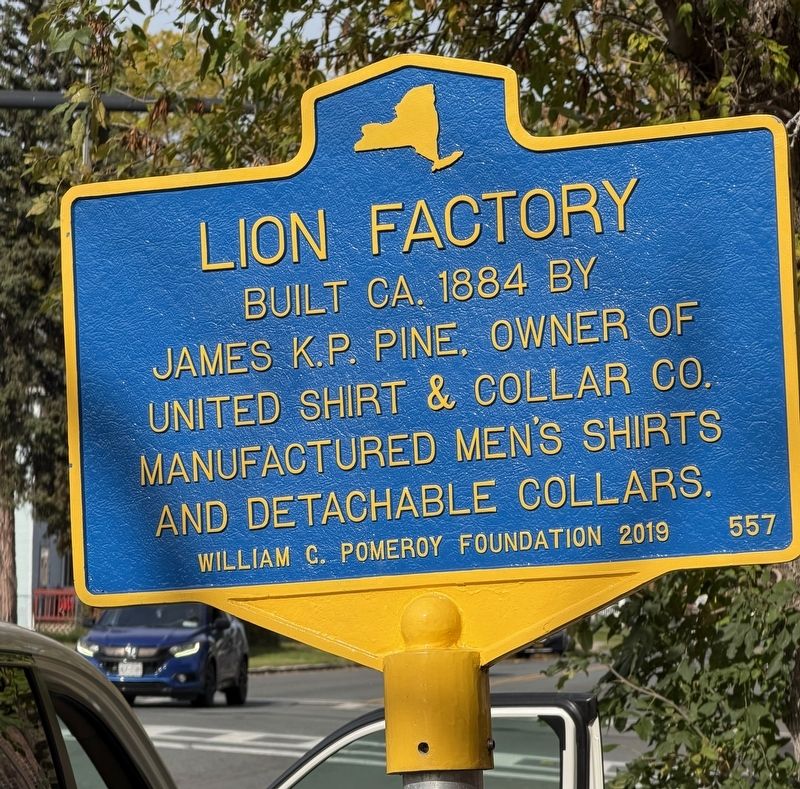
1. Lion Factory Marker
Built ca. 1884 by James K.P. Pine, owner of United Shirt & Collar Co. Manufactured men's shirts and detachable collars.
Erected 2019 by William C Pomeroy Foundation. (Marker Number 557.)
Topics and series. This historical marker is listed in this topic list: Industry & Commerce. In addition, it is included in the William G. Pomeroy Foundation series list. A significant historical year for this entry is 1884.
Location. 42° 46.884′ N, 73° 40.439′ W. Marker is in Troy, New York, in Rensselaer County. It is in Lansingburgh. It is on 2nd Avenue (U.S. 4) 0.2 miles south of 121st Street, on the left when traveling north. Touch for map. Marker is at or near this postal address: 750 2nd Ave, Troy NY 12182, United States of America. Touch for directions.

Regionally, this marker is in Upstate New York, in the Capital District, and in the Albany Metropolitan Area. It is also in the American Northeast and in the Mid-Atlantic. Globally, it is in North America, the Western Hemisphere, the Western World, and the Anglosphere. Historically, it finds itself in what was once New Netherland and also one of the original
this page online
Other nearby markers. At least 8 other markers are within walking distance of this marker: In All Seasons / Ebbs and Flows For Shipyard Workers (approx. 0.3 miles away); View of Van Schaick Island (approx. 0.4 miles away); Water Ford (approx. 0.4 miles away); Breastworks (approx. 0.4 miles away); The Matton Shipyard (approx. 0.4 miles away); Cluett, Peabody & Company (approx. 0.4 miles away); An Urban Refuge (approx. 0.4 miles away); Native American & 17th-century History of Peebles Island (approx. 0.4 miles away).
Regarding Lion Factory. The Lion Factory was begun in 1884 for collar manufacturer James K. P. Pine. Contemporary newspaper accounts described a four-story brick factory approximately 53 by 250 feet, designed by architect M. F. Cummings to house shirt, collar and cuff manufacturing, a laundry, and initially part of the Troy Carriage Works. The new enterprise was expected to employ about 300 workers.
Pine had been active in Troy’s collar industry since the 1860s. In 1890 he helped consolidate five firms into the United Shirt and Collar Company, whose nationally marketed Lion brand was manufactured
Photographed by Trudi Jacobson, October 10, 2026
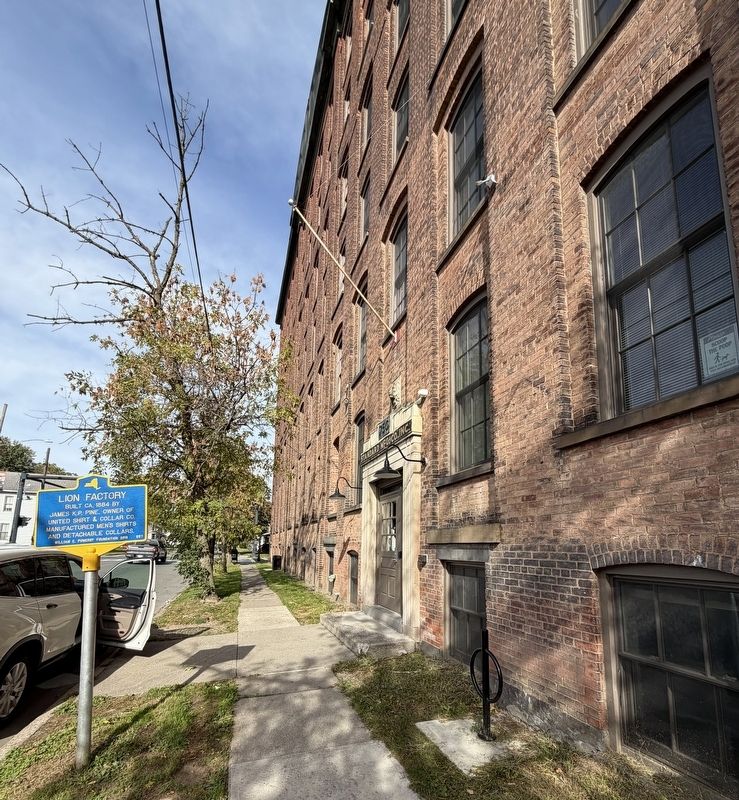
2. Lion Factory Marker and View of Part of the Building
Standard Manufacturing Company acquired the property in 1970 and continued textile manufacturing in the building. The Lion Factory was listed on the National Register of Historic Places in 2022 as an important surviving example of the industry that gave Troy its nickname, the “Collar City.”
Sources:
Hudson Mohawk Gateway. “The Lion Factory and the Pine Automobiles.” Gateway News, Spring 2023. — Useful for the factory’s later history and the experimental automobiles associated with James K. P. Pine and his family.
Lansingburgh Historical Society. “Lion Factory.” — Excellent local history compilation drawing on contemporary newspaper accounts; especially useful for the 1884 construction, architect M. F. Cummings, dimensions of the factory, anticipated employment, later additions, and technological improvements.
New York State Office of Parks, Recreation and Historic Preservation. State Review Board Meeting Minutes, March 10, 2022.
Photographed by Trudi Jacobson, October 10, 2026
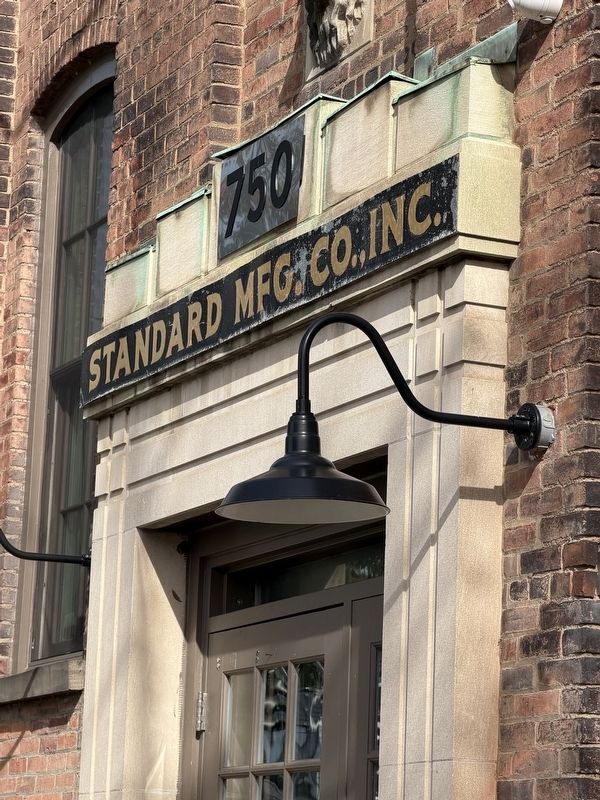
3. Lion Factory Marker
Current Signage Over the Building Entrance
Regan Development Corporation. “Lion Factory Building: Historic Restoration for Quality Housing and Commercial Revitalization.” — Useful for the building’s recent adaptive-reuse history and current restoration.
United States Department of the Interior, National Park Service. National Register of Historic Places, Weekly List, 2022. — Documents the Lion Factory’s listing on the National Register of Historic Places.
Credits. This page was last revised on October 11, 2026. It was originally submitted on October 11, 2026, by Trudi Jacobson of Slingerlands, New York. This page has been viewed 8 times since then. Photos: 1, 2, 3. submitted on October 11, 2026, by Trudi Jacobson of Slingerlands, New York. • Andrew Ruppenstein was the editor who published this page.
