Cavern Quarter in Liverpool in Merseyside, England, United Kingdom — Northwestern Europe (the British Isles)
Sir George Martin
Record Producer of the Beatles
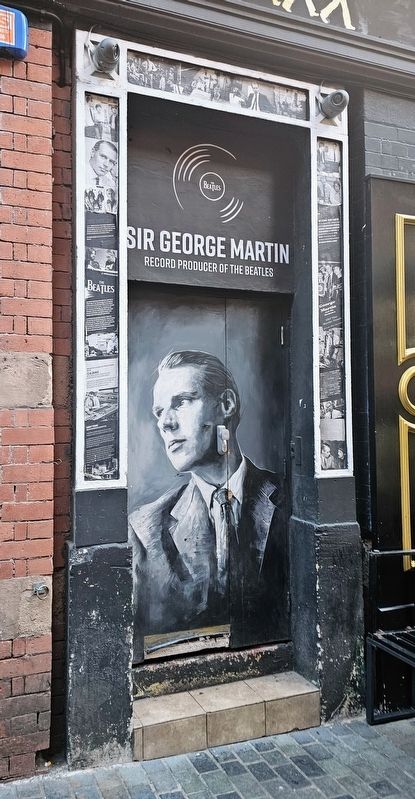
Photographed by Ian Lefkowitz, September 13, 2026
1. Sir George Martin Marker
CBE (3 January 1926 – 8 March 2016) was an English record producer, arranger, composer, conductor, audio engineer, and musician. He was referred to as the “Fifth Beatle” in reference to his extensive involvement in each of the Beatles’ original albums.
Early Years
Martin was born on 3 January 1926 in Highbury, London. When he was six, his family acquired a piano that sparked his interest in music.
At eight years of age, he persuaded his parents, Henry and Betha Beatrice (née Simpson) Martin,[4] that he should take piano lessons, but those ended after only eight lessons because of a disagreement between his mother and the teacher.
As a child, he attended several schools, including a “convent school in Holloway”, St Joseph’s School (Highgate), and at St Ignatius’ College (Stamford Hill), where he had won a scholarship. When WWII broke out St. Ignatius College students were evacuated to Welwyn Garden City. George’s family left London, with him being enrolled at Bromley Grammar School.
Martin was contacted by Sid Coleman of Ardmore & Beechwood, who told him about Brian Epstein, the manager of a band whom he had met. He thought Martin might be interested in the group, even though they had been turned down by Decca Records. Until that time, although there had been considerable success with comedy records, and a number 1 hit with the Temperance Seven, Martin had only minor success with pop music, such as “Who Could Be Bluer” by Jerry Lordan, and singles with Shane Fenton and Matt Monro. After the telephone call by Coleman, Martin arranged a meeting on 13 February 1962 with Brian Epstein. [27] Martin listened to a tape recorded at Decca, and thought that Epstein’s group was “rather unpromising”, but liked the sound of Lennon’s and McCartney’s vocals.
The Beatles
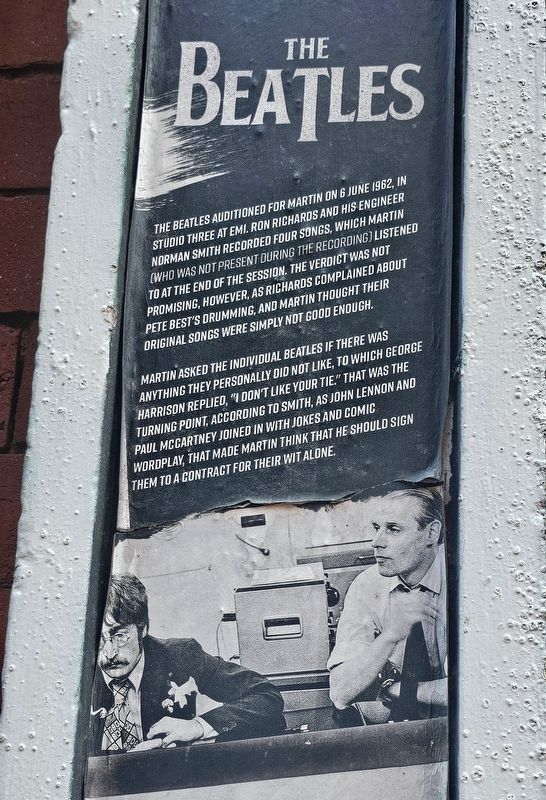
The Beatles auditioned for Martin
this page online
Martin asked the individual Beatles if there was anything they personally did not like, to which George Harrison replied, “I don’t like your tie.” That was the turning point, according to Smith, as John Lennon and Paul McCartney joined in with jokes and comic wordplay, that made Martin think that he should sign them to a contract for their wit alone.
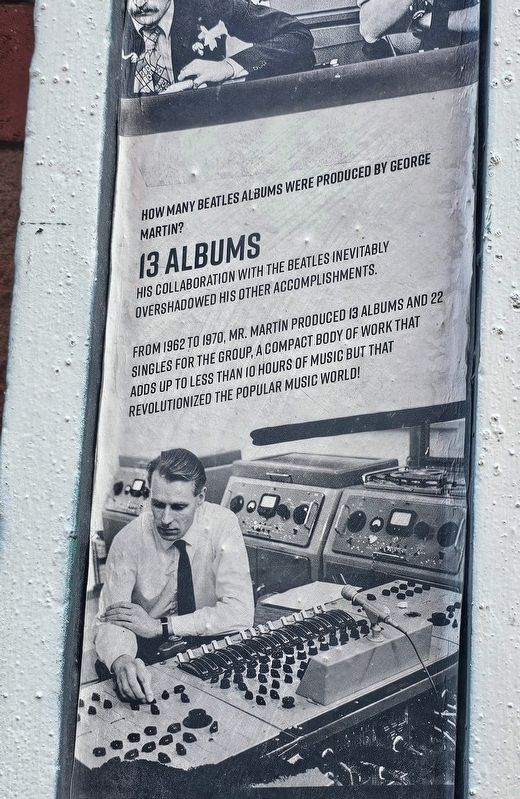
How many Beatles albums were produced by George Martin?
13 Albums
His collaboration with the Beatles inevitably overshadowed his other accomplishments.
From 1962 to 1970, Mr. Martin produced 13 albums and 22 singles for the group, a compact body of work that adds up to less than 10 hours of music but that revolutionized the popular music world!
25th April 2011
Quote: “When I first met them I wasn’t convinced that they were able to write
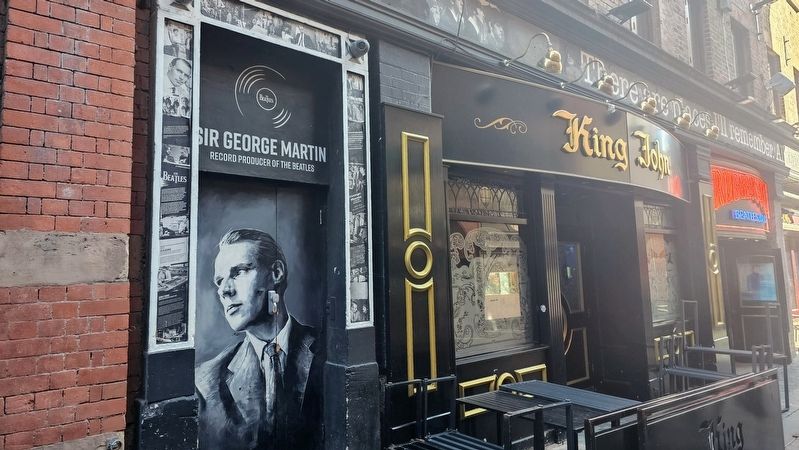
Photographed by Ian Lefkowitz, September 13, 2026
2. Sir George Martin Marker
The marker is located on a door frame outside a Mathew Street Bar.
Sir George Martin had his doubts about signing the Beatles.
Topics and series. This historical marker is listed in these topic lists: Arts, Letters, Music • Entertainment. In addition, it is included in the The Beatles series list. A significant historical date for this entry is June 6, 1962.
Location. 53° 24.383′ N, 2° 59.254′ W. Marker is in Liverpool, England, in Merseyside. It is in the Cavern Quarter. It is on Mathew Street east of North John Street, on the left when traveling east. Touch for map. Marker is at or near this postal address: 9 Mathew St, Liverpool, England L2 6RE, United Kingdom. Touch for directions.

Regionally, this marker is in North West England. Globally, it is on the Atlantic Ocean, in the North Atlantic Region, in Europe, in Atlantic Europe, on one of the British Isles, in the Western World, and in the Anglosphere. Historically, it finds itself in what was once the Roman Empire.
Other nearby markers. At least 8 other markers
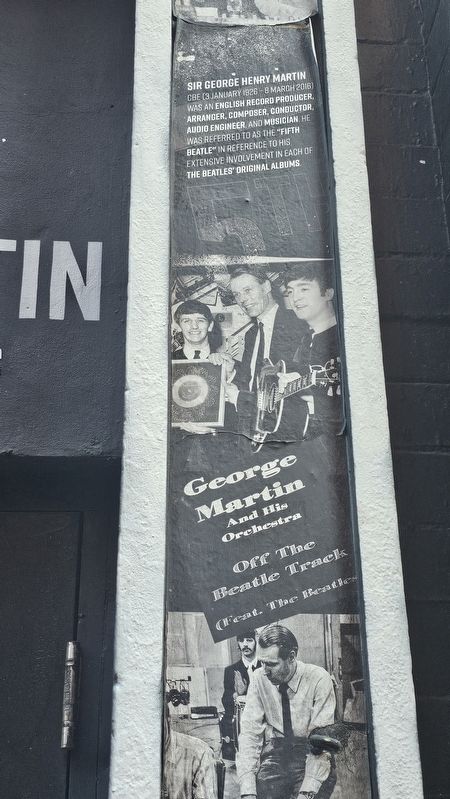
Photographed by Ian Lefkowitz, September 13, 2026
3. Sir George Martin Marker
A close-up of one of the panels of the marker.
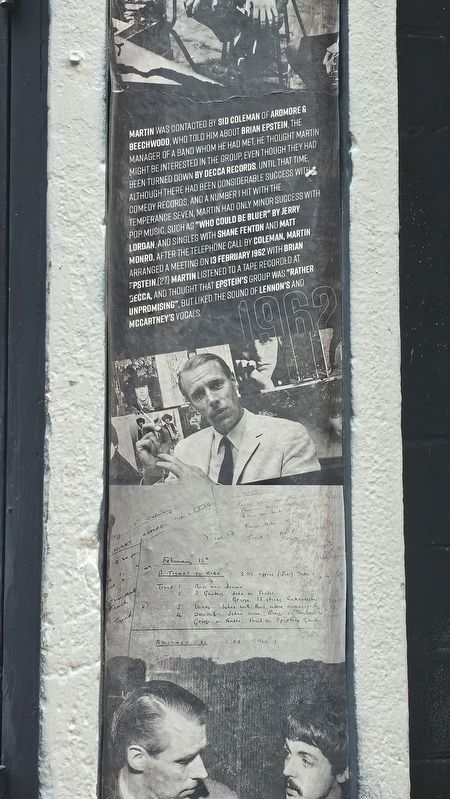
Photographed by Ian Lefkowitz, September 13, 2026
4. Sir George Martin Marker
A closeup of one of the panels of the marker.
Photographed by Ian Lefkowitz, September 13, 2026
5. Sir George Martin Marker
A closeup of one of the panels of the marker.
Photographed by Ian Lefkowitz, September 13, 2026
6. Sir George Martin Marker
A closeup of one of the panels of the marker.
Credits. This page was last revised on October 13, 2026. It was originally submitted on October 11, 2026, by Ian Lefkowitz of New York, New York. This page has been viewed 11 times since then. Photos: 1, 2, 3, 4, 5, 6. submitted on October 11, 2026, by Ian Lefkowitz of New York, New York. • Andrew Ruppenstein was the editor who published this page.
