Golden in Columbia-Shuswap, British Columbia — Canada’s West Coast (North America)
Dig For Victory
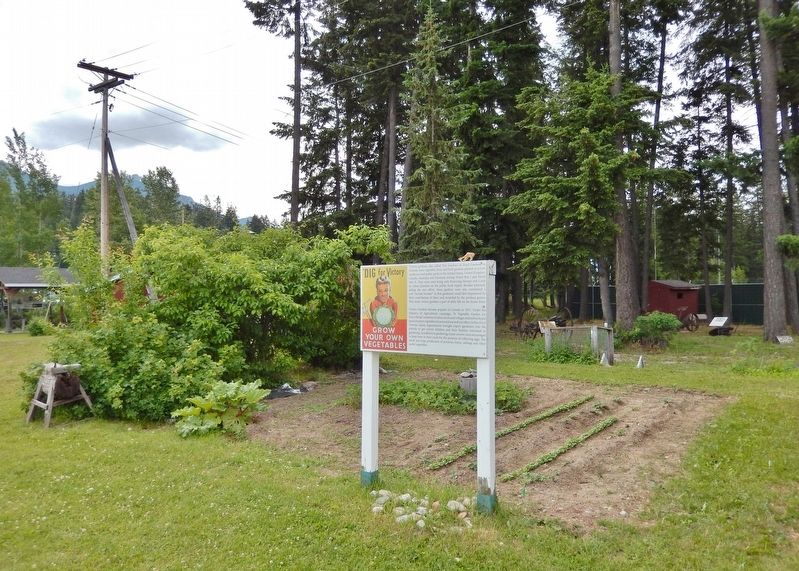
Grow Your Own Vegetables

Photographed by Cosmos Mariner, July 3, 2022
1. Dig For Victory Marker
Victory gardens, also called War Gardens or Food Gardens for Defense, were vegetable, fruit, and herb gardens planted at private residences and public parks in the United States, United Kingdom, Canada, Australia and Germany during World War I and World War II. They were used along with Rationing Stamps and Cards to reduce pressure on the public food supply. Besides indirectly aiding the war effort, these gardens were also considered a civil “morale booster” in that gardeners could feel empowered by their contribution of labor and rewarded by the produce grown. This made victory gardens a part of daily life on the home front.
Victory Gardens became popular in Canada in 1917. Under the Ministry of Agriculture's campaign, “A Vegetable Garden for Every Home”, residents of cities, towns and villages utilized backyard spaces to plant vegetables for personal use and war effort. In the city of Toronto, ladies organizations brought expert gardeners into the schools to get school children and their families interested in gardening. In addition to gardening, home owners were encouraged to keep hens in their yards for the purpose
this page online
Topics. This historical marker is listed in these topic lists: Patriots & Patriotism • War, World I • War, World II.
Location. 51° 17.52′ N, 116° 57.659′ W. Marker is in Golden, British Columbia, in Columbia-Shuswap. It can be reached from the intersection of 11 Avenue South and 14 Street South, on the right when traveling north. The marker and garden exhibit are on the Golden & District Museum grounds. Touch for map. Marker is at or near this postal address: 1302 11 Avenue South, Golden BC V0A 1H0, Canada. Touch for directions.

Regionally, this marker is in the BC Interior and in Thompson-Okanagan. Globally, it is in North America, in the Rocky Mountains, on the Ring of Fire, on the Pacific Rim, in the Western Hemisphere, in the Western World, and in the Anglosphere. Historically, it finds itself in what was once a British colony.
Other nearby markers. At least 8 other markers are within walking distance of this marker: Horse Drawn Hay Mower (within
Photographed by Cosmos Mariner, July 3, 2022
2. Dig For Victory Marker & Garden
Also see . . . What Were Victory Gardens and Why Did They Matter? (ScienceInsights.org).
Excerpt: Victory gardens were home and community vegetable gardens planted by millions of civilians during World War I and World War II to boost the domestic food supply while military operations strained agricultural resources. At their peak in 1944, an estimated 18 to 20 million victory gardens provided roughly 40 percent of all vegetables consumed in the United States. The concept was simple: if ordinary families grew their own produce, more commercially farmed food could be shipped to soldiers, allies, and industrial workers fueling the war effort.(Submitted on October 11, 2026, by Cosmos Mariner of Cape Canaveral, Florida.)
War created a food crisis on multiple fronts. Millions of young men who had worked on farms were now in uniform. Commercial food needed to be canned, packaged, and shipped overseas in enormous quantities. Transportation networks were stretched thin. Rationing limited what civilians could buy at the store, and many staple foods, including meat, fats, and canned goods, were in short supply.
Government guides recommended crops that produced a lot of food in a small space or matured quickly enough to allow a second planting later in the season. On a modest plot of about 20 by 40 feet, gardeners were advised to focus on spinach, leaf lettuce, Swiss chard, snap beans, tomatoes, summer squash, onions, radishes, early beets, early carrots, early cabbage, broccoli, kale, kohlrabi, and Chinese cabbage.
Credits. This page was last revised on October 11, 2026. It was originally submitted on October 11, 2026, by Cosmos Mariner of Cape Canaveral, Florida. This page has been viewed 3 times since then. Photos: 1, 2. submitted on October 11, 2026, by Cosmos Mariner of Cape Canaveral, Florida.
