Liverpool in Merseyside, England, United Kingdom — Northwestern Europe (the British Isles)
Corn Exchange
Photographed by Ian Lefkowitz, September 13, 2026
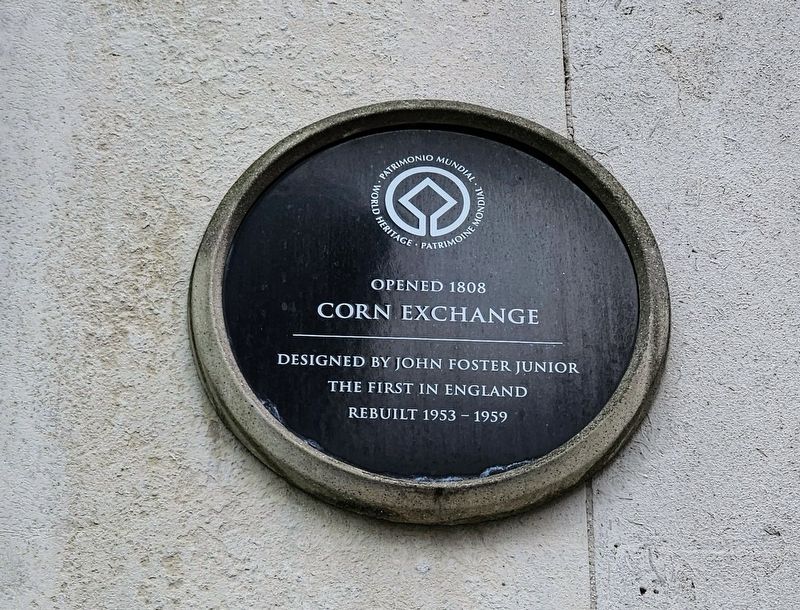
1. Corn Exchange Marker
Opened 1808
Corn Exchange
Designed by John Foster Junior
The first in England
Rebuilt 1953 – 1959
Erected by UNESCO World Heritage Site.
Topics and series. This historical marker is listed in this topic list: Industry & Commerce. In addition, it is included in the UNESCO World Heritage Sites series list. A significant historical year for this entry is 1808.
Location. 53° 24.348′ N, 2° 59.502′ W. Marker is in Liverpool, England, in Merseyside. It is at the intersection of Brunswick Street and Fenwick Street, on the left when traveling west on Brunswick Street. Touch for map. Marker is at or near this postal address: 21 Brunswick Street, Liverpool, England L2 7LS, United Kingdom. Touch for directions.

Regionally, this marker is in North West England. Globally, it is on the Atlantic Ocean, in the North Atlantic Region, in Europe, in Atlantic Europe, on one of the British Isles, in the Western World, and in the Anglosphere. Historically, it finds itself in what was once the Roman Empire.
Other nearby markers. At least 8 other markers are within walking distance of this marker: Remember the Great Famine / Coinnigh Cuimhne ar an Gorta Mór
this page online
Also see . . . Corn Exchange, Liverpool (Wikipedia).
The new building was designed by John Foster Sr in the neoclassical style, built in white stone from Runcorn at a cost of £10,000 and was officially opened in August 1808...The corn exchange was completely destroyed by German bombing in the Liverpool Blitz in May 1941 during the Second World War.(Submitted on October 12, 2026, by Ian Lefkowitz of New York, New York.)
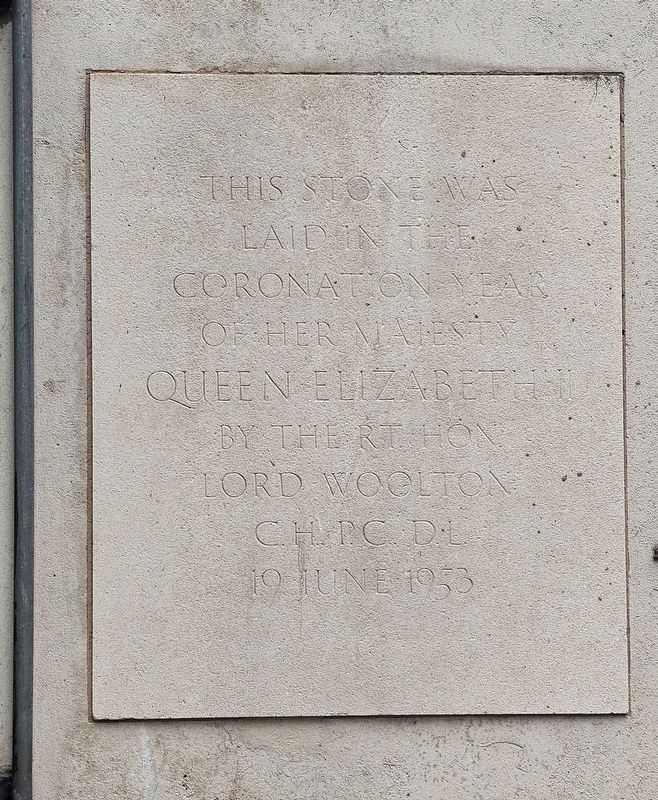
After the war, civic leaders decided to rebuild the structure again. The foundation stone for the new building was laid by the Chancellor of the Duchy of Lancaster, Frederick Marquis, 1st Earl of Woolton, on 19 June 1953. In his speech, Woolton observed that "The history of the Liverpool Corn Exchange is the history of the corn trade of the UnitedKingdom. It is the history of adventure and enterprise that made Liverpool the largest market for foreign wheat in the World."Photographed by Ian Lefkowitz, September 13, 20262. Coronation Year StoneA tablet below the plaque reads:
This stone was
laid in the
coronation year
of Her Majesty
Queen Elizabeth II
by the Rt. Hon.
Lord Woolton
C.H. P.C. D.L.
19 June 1953
Additional keywords. black plaque
Photographed by Ian Lefkowitz, September 13, 2026
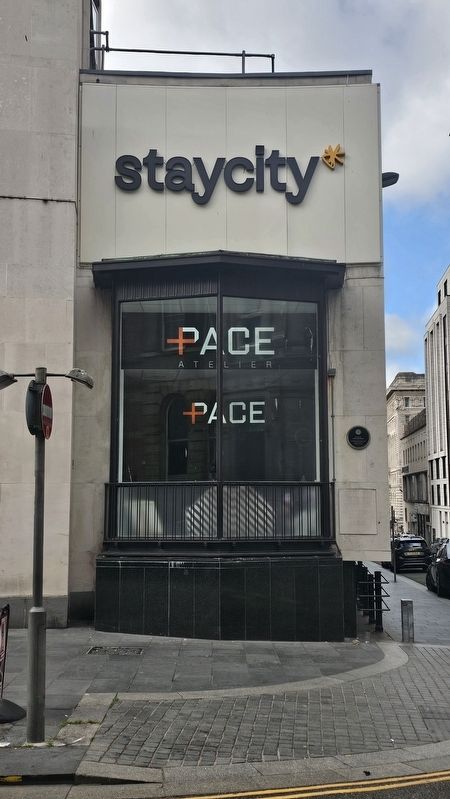
3. Corn Exchange Marker
The marker is at the corner of Fenwick St and Brunswick St.
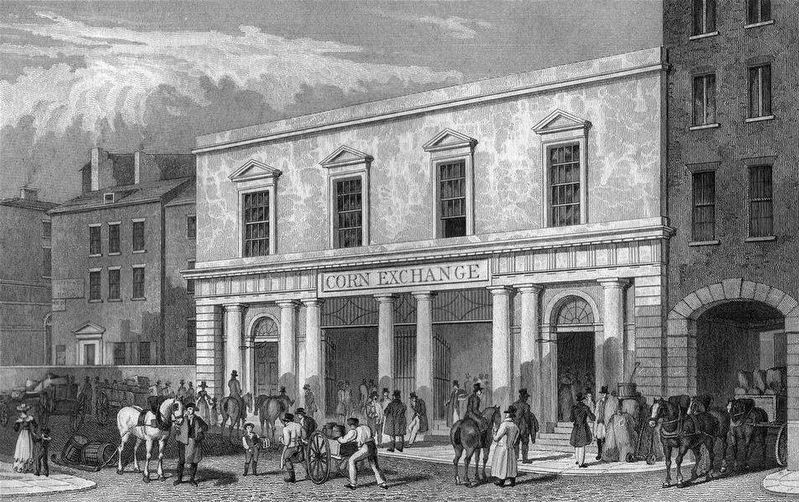
Drawn by G.& C. Pyne, engraved by Thomas. Dixon
4. 1827 engraving of the Liverpool Corn Exchange
Credits. This page was last revised on October 12, 2026. It was originally submitted on October 12, 2026, by Ian Lefkowitz of New York, New York. This page has been viewed 8 times since then. Photos: 1, 2, 3, 4. submitted on October 12, 2026, by Ian Lefkowitz of New York, New York. • Andrew Ruppenstein was the editor who published this page.
