
Warwick in Warwickshire, England, United Kingdom — Northwestern Europe (the British Isles)
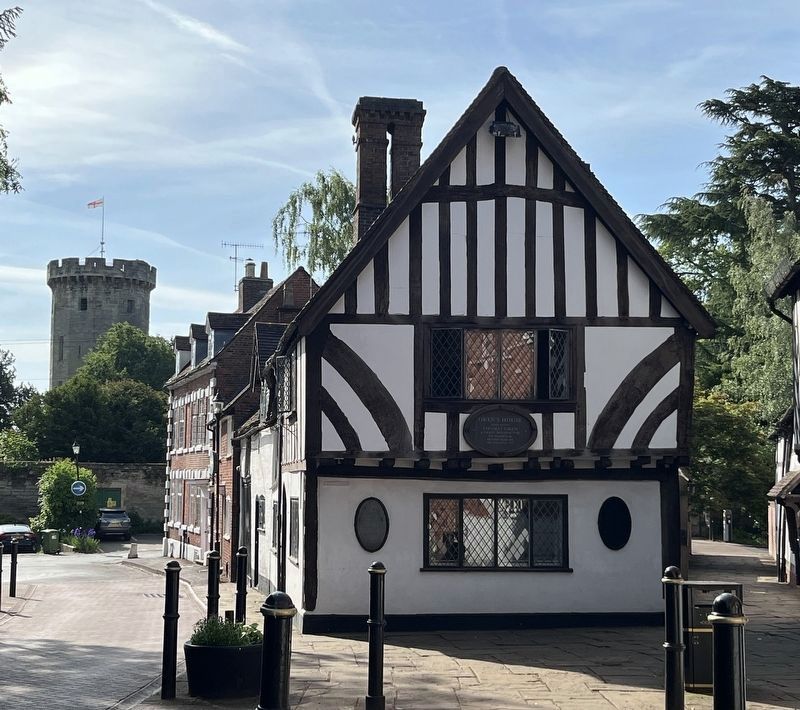
Oken's House
Photographed by Ray Gurganus, May 22, 2026
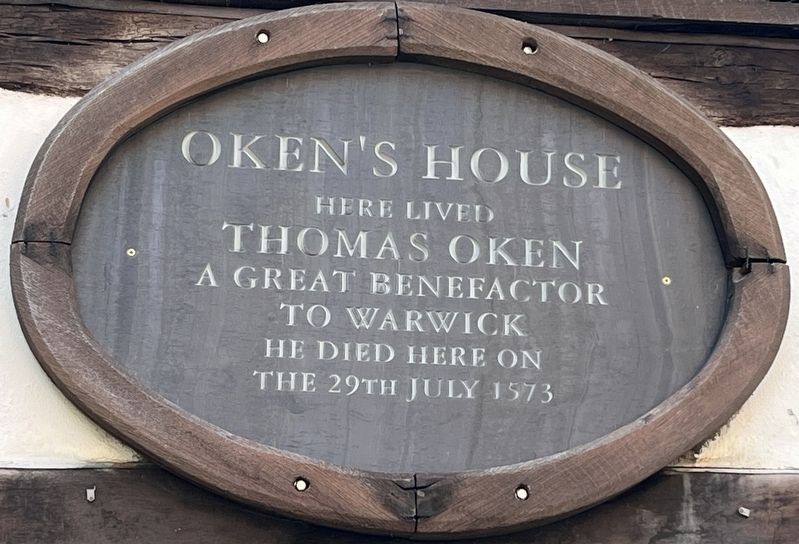
1. Oken's House Marker
Here lived Thomas Oken
A great benefactor
to Warwick
He died here on
the 29th July 1573
Topics. This historical marker is listed in this topic list: Charity & Public Work. A significant historical year for this entry is 1573.
Location. 52° 16.843′ N, 1° 35.218′ W. Marker is in Warwick, England, in Warwickshire. It is on Castle Street, on the left when traveling south. Touch for map. Marker is at or near this postal address: 10 Castle Street, Warwick, England CV34 4ST, United Kingdom. Touch for directions.

Regionally, this marker is in the Midlands. Globally, it is on the Atlantic Ocean, in the North Atlantic Region, in Europe, in Atlantic Europe, on one of the British Isles, in the Western World, and in the Anglosphere. Historically, it finds itself in what was once the Roman Empire.
Other nearby markers. At least 8 other markers are within 5 kilometers of this marker, measured as the crow flies: Warwick 1100 Years (within shouting distance of this marker); The Court House (within shouting distance of this marker); Eastgate (about 210 meters away, measured in a direct line); The Market Hall (approx. 0.2
this page online
Also see . . . History (The Charity of Thomas Oken and Nicholas Eyffler). Excerpt:
Thomas Oken lived in Warwick during the reigns of Henry VII, Henry VIII, Edward VI, Mary I and Elizabeth I, a period of great religious change with all the social upheaval that this brought in its wake.(Submitted on October 12, 2026.)
A mercer, who made a comfortable fortune, he devoted his talents to the service of his town and his fellow citizens. He was a public-spirited man, heavily involved in local government and of deep religious conviction. He was the last Master of the Guild of Holy Trinity and St George, which was dissolved in 1546.
Between Michaelmas 1544 and May 15th 1545, the date of the grant of the municipal charter to Warwick, he conducted the difficult negotiations with Henry VIII’s Commissioners which secured for the people of Warwick a substantial partof the Church and Guild endowments, thereby preventing the worst effects of subsequent legislation by the Crown.Photographed by Ray Gurganus, May 22, 20262. Thomas Oken's House
He was one of the principal Burgesses named in the Charter and was Bailiff from 1557 – 1558 remaining a member of the Corporation until his death on July 29th 1573.
In his will, from his personal fortune, he arranged amongst other things, for the payment of the salary of the schoolmaster, annual payments to “the poor”, the paving of certain streets, the repairing of the bridge, the wages of the herdsmen and the beadle, the repairing of the wells, and the provision of the almshouses for six people. Such provisions as are applicable today are carried out by Oken’s Charity including the building and maintenance of the almshouses.
Credits. This page was last revised on October 12, 2026. It was originally submitted on October 12, 2026, by Ray Gurganus of Washington, District of Columbia. This page has been viewed 6 times since then. Photos: 1, 2. submitted on October 12, 2026, by Ray Gurganus of Washington, District of Columbia. • Andrew Ruppenstein was the editor who published this page.
