Tifton in Tift County, Georgia — The American South (South Atlantic)
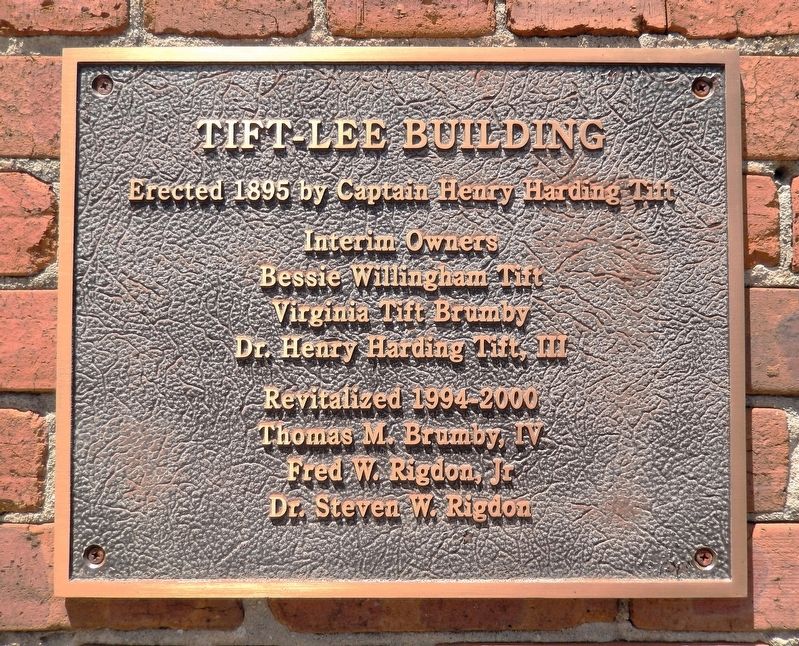
Tift-Lee Building
Erected 1895 by Captain Henry Harding Tift
Photographed by Cosmos Mariner, April 19, 2022
1. Tift-Lee Building Marker
Bessie Willingham Tift
Virginia Tift Brumby
Dr. Henry Harding Tift, III
Revitalized 1994-2000
Thomas M. Brumby, IV
Fred W. Rigdon, Jr
Dr. Steven W. Rigdon
Topics and series. This historical marker is listed in these topic lists: Architecture • Industry & Commerce. In addition, it is included in the National Register of Historic Places (NRHP) series list. A significant historical year for this entry is 1895.
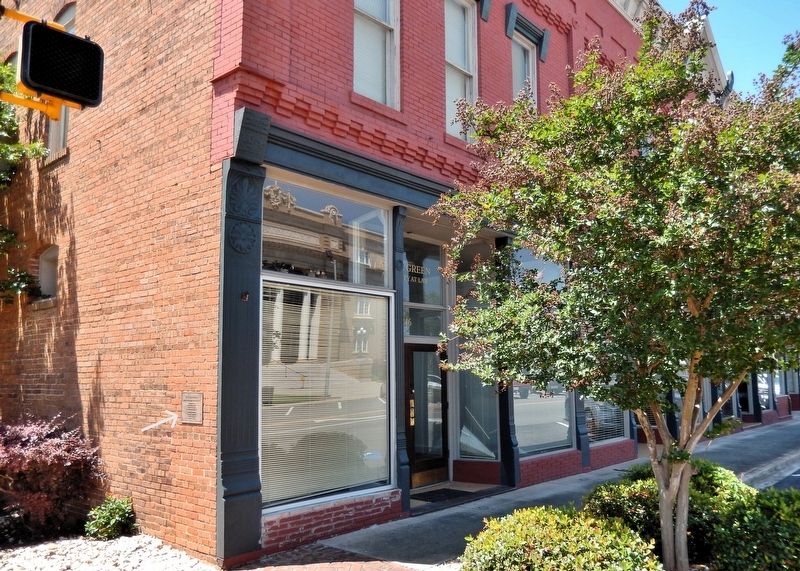
Location. 31° 27.231′ N, 83° 30.474′ W. Marker is in Tifton, Georgia, in Tift County. It is at the intersection of Tift Avenue South and 2nd Street East, on the left when traveling north on Tift Avenue South. The marker is on the northeast corner of the Tift-Lee Building, facing Tift Avenue South. Touch for map. Marker is at or near this postal address: 246 2nd Street East, Tifton GA 31794, United States of America. Touch for directions.

Regionally, this marker is on the Coastal Plain. It is also in the American South, specifically in the Deep South, and in the Wiregrass. Globally, it is in North America, the Western Hemisphere, the Western World, and the Anglosphere. Historically, it finds itself
this page online
Other nearby markers. At least 8 other markers are within walking distance of this marker: Tift County (within shouting distance of this marker); Who Are We and Where Did We Come From? (within shouting distance of this marker); Tifton: A Railroad Town (about 500 feet away, measured in a direct line); Guns, Churches and a Museum (about 500 feet away); The Olympic Torch Paused at this Site (about 600 feet away); From Mystic to Wiregrass (about 600 feet away); Purple Heart Memorial (approx. 0.2 miles away); "Major" Jack L. Woolard (approx. 0.2 miles away). Touch for a list and map of all markers in Tifton.
Regarding Tift-Lee Building. Contributing property, Tifton Commercial Historic District, National Register of Historic Places № 86000382.
From the National Register Nomination prepared by Carolyn Brooks, November 26, 1985:
The Tifton Commercial Historic District consists of portions of ten blocks of primarily commercial buildings in Tifton’s historic downtown.Buildings date from the 1890s to the late 1930s. The primary building material in the district is brick, used structurally, as a veneer, and decoratively. Victorian Eclectic and Early 20th Century Commercial style structures predominate. Typical features associated with the Victorian Eclectic buildings include segmentally arched and bay windows, trabeated windows with lintel cornices, pressed metal and corbeled brick roofline cornices, corbeled string courses, and storefronts with cast-iron columns.Photographed by Cosmos Mariner, April 19, 20222. Tift-Lee Building MarkerThe marker is on the northeast corner of the Tift-Lee Building, facing Tift Avenue South.
The Tifton Commercial Historic District is historically significant in terms of community planning and development and transportation, architecture, commerce, politics and government. In terms of community planning and development and transportation, the district is significant as the center of a railroad town that developed first around the sawmill and from the extensive land holdings of one man, and later as a county seat. Architecturally, the district is significant for its representative collection of late 19th- and early 20th-century commercial, institutional, and transportation-related architecture. Included in the district are manyVictorian Eclectic and Early 20th Century Commercial style buildings.Photographed by Cosmos Mariner, April 19, 20223. Tift-Lee Building
In 1872 Henry Harding Tift purchased 4,900 acres of undeveloped timberland along the tracks of the Brunswick and Albany Railroad (later the Atlantic Coast Line) in Berrien County and established a sawmill. A settlement rapidly grew up around the mill, triggered in 1888 by the arrival of a second railroad, the Georgia Southern and Florida (later the Southern). In 1890 the settlement was incorporated as Tifton, and all Henry Tift's property lying within the incorporated limits was laid off in blocks and put up for sale. By 1892 Tifton already had 1,200 residents, 11 business houses, 2 restaurants, a hotel, and an academy. Guided by Tift's strong leadership and located at the intersection of two important rail systems, the town grew into an important regional timber and, later, agricultural center. In the 1890s Tift financed two more railroads that terminated in town; in 1896 he established the Bank of Tifton. In 1905 Tifton became the county seat of newly created Tift County, and by 1906 the population had jumped to 2,394.

Also see . . . Henry Tift (1841-1922) (New Georgia Encyclopedia).
(by John Fair, updated Dec 13, 2019.) Excerpt: Henry Tift was a businessman and developer who founded the city of Tifton. As civic leader and benefactor, he contributed for half a century to the industrial, agricultural, financial, religious, and educational growth of his city and to the well-being of its citizens. Often called “the Captain” from his early seafaring days, Henry Harding Tift was born in Mystic, Connecticut, on March 16, 1841. His father was a businessman in Mystic and in Key West, Florida. After graduating from Connecticut’s Greenwich Academy in 1859, Tift apprenticed as a machinist and worked as a steamship engineer on a shipping line between New York and the Gulf Coast.(Submitted on October 14, 2026, by Cosmos Mariner of Cape Canaveral, Florida.)
In 1870 Tift became general manager of a manufacturing firm owned by his uncles, Nelson Tift and Asa Tift, in Albany, Georgia, and in 1872 he purchased a large tract of pine forest in nearby Berrien County, along the newly completed Brunswick and Western Railway. There, on the highest ground south of the fall line at Macon, Tift established a sawmill and a village for his workers. Eventually he expanded into turpentine and barrel-making operations and turned his barren timberlands into farms for cotton, corn, livestock, fruit, tobacco, pecans, and sweet potatoes. When the Georgia Southern and Florida Railway intersected the Brunswick and Western at Tift’s mill in 1888, the settlement was connected to Atlanta and became a boom town. It was incorporated as Tifton by an 1890 legislative act. It became the county seat of Tift County, which was carved out of Berrien, Irwin, and Worth counties in 1905.
Credits. This page was last revised on October 14, 2026. It was originally submitted on October 12, 2026, by Cosmos Mariner of Cape Canaveral, Florida. This page has been viewed 9 times since then. Photos: 1, 2, 3. submitted on October 14, 2026, by Cosmos Mariner of Cape Canaveral, Florida.
