Kobern-Gondorf in Mayen-Koblenz, Rhineland-Palatinate, Germany — Central Europe
Gondorf
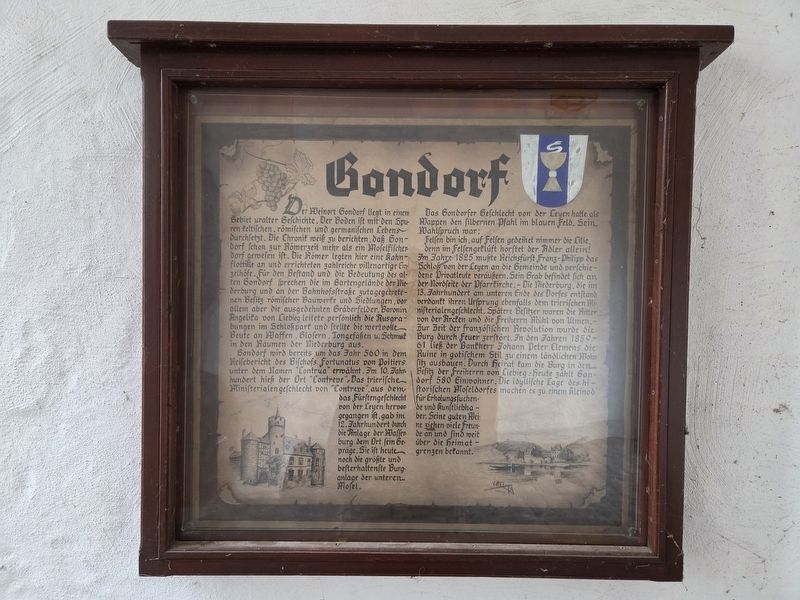
Photographed by James Hulse, October 5, 2026
1. Gondorf Marker

Der Weinort Gondorf liegt in einem Gebiet uralter Geschichte. Der Boden ist mit den Spuren keltischen, römischen und germanischen Lebens durchsetzt. Die Chronik weiß zu berichten, daß Gondorf schon zur Römerzeit mehr als ein Moselfischerdorf gewesen ist. Die Römer legten hier eine Kahmflottille an und errichteten zahlreiche villenartige Einzelhöfe. Für den Bestand und die Bedeutung des alten Gondorf sprechen die im Gartengelände der Niederburg und an der Bahnhofstraße zutagegetretenen Reste römischer Bauwerke und Siedlungen, vor allem aber die ausgedehnten Gräberfelder. Baronin Angelica von Liebieg leitete persönlich die Ausgrabungen im Schloßpark und stellte die wertvolle Beute an Waffen, Gläsern, Tongefäßen u. Schmuck in den Räumen der Niederburg aus.
Gondorf wird bereits um das Jahr 560 in dem Reisebericht des Bischofs Fortunatus von Poitiers unter dem Namen "Contrua" erwähnt. Im 10. Jahrhundert hieß der Ort "Contreve". Das trierische Ministerialengeschlecht von "Contreve", aus dem das Fürstengeschlecht von der Leyen hervorgegangen ist, gab im 12. Jahrhundert durch die Anlage der Wasserburg dem Ort
this page online
Das Gondorfer Geschlecht von der Leyen hatte als Wappen den silbernen Pfahl im blauen Feld. Sein Wahlspruch war:
Felsen bin ich, auf Felsen gedeihet nimmer die Lilie,
denn im Felsengeklüft horstet der Adler allein!
Im Jahre 1825 mußte Reichsfürst Franz-Philipp das Schloß von der Leyen an die Gemeinde und verschiedene Privatleute veräußern. Sein Grab befindet sich an der Nordseite der Pfarrkirche. – Die Niederburg, die im 13. Jahrhundert am unteren Ende des Dorfes entstand, verdankt ihren Ursprung ebenfalls dem trierischen Ministerialengeschlecht. Spätere Besitzer waren die Ritter von der Arcken und die Freiherrn Huhn von Ullmen. – Zur Zeit der französischen Revolution wurde die Burg durch Feuer zerstört. In den Jahren 1859–61 ließ der Bankherr Johann Peter Clemens die Ruine in gotischem Stil zu einem ländlichen Wohnsitz ausbauen. Durch Heirat kam die Burg in den Besitz der Freiherrn von Liebieg. – Heute zählt Gondorf 580 Einwohner. Die idyllische Lage des historischen Moseldorfes machen es zu einem Kleinod für Erholungsuchende und Kunstliebhaber.
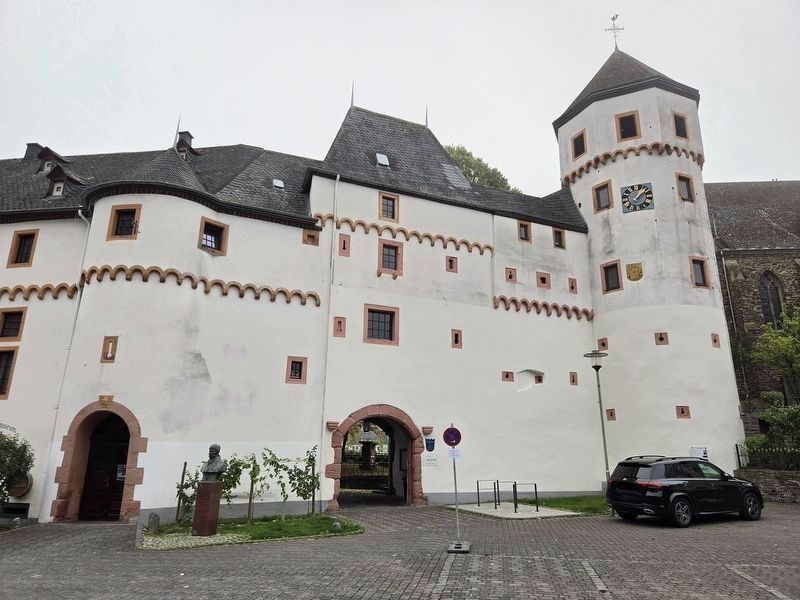
Photographed by James Hulse
2. Gondorf Marker
The marker is visible on the right side of the pathway through the castle grounds.
Gondorf
The wine village of Gondorf lies in an area with an ancient history. Its soil contains traces of Celtic, Roman and Germanic life. Historical accounts indicate that Gondorf was already more than a Moselle fishing village in Roman times. The Romans stationed a flotilla of boats here and built numerous individual villa-like farmsteads. Remains of Roman buildings and settlements discovered in the grounds of the Lower Castle and along Bahnhofstraße, and particularly the extensive burial grounds, testify to ancient Gondorf’s existence and importance. Baroness Angelica von Liebieg personally directed excavations in the castle park and displayed the valuable finds of weapons, glassware, pottery and jewelry in the Lower Castle.
Gondorf was mentioned around 560 in the travel account of Bishop Fortunatus of Poitiers under the name "Contrua." In the tenth century, the village was called "Contreve." The Trier ministerial family of Contreve, from which the princely von der Leyen family descended, shaped the village by constructing a moated castle in the twelfth century. It remains the largest and best-preserved castle complex on the Lower Moselle.
The Gondorf von der Leyen family’s coat of arms featured a silver vertical stripe on a blue field. Its motto was: "Rock am I; upon rock the lily never flourishes, for in the rocky clefts the eagle alone makes its nest!"
In 1825, Imperial Prince Franz-Philipp had to sell von der Leyen Castle to the municipality and several private individuals. His grave is on the north side of the parish church. The Lower Castle, built at the lower end of the village in the thirteenth century, also originated with the Trier ministerial family. Later owners included the knights von der Arcken and the barons Huhn von Ullmen. During the French Revolution, the castle was destroyed by fire. Between 1859 and 1861, banker Johann Peter Clemens had the ruins rebuilt in Gothic style as a country residence. Through marriage, the castle passed to the barons von Liebieg. At the time this text was written, Gondorf had 580 inhabitants. The idyllic setting of this historic Moselle village makes it a gem for those seeking relaxation and for art lovers. Its fine wines attract many admirers and are known far beyond the region.
Topics. This historical marker is listed in this topic list: Settlements & Settlers. A significant historical year for this entry is 1825.
Location. 50° 17.471′ N, 7° 27.508′ E. Marker is in Kobern-Gondorf, Rheinland-Pfalz (Rhineland-Palatinate), in Mayen-Koblenz. It is on Von-der-Leyen-Platz 0.1 kilometers west of Römerstraße, on the left when traveling west. Touch for map. Marker is at or near this postal address: Von-der-Leyen-Platz 5, Kobern-Gondorf RP 56330, Germany. Touch for directions.

Regionally, this marker is in the German Rhineland, in the Eifel, and in the Moselle Valley. Globally, it is in Europe, the European Union, Atlantic Europe, Central Europe, the Schengen Area, Western Europe, and the Western World. Historically, it finds itself in what was once the Roman Empire, the Holy Roman Empire, and the former West Germany.
Other nearby markers. At least 8 other markers are within walking distance of this marker: Die Kirchenglocken von Gondorf / The Church Bells of Gondorf (a few steps from this marker); Oberburg / Upper Castle (a few steps from this marker); Tuffsteinsarg / Tuff Stone Coffin (a few steps from this marker); Die „Gänseliesel“ … / The “Goose Girl” … (within shouting distance of this marker); Grabplatte / Grave Slab (within shouting distance of this marker); Ehemalige Gondorfer zweiklassige Volksschule / Former Gondorf Two-Class Elementary School (within shouting distance of this marker); Ehemaliges Gondorfer Rathaus / Former Gondorf Town Hall (within shouting distance of this marker); Historische Grabkreuze / Historic Grave Crosses (within shouting distance of this marker). Touch for a list and map of all markers in Kobern-Gondorf.
Credits. This page was last revised on October 15, 2026. It was originally submitted on October 14, 2026, by James Hulse of Medina, Texas. This page has been viewed 8 times since then. Photos: 1, 2. submitted on October 15, 2026, by James Hulse of Medina, Texas.
