Cäcilien-Viertel in Köln, North Rhine-Westphalia, Germany — Central Europe
St. Cäcilien
⎯⎯⎯
Museum Schnütgen
Photographed by James Hulse
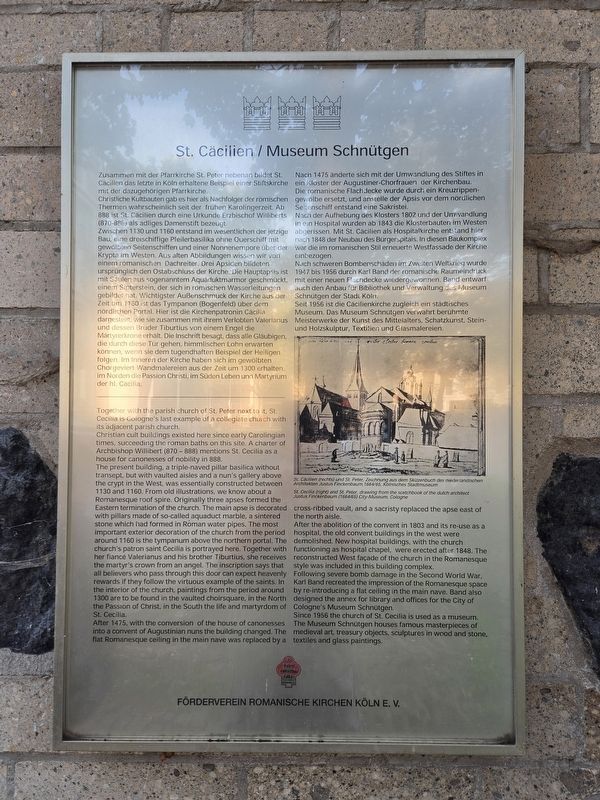
1. St. Cäcilien / Museum Schnütgen Marker

Christliche Kultbauten gab es hier als Nachfolger der römischen Thermen wahrscheinlich seit der frühen Karolingerzeit. Ab 888 ist St. Cäcilien durch eine Urkunde Erzbischof Williberts (870-888) als adliges Damenstift bezeugt.
Zwischen 1130 und 1160 entstand im wesentlichen der jetzige Bau, eine dreischiffige Pfeilerbasilika ohne Querschiff mit gewölbten Seitenschiffen und einer Nonnenempore über der Krypta im Westen. Aus alten Abbildungen wissen wir von einem romanischen Dachreiter. Drei Apsiden bildeten ursprünglich den Ostabschluss der Kirche. Die Hauptapsis ist mit Säulen aus sogenanntem Aquäduktmarmor geschmückt, einem Sinterstein, der sich in römischen Wasserleitungen gebildet hat. Wichtigster Außenschmuck der Kirche aus der Zeit um 1160 ist das Tympanon (Bogenfeld) über dem nördlichen Portal. Hier ist die Kirchenpatronin Cäcilia dargestellt, wie sie zusammen mit ihrem Verlobten Valerianus und dessen Bruder Tiburtius von einem Engel die Märtyrerkrone
this page online
Nach 1475 änderte sich mit der Umwandlung des Stiftes in ein Kloster der Augustiner-Chorfrauen der Kirchenbau. Die romanische Flachdecke wurde durch ein Kreuzrippengewölbe ersetzt, und anstelle der Apsis vor dem nördlichen Seitenschiff entstand eine Sakristei.
Nach der Aufhebung des Klosters 1802 und der Umwandlung in ein Hospital wurden ab 1843 die Klosterbauten im Westen abgerissen. Mit St. Cäcilien als Hospitalkirche entstand hier nach 1848 der Neubau des Bürgerspitals. In diesen Baukomplex war die im romanischen Stil erneuerte Westfassade der Kirche einbezogen.
Nach schweren Bombenschäden im Zweiten Weltkrieg wurde 1947 bis 1956 durch Karl Band der romanische Raumeindruck mit einer neuen Flachdecke wiedergewonnen. Band entwarf auch den Anbau für Bibliothek und Verwaltung des Museum
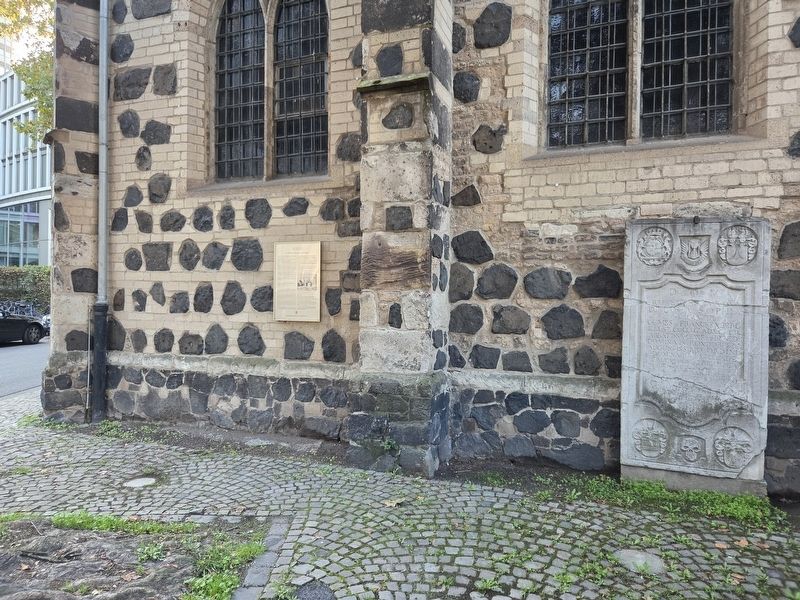
Photographed by James Hulse, October 6, 2026
2. St. Cäcilien / Museum Schnütgen Marker
Seit 1956 ist die Cäcilienkirche zugleich ein städtisches Museum. Das Museum Schnütgen verwahrt berühmte Meisterwerke der Kunst des Mittelalters, Schatzkunst, Stein- und Holzskulptur, Textilien und Glasmalereien.
St. Cäcilien (rechts) und St. Peter, Zeichnung aus dem Skizzenbuch des niederländischen Architekten Justus Finckenbaum, 1664/65, Kölnisches Stadtmuseum.
Christian cult buildings existed here since early Carolingian times, succeeding the roman baths on this site. A charter of Archbishop Willibert (870–888) mentions St. Cecilia as a house for canonesses of nobility in 888.
The present building, a triple-naved pillar basilica without transept, but with vaulted aisles and a nun’s gallery above the crypt in the West, was essentially constructed between 1130 and 1160. From old illustrations, we know about a Romanesque roof spire. Originally three apses formed the Eastern termination of the church. The main apse is decorated with pilasters
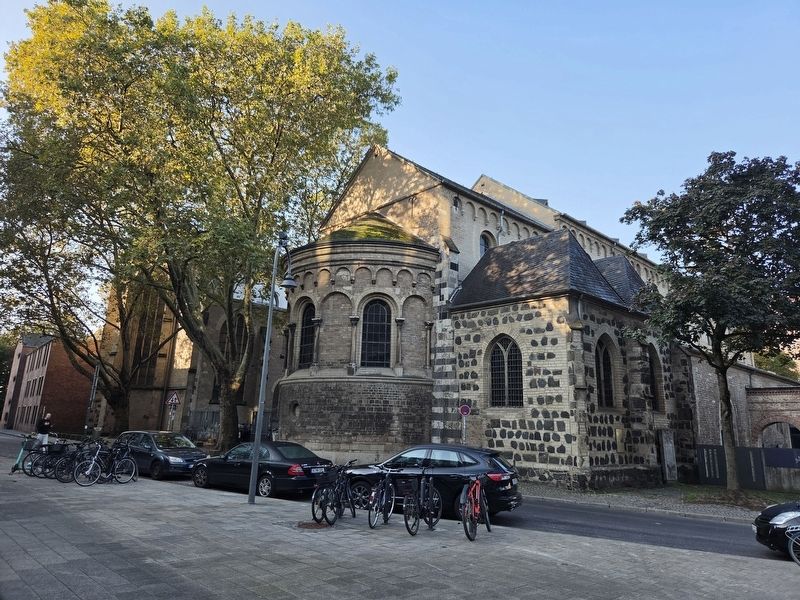
Photographed by James Hulse, October 6, 2026
3. St. Cäcilien
After 1475, with the conversion of the house of canonesses into a convent of Augustinian nuns the building changed. The flat Romanesque ceiling in the main nave was replaced by a cross-ribbed vault, and a sacristy replaced the apse east of the north aisle.
After the abolition of the convent in 1803 and its re-use as a hospital, the old convent buildings in the west were demolished. New hospital buildings, with the church functioning as hospital chapel, were erected after 1848. The reconstructed West façade of the church in the Romanesque style was included in this building complex.
Following severe bomb damage in the Second World War, Karl Band recreated the impression of the Romanesque space by re-introducing a flat ceiling in the main nave. Band also designed the annex for library and offices for the City of Cologne’s Museum Schnütgen.
Since 1956 the church of St. Cecilia is used as a museum. The Museum Schnütgen houses famous masterpieces of medieval art, treasury objects, sculptures in wood and stone, textiles and glass paintings.
St. Cecilia (right) and St. Peter, drawing from the sketchbook of the dutch architect Justus Finckenbaum (1664/65), City-Museum, Cologne.
Association of Friends of Cologne’s Romanesque Churches.
Erected by Förderverein Romanische Kirchen Köln e. V.
Topics. This historical marker is listed in this topic list: Religion & Religious Structures.
Location. 50° 56.089′ N, 6° 57.116′ E. Marker is in Köln, Nordrhein-Westfalen (North Rhine-Westphalia). It is in Cäcilien-Viertel. It is at the intersection of Cäcilienkloster and Cäcilienstraße, on the right when traveling south on Cäcilienkloster. Touch for map. Marker is at or near this postal address: Cäcilienkloster 2, Köln HE 50676, Germany. Touch for directions.

Regionally, this marker is in the German Rhineland. Globally, it is in Europe, the European Union, Atlantic Europe, Central Europe, the Schengen Area, Western Europe, and the Western World. Historically, it finds itself in what was once the Roman Empire, the Holy Roman Empire, the Hanseatic League, and the former West Germany.
Other nearby markers. At least 8 other markers are within walking distance of this marker: Fygen Lutzenkirchen (within shouting distance of this marker); St. Peter (within shouting distance of this marker); Margarete Pins (about 180 meters away, measured in a direct line); Liddy Pins (about 180 meters away); Antoniterkirche (about 180 meters away); At This Location (about 180 meters away); Mathilde Joseph (about 180 meters away); Romm (about 180 meters away). Touch for a list and map of all markers in Köln.
Credits. This page was last revised on October 15, 2026. It was originally submitted on October 14, 2026, by James Hulse of Medina, Texas. This page has been viewed 8 times since then. Photos: 1, 2, 3. submitted on October 15, 2026, by James Hulse of Medina, Texas.
