
Sandy in Central Bedfordshire, England, United Kingdom — Northwestern Europe (the British Isles)
The Railway Triangle
A Gateway Garden for Sandy
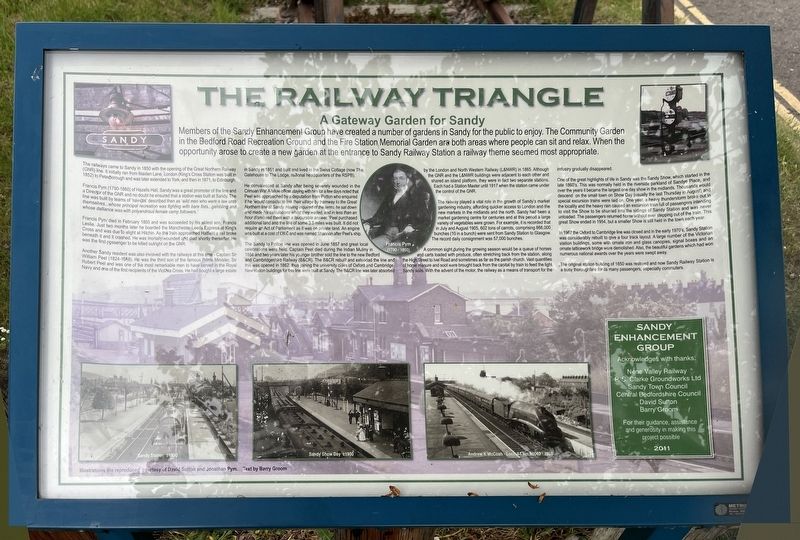
Photographed by Ray Gurganus, May 6, 2026
1. The Railway Triangle Marker
The railways came to Sandy in 1850 with the opening of the Great Northern Railway (GNR) line. It initially ran from Maiden Lane, London (King's Cross Station was built in 1852) to Peterborough and was later extended to York, and then in 1871, to Edinburgh.
Francis Pym (1790-1860) of Hazells Hall, Sandy was a great promoter of the line and a Director of the GNR and no doubt he ensured that a station was built at Sandy. The line was built by teams of 'naves' described then as 'wild men who were a law unto themselves...whose principal recreation was fighting with bare fists...gambling and whose dalliance was with polyandrous female camp followers."
Francis Pym died in February 1860 and was succeeded by his eldest son, Francis Leslie. Just two
this page online
Another Sandy resident was also involved with the railways at this time - Captain Sir William Peel (1824-1868). He was the third son of the famous Prime Minister, Sir Robert Peel and was one of the most remarkable men to have served in the Royal Navy and one of the first recipients of the Victoria Cross. He had bought a large estate in Sandy in 1851 and built and lived in the Swiss Cottage (now The Gatehouse to The Lodge, national headquarters of the RSPB).
He convalesced at Sandy after being severely wounded in the Crimean War. A fellow officer staying with him for a few days noted that Peel was approached by a deputation from Potton who enquired if he 'would consider to link their village by tramway to the Great Northern line at Sandy. Having inquired of the terms he sat down and made his calculations whilst they waited, and in less than an
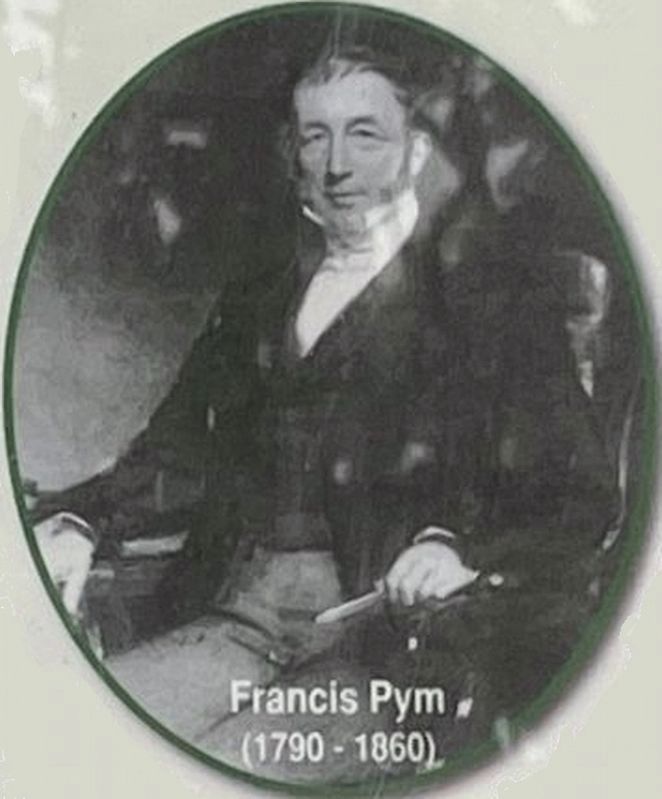
Picture from the marker
2. Francis Pym (1790-1860)
The Sandy to Potton line was opened in June 1857 and great local celebrations were held. Captain Peel died during the Indian Mutiny in 1858 and two years later his younger brother sold the line to the new Bedford and Cambridgeshire Railway (B&CR). The B&CR rebuilt and extended the line and this was opened in 1862, thus joining the university cities of Oxford and Cambridge. New station buildings for this line were built at Sandy. The B&CR line was later absorbed by the London and North Western Railway (L&NWR) in 1865. Although the GNR and the L&NWR buildings were adjacent to each other and shared an island platform, they were in fact two separate stations. Each had a Station Master until 1917 when the station came under the control of the GNR.
The railway played a vital role in the growth of Sandy's market gardening industry, affording quicker access to London and the new markets in the midlands and the north. Sandy had been a market gardening centre for centuries and at this period a large variety of vegetables were grown. For example, it is recorded that in July and August 1905, 602 tons of carrots, comprising 866,000 bunches (10 in a bunch) were sent from Sandy Station to Glasgow. The record daily consignment was 57,000 bunches.
A common sight during the growing season would be a queue of horses and carts loaded with produce, often stretching back from the station, along the High Street to Ivel Road and sometimes as far as the parish church. Vast quantities of horse manure and soot were brought back from the capital by train to feed the light Sandy soils. With the advent of the motor, the railway as a means of transport for the industry gradually disappeared.
One of the great highlights of life in Sandy was the Sandy Show, which started in the late 1860's. This was normally held in the riverside parkland of Sandye Place, and over the years it became the largest one day show in the midlands. Thousands would descend on the small town on Show Day (usually the last Thursday in August) and special excursion trains were laid on. One year, a heavy thunderstorm broke out in the locality and the heavy rain caused an excursion train full of passengers intending to visit the Show to be shunted into the sidings of Sandy Station and was never unloaded. The passengers returned home without ever stepping out of the train. This great Show ended in 1954, but a smaller Show is still held in the town each year.
In 1967 the Oxford to Cambridge line was closed and in the early 1970's, Sandy Station was considerably rebuilt to give a four track layout. A large number of the Victorian station buildings, some with ornate iron and glass canopies, signal boxes and an ornate latticework bridge were demolished. Also, the beautiful gardens which had won numerous national awards over the years were swept away.
The original station building of 1850 was restored and now Sandy Railway Station is a busy thoroughfare for its many passengers, especially commuters.
Erected by Sandy Enhancement Group.
Topics. This historical marker is listed in this topic list: Railroads & Streetcars. A significant historical year for this entry is 1850.
Location. 52° 7.497′ N, 0° 16.896′ W. Marker is in Sandy, England, in Central Bedfordshire. It is on Station Road, in the median. The marker is in the median, by a rail display (the Railway Triangle) near the Sandy railway station. Touch for map. Marker is at or near this postal address: 2 Station Road, Sandy, England SG19 1AW, United Kingdom. Touch for directions.

Regionally, it is on the Atlantic Ocean, in the North Atlantic Region, in Europe, in Atlantic Europe, on one of the British Isles, in the Western World, and in the Anglosphere. Historically, it finds itself in what was once the Roman Empire.
Other nearby markers. At least 8 other markers are within 21 kilometers of this marker, measured as the crow flies: The Sandy Show (approx. 0.3 kilometers away); In celebration of the life and reign of our beloved Queen Elizabeth II (approx. 0.3 kilometers away); Captain Sir William Peal (approx. 0.4 kilometers away); The Two Shannons (approx. 0.4 kilometers away); Biggleswade Station (approx. 4.6 kilometers away); George Bower (approx. 11.5 kilometers away); Rose & Crown (approx. 19.8 kilometers away); The Angel Vaults (approx. 19.9 kilometers away). Touch for a list and map of all markers in Sandy.
Credits. This page was last revised on November 4, 2026. It was originally submitted on October 15, 2026, by Ray Gurganus of Washington, District of Columbia. This page has been viewed 6 times since then. Photos: 1, 2. submitted on October 15, 2026, by Ray Gurganus of Washington, District of Columbia. • Andrew Ruppenstein was the editor who published this page.
Editor’s want-list for this marker. photo of the marker within its surroundings • Can you help?
