Groß-Gerau, Hesse, Germany — Central Europe
Kleine Geschichte der Stadtkirche
⎯⎯⎯
A Short History of the Town Church
Photographed by Andrew Ruppenstein, October 15, 2026
1. A Short History of the Town Church Marker

Kleine Geschichte der Stadtkirche
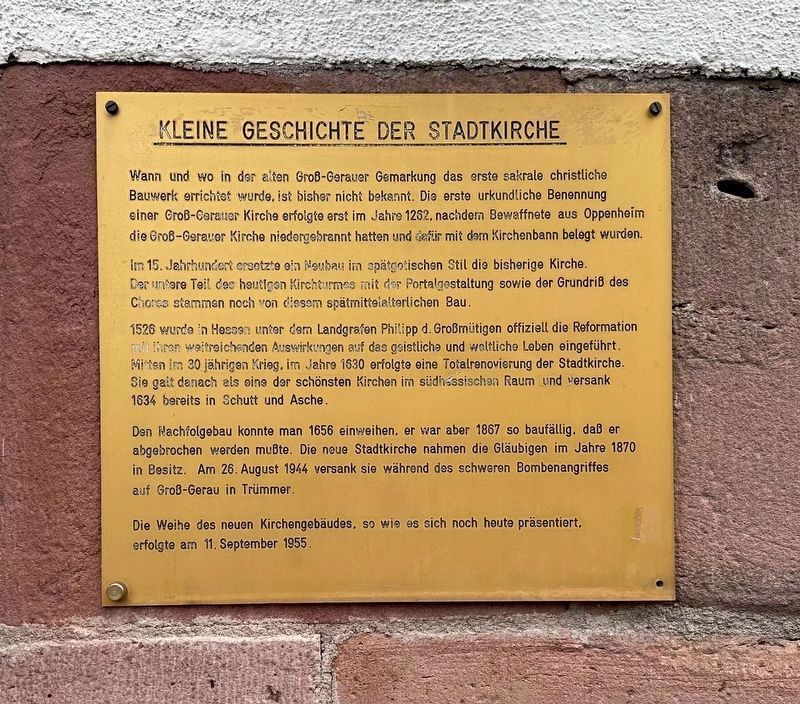
Wann und wo in der alten Groß-Gerauer Gemarkung das erste sakrale christliche Bauwerk errichtet wurde, ist bisher nicht bekannt. Die erste urkundliche Benennung einer Groß-Gerauer Kirche erfolgte erst im Jahre 1262, nachdem Bewaffnete aus Oppenheim die Groß-Gerauer Kirche niedergebrannt hatten und dafür mit dem Kirchenbann belegt wurden.
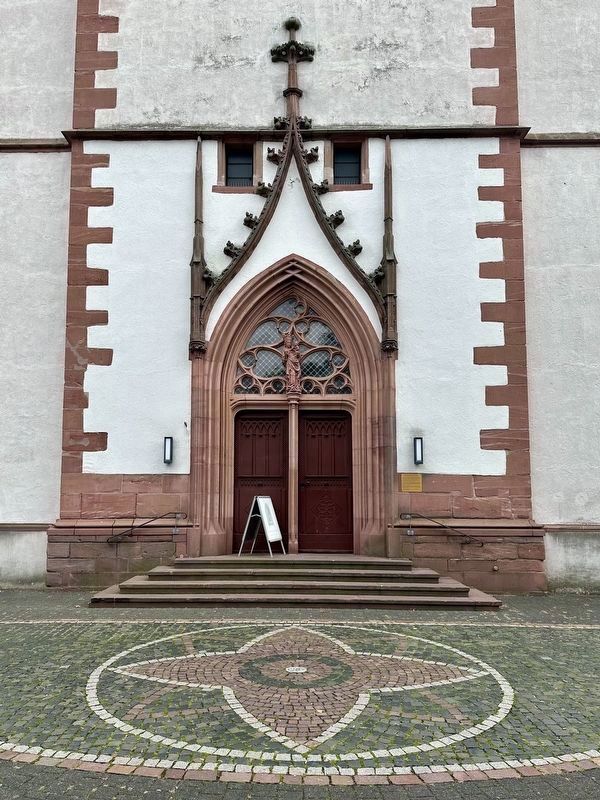
Im 15. Jahrhundert ersetzte ein Neubau im spätgotischen Stil die bisherige Kirche. Der untere Teil des heutigen Kirchturmes mit der Portalgestaltung sowie der Grundriß des Chores stammen noch von diesem spätmittelalterlichen Bau.
1526 wurde in Hessen unter dem Landgrafen Philipp d. Großmütigen offiziell die Reformation mit ihren weitreichenden Auswirkungen auf das geistliche und weltliche Leben eingeführt. Mitten im 30 jährigen Krieg, im Jahre 1530 erfolgte eine Totalrenovierung der Stadtkirche. Sie galt danach als eine der schönsten Kirchen im südhessischen Raum und versank 1634 bereits in Schutt und Asche.
Den Nachfolgebau konnte man 1656 einweihen, er war aber 1867 so baufällig, daß er abgebrochen werden mußte. Die neue Stadtkirche
this page online
Die Weihe des neuen Kirchengebäudes, so wie es sich noch heute präsentiert. erfolgte am 11. September 1955.
A Short History of the Church
It is not yet known when or where the first Christian religious structure was erected within the historical territory of Groß-Gerau. The first documentary mention of a church in Groß-Gerau did not occur until 1262 — following an incident in which armed men from Oppenheim burned down the church, an act for which they were subsequently placed under an ecclesiastical ban (excommunication).
In the 15th century, a new building in the Late Gothic style replaced the existing church. The lower section of the current church tower — including the design of its portal — as well as the ground plan of the chancel, date back to this late medieval structure.
In 1526, the Reformation—with its far-reaching consequences for both spiritual and secular life — was officially introduced in Hesse under Landgrave Philip the Magnanimous. In
Photographed by Andrew Ruppenstein, October 15, 2026
2. A Short History of the Town Church Marker - wide view
The marker is visible here just to the right of the door
A successor building was consecrated in 1656, but by 1867, it had become so dilapidated that it had to be demolished. The congregation took possession of the new town church in 1870. On August 26, 1944, it was reduced to ruins during a heavy bombing raid on Groß-Gerau.
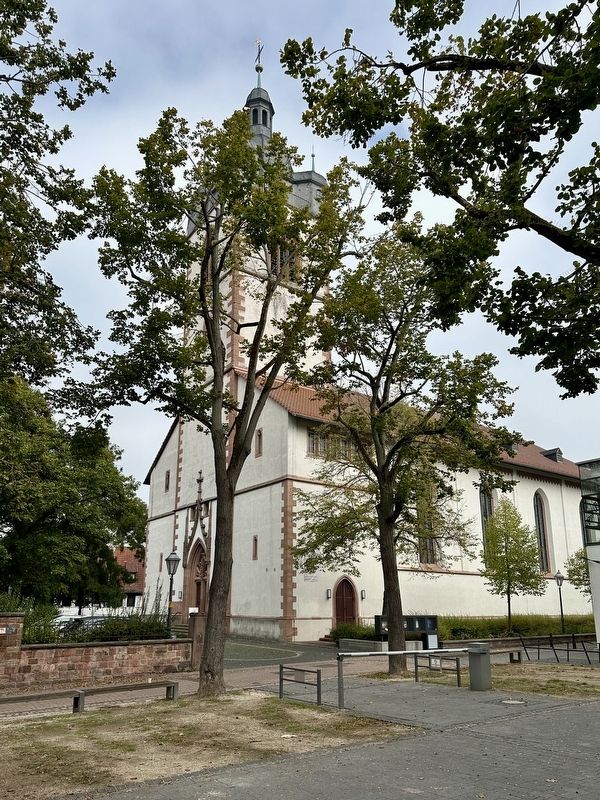
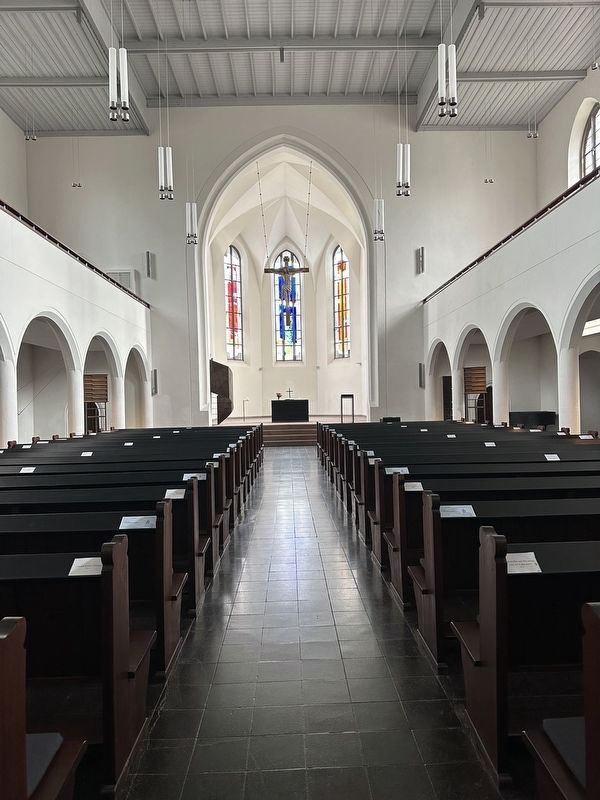
The current church building — as it stands today — was consecrated on September 11, 1955.
Topics. This historical marker is listed in this topic list: Religion & Religious Structures. A significant historical date for this entry is August 26, 1944.
Location. 49° 55.314′ N, 8° 29.032′ E. Marker is in Groß-Gerau, Hessen (Hesse). It is at the intersection of Schöneckenstraße and Kirchstraße, on the left when traveling west on Schöneckenstraße. Touch for map. Marker is at or near this postal address: Kirchstraße 10, Groß-Gerau HE 64521, Germany. Touch for directions.

Regionally, this marker is on the German Upper Rhine. Globally, it is in Europe,
Photographed by Andrew Ruppenstein, October 15, 2026
3. The Town Church of Gross-Gerau
Other nearby markers. At least 8 other markers are within 13 kilometers of this marker, measured as the crow flies: Das Älteste Fachwerkhaus / The Oldest Half-Timbered House (about 180 meters away, measured in a direct line); Die Kirche / The Church (approx. 8.3 kilometers away); Gräfenhausen Synagogue (approx. 8.4 kilometers away); Das frühere Hirtenhaus / Former Shepherds House (approx. 8.4 kilometers away); Mörfelden Synagoge (approx. 8.5 kilometers away); Erinnerungsort Liberale Synagoge / Liberal Synagogue Memorial Site (approx. 12.8 kilometers away); Gedenken an die Opfer von Zwangssterilisierung / Victims of Forced Sterilization Memorial (approx. 12.8 kilometers away); Darmstadt Sister City Occupation and Holocaust Memorial (approx. 12.8 kilometers away).
Photographed by Andrew Ruppenstein, October 15, 2026
4. Church interior
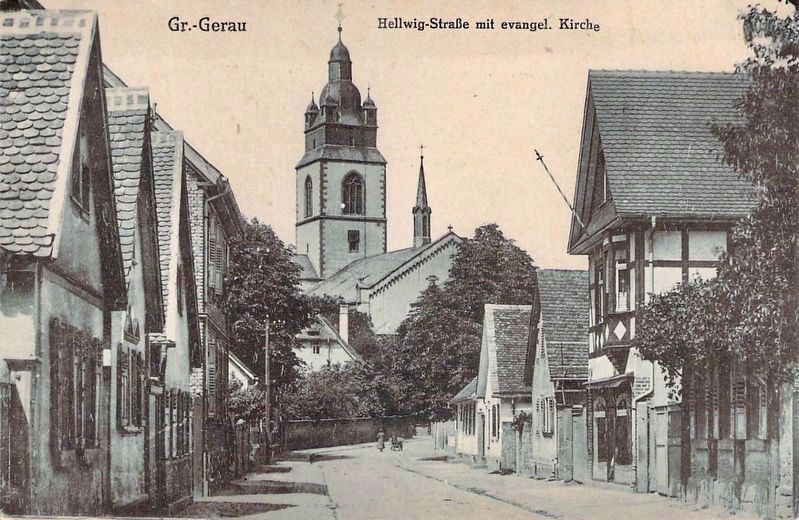
Photographed by Graph. Verlag-Anstalt G.m.b.H., Dresden-Blasewitz, circa 1905
5. Helwigstraße with the Protestant Town Church
Credits. This page was last revised on October 15, 2026. It was originally submitted on October 15, 2026, by Andrew Ruppenstein of Lamorinda, California. This page has been viewed 11 times since then. Photos: 1, 2, 3, 4. submitted on October 15, 2026, by Andrew Ruppenstein of Lamorinda, California. 5. submitted on October 15, 2026.
