Liverpool in Merseyside, England, United Kingdom — Northwestern Europe (the British Isles)
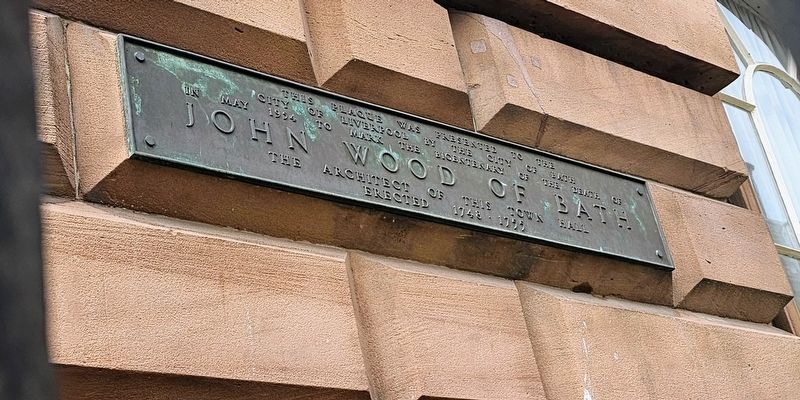
John Wood of Bath
Photographed by Ian Lefkowitz, September 13, 2026
1. John Wood of Bath Marker
John Wood of Bath
The architect of this town hall.
Erected 1748 – 1754.
Erected 1954 by The City of Bath.
Topics. This historical marker is listed in this topic list: Architecture. A significant historical year for this entry is 1754.
Location. 53° 24.425′ N, 2° 59.476′ W. Marker is in Liverpool, England, in Merseyside. It is at the intersection of High Street and Dale Street, on the left when traveling north on High Street. Touch for map. Marker is at or near this postal address: 8403 High Street, Liverpool, England L2 4SW, United Kingdom. Touch for directions.

Regionally, this marker is in North West England. Globally, it is on the Atlantic Ocean, in the North Atlantic Region, in Europe, in Atlantic Europe, on one of the British Isles, in the Western World, and in the Anglosphere. Historically, it finds itself in what was once the Roman Empire.
Other nearby markers. At least 8 other markers are within walking distance of this marker: Liverpool's First Town Hall (a few steps from
this page online
Also see . . . John Wood, the Elder (Wikipedia).
John Wood, the Elder (1704 – 23 May 1754) was an English architect, working mainly in Bath...Liverpool Town Hall was built between 1749 and 1754 to a design by Wood replacing an earlier town hall nearby. An extension to the north designed by James Wyatt was added in 1785. The ground floor acted as the exchange, and a council room and other offices were on the upper floor. The ground floor had a central courtyard surrounded by Doric colonnades but it was "dark and confined, and the merchants preferred to transact business in the street outside".(Submitted on October 16, 2026, by Ian Lefkowitz of New York, New York.)
Photographed by Ian Lefkowitz, September 13, 2026
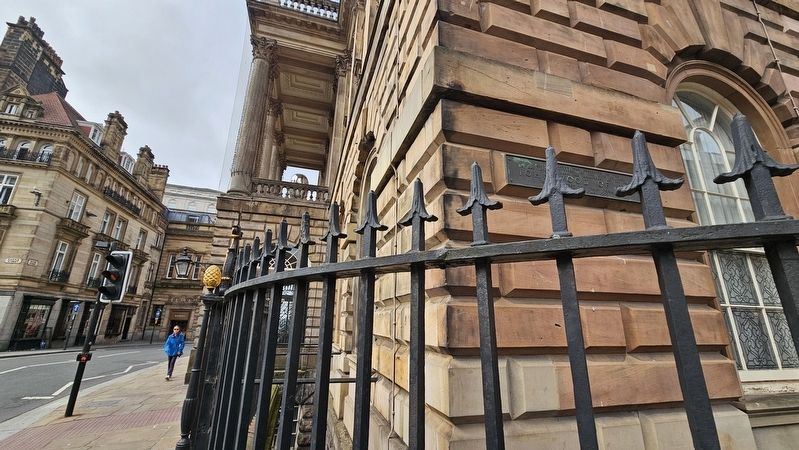
2. John Wood of Bath Marker
The marker is located on the eastern face of Liverpool Town Hall, facing High Street.
Photographed by Ian Lefkowitz, September 13, 2026
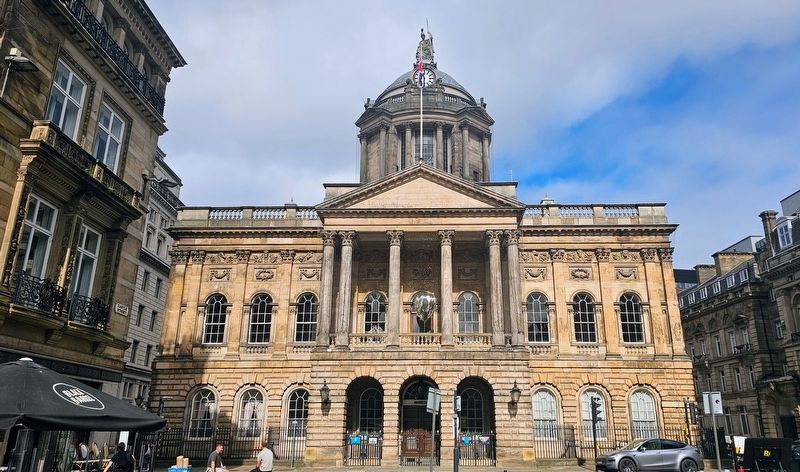
3. Liverpool Town Hall
The town hall was described by Buildings of England as "probably the grandest ...suite of civic rooms in the country."
Public Domain
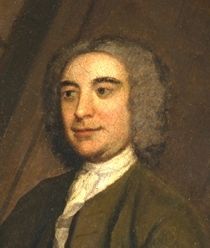
4. John Wood of Bath
Credits. This page was last revised on October 16, 2026. It was originally submitted on October 16, 2026, by Ian Lefkowitz of New York, New York. This page has been viewed 5 times since then. Photos: 1, 2, 3, 4. submitted on October 16, 2026, by Ian Lefkowitz of New York, New York. • Andrew Ruppenstein was the editor who published this page.
