Liverpool in Merseyside, England, United Kingdom — Northwestern Europe (the British Isles)
Pte. William Ratcliffe VC MM
“The Dockers’ VC”
| — | World War One Victoria Cross Centenary Commemoration | — |
Photographed by Ian Lefkowitz, September 13, 2026
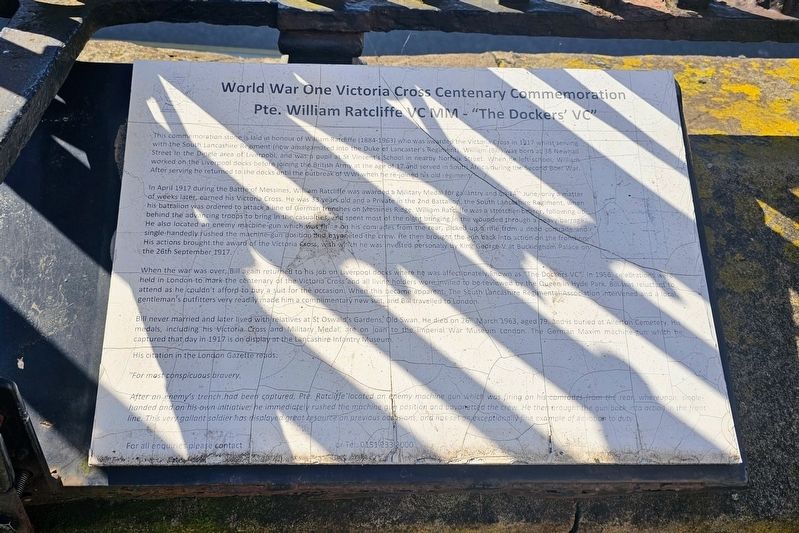
1. Pte. William Ratcliffe VC MM Marker
In April 1917 during the Battle of Messines, William Ratcliffe was awarded a Military Medal for gallantry and on 14th June, only a matter of weeks later, earned his Victoria Cross. He was 33 years old and a Private in the 2nd Battalion, the South Lancashire Regiment, when his battalion was ordered to attack a line of German trenches on Messines Ridge. William Ratcliffe was a stretcher-bearer, following up behind the advancing troops to bring in the casualties, and spent most of the night bringing in
this page online
When the war was over, Bill again returned to his job on Liverpool docks where he was affectionately known as “The Dockers’ VC”. In 1956, celebrations were held in London to mark the centenary of the Victoria Cross and all living holders were invited to be reviewed by the Queen in Hyde Park. Bill was reluctant to attend as he couldn’t afford to buy a suit for the occasion. When this became apparent, The South Lancashire Regimental Association intervened and a local gentleman’s outfitters very readily made him a complimentary new suit, and Bill travelled to London.
Bill never married and later lived with relatives at St Oswald’s Gardens, Old Swan. He died on 26th March 1963, aged 79, and is buried
Photographed by Ian Lefkowitz, September 13, 2026
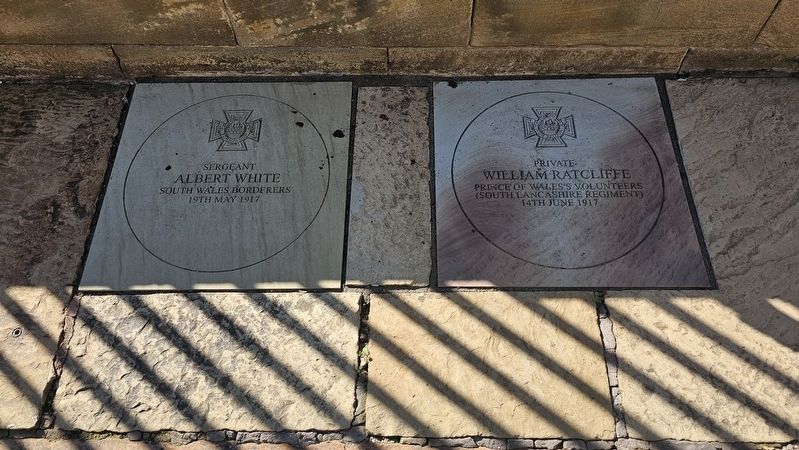
2. Private William Ratcliffe Commemoration Stone
The stone reads:
Private
William Ratcliffe
Prince of Wales’s Volunteers
(South Lancashire Regiment)
14th June 1917
Private
William Ratcliffe
Prince of Wales’s Volunteers
(South Lancashire Regiment)
14th June 1917
His citation in the London Gazette reads:
“For most conspicuous bravery.
After an enemy’s trench had been captured, Pte. Ratcliffe located an enemy machine gun which was firing on his comrades from the rear, whereupon, single-handed and on his own initiative, he immediately rushed the machine gun position and bayonetted the crew. He then brought the gun back into action in the front line. This very gallant soldier has displayed great resource on previous occasions, and has set an exceptionally fine example of devotion to duty.”
Erected 2017.
Topics and series. This memorial is listed in this topic list: War, World I. In addition, it is included in the Victoria Cross and George Cross Recipients series list. A significant historical date for this entry is September 26, 1917.
Location. 53° 24.413′ N, 2° 59.712′ W. Memorial is in Liverpool, England, in Merseyside. It can be reached from Old Churchyard near Chapel
Photographed by Ian Lefkowitz, September 13, 2026
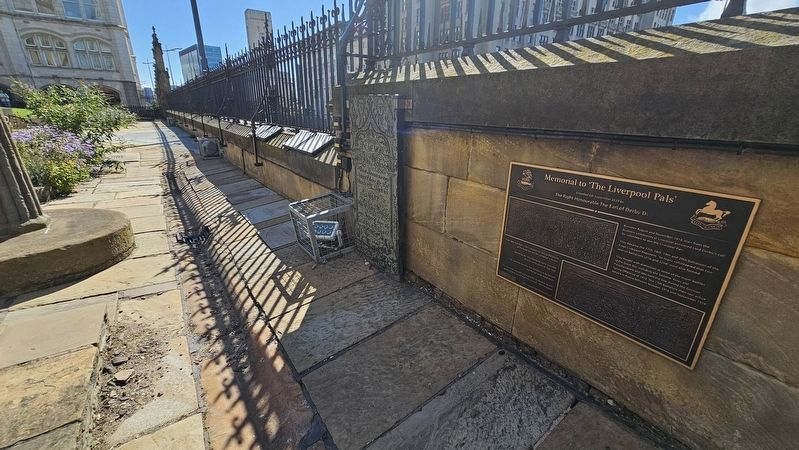
3. Pte. William Ratcliffe VC MM Marker
The marker and four commemoration stones are laid in the garden. This stone is second from left.

Regionally, this memorial is in North West England. Globally, it is on the Atlantic Ocean, in the North Atlantic Region, in Europe, in Atlantic Europe, on one of the British Isles, in the Western World, and in the Anglosphere. Historically, it finds itself in what was once the Roman Empire.
Other nearby markers. At least 8 other markers are within walking distance of this marker: Memorial to ‘The Liverpool Pals’ (here, next to this marker); Lieutenant Hugh McKenzie (here, next to this marker); Sgt Albert White VC (here, next to this marker); Sergeant Cyril Gourley (here, next to this marker); Royal Naval Volunteer Reserve World War II Memorial (here, next to this marker); Liverpool Blitz Memorial (here, next to this marker); Saint Nicholas's Church Yard (a few steps from this marker); The Battle of the Atlantic Memorial (a few steps from this marker). Touch for a list and map of all markers in Liverpool.
Credits. This page was last revised on November 1, 2026. It was originally submitted on October 17, 2026, by Ian Lefkowitz of New York, New York. This page has been viewed 6 times since then. Photos: 1, 2, 3. submitted on October 17, 2026, by Ian Lefkowitz of New York, New York. • Andrew Ruppenstein was the editor who published this page.
