Liverpool in Merseyside, England, United Kingdom — Northwestern Europe (the British Isles)
Church of Our Lady & St Nicholas
Photographed by Ian Lefkowitz, September 13, 2026
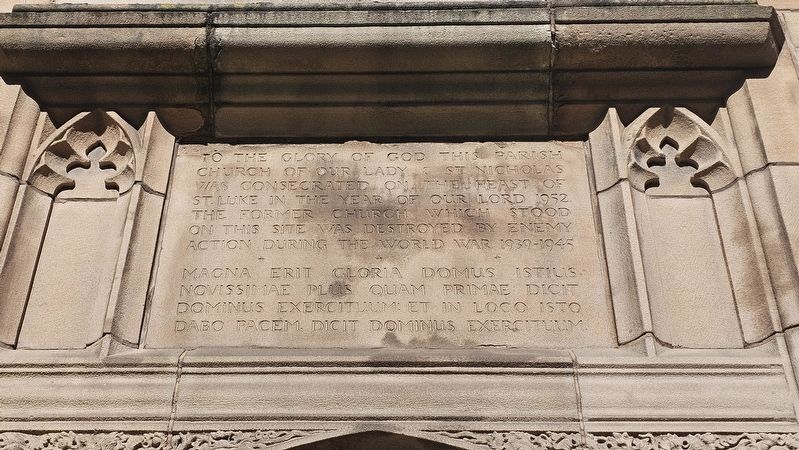
1. Church of Our Lady & St Nicholas Marker

To the glory of God this parish church of Our Lady & St Nicholas was consecrated on the feast of St Luke in the year of Our Lord 1952. The former church which stood on this site was destroyed by enemy action during the World War 1939–1945.
Magna erit gloria domus istius novissimae plus quam primae dicit Dominus exercituum: et in loco isto dabo pacem, dicit Dominus exercituum.
The glory of this latter house shall be greater than of the former, saith the Lord of hosts: and in this place will I give peace, saith the Lord of hosts.
Erected 1952 by Church of Our Lady & St Nicholas.
Topics. This memorial is listed in these topic lists: Religion & Religious Structures • War, World II.
Location. 53° 24.419′ N, 2° 59.677′ W. Memorial is in Liverpool, England, in Merseyside. It can be reached from the intersection of Old Churchyard and Chapel Street, on the right when traveling south. Touch for map. Memorial is at or near this postal address: 5 Old Churchyard, Liverpool, England L2 8TX, United Kingdom. Touch for directions.

Regionally,
this page online
Other nearby markers. At least 8 other markers are within walking distance of this marker: James Harrison (here, next to this marker); SS Atlantic Conveyor Memorial (a few steps from this marker); Abell (a few steps from this marker); Church of Our Lady and St. Nicholas (a few steps from this marker); MV Derbyshire (within shouting distance of this marker); St. Nicholas' Church (within shouting distance of this marker); The Battle of the Atlantic Memorial (within shouting distance of this marker); Arctic Campaign Memorial (within shouting distance of this marker). Touch for a list and map of all markers in Liverpool.
Also see . . . Church of Our Lady and St Nicholas, Liverpool (Wikipedia).
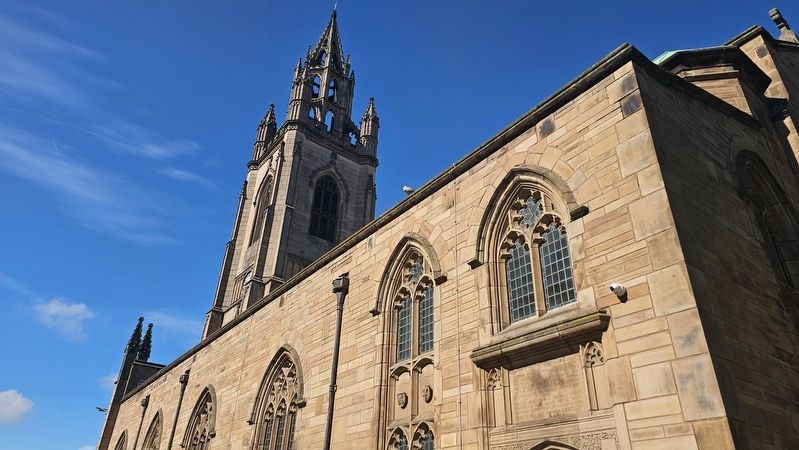
During World War II, the bells were removed for safety, but they were never rehung. Following a German air raid on 21 December 1940, the main body(Submitted on October 17, 2026, by Ian Lefkowitz of New York, New York.)of the church was destroyed by fire, leaving only the parish rooms, vestries and the 19th-century tower. Rebuilding did not begin until March 1949, and the completed church, dedicated to 'Our Lady and St Nicholas', was consecrated on 18 October 1952 (the Feast of St Luke). A new ring of 12 bells was cast by John Taylor and Co. of Loughborough.Photographed by Ian Lefkowitz, September 13, 20262. Church of Our Lady & St Nicholas MarkerThe inscription is located towards the rear of the church, facing Our Lady and St Nicholas Church Garden. This section of the church was destroyed from bombing during World War II and rebuilt in 1952.
The new church was designed by architect Edward C. Butler, who introduced major changes to its design. Rather than the traditional practice of placing the altar at the east end (for the light of the rising sun and to signify the Resurrection), Butler placed it at the western end of the church.
Credits. This page was last revised on November 3, 2026. It was originally submitted on October 17, 2026, by Ian Lefkowitz of New York, New York. This page has been viewed 9 times since then. Photos: 1, 2. submitted on October 17, 2026, by Ian Lefkowitz of New York, New York. • Andrew Ruppenstein was the editor who published this page.
