Regina in Sherwood No. 159, Saskatchewan — The Prairie Region (North America)
Walter Scott
Photographed by Cosmos Mariner, June 20, 2022
1. Walter Scott Marker

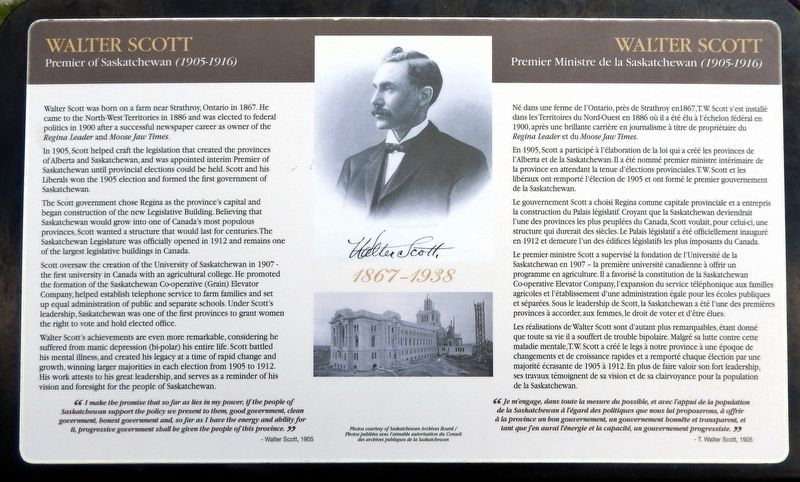
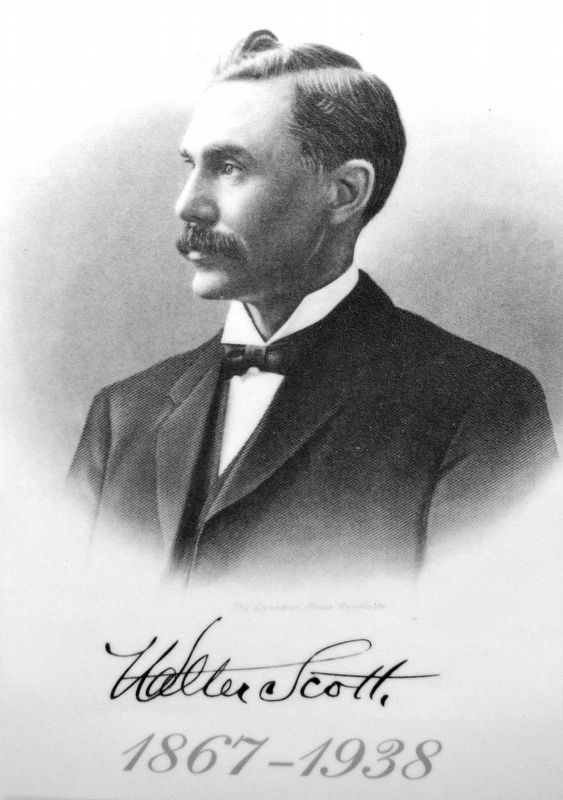
Walter Scott was born on a farm near Strathroy, Ontario in 1867. He came to the North-West Territories in 1886 and was elected to federal politics in 1900 after a successful newspaper career as owner of the Regina Leader and Moose Jaw Times.
In 1905, Scott helped craft the legislation that created the provinces of Alberta and Saskatchewan, and was appointed interim Premier of Saskatchewan until provincial elections could be held. Scott and his Liberals won the 1905 election and formed the first government of Saskatchewan.
The Scott government chose Regina as the province's capital and began construction of the new Legislative Building. Believing that Saskatchewan would grow into one of Canada's most populous provinces, Scott wanted a structure that would last for centuries. The Saskatchewan Legislature was officially opened in 1912 and remains one of the largest legislative buildings in Canada.
Scott oversaw the creation of the University of Saskatchewan in 1907 — the first university in Canada with an agricultural college. He promoted the formation of the Saskatchewan
this page online
Walter Scott's achievements are even more remarkable, considering he suffered from manic depression (bi-polar) his entire life. Scott battled his mental illness, and created his legacy at a time of rapid change and growth, winning larger majorities in each election from 1905 to 1912. His work attests to his great leadership, and serves as a reminder of his vision and foresight for the people of Saskatchewan.
“I make the promise that so far as lies in my power, if the people of Saskatchewan support the policy we present to them, good government, clean government, honest government and, so far as I have the energy and ability for it progressive government shall be given the people of this province.”
— Walter Scott, 1905
Né dans une ferme de l’Ontario, près de Strathroy en 1867, T.W. Scott s'est installé
Saskatchewan Archives Board
2. Marker detail: Walter Scott
En 1905, Scott a participé à l'élaboration de la loi qui a créé les provinces de l'Alberta et de la Saskatchewan. Il a été nommé premier ministre intérimaire de la province en attendant la tenue d'élections provinciales. T.W. Scott et les libéraux ont remporté l'élection de 1905 et ont formé le premier gouvernement de la Saskatchewan.
Le gouvernement Scott a choisi Regina comme capitale provinciale et a entrepris la construction du Palais législatif. Croyant que la Saskatchewan deviendrait l'une des provinces les plus peuplées du Canada, Scott voulait, pour celui-ci, une structure qui durerait des siècles. Le Palais législatif a été officiellement inauguré en 1912 et demeure l'un des édifices législatifs les plus imposants du Canada.
Le premier ministre Scott a supervisé la fondation de l'Université de la Saskatchewan en 1907 — la première université canadienne à offrir un programme en agriculture. Il a favorisé la constitution de la Saskatchewan
Photographed by Cosmos Mariner, June 20, 2022
3. Walter Scott Marker and Statue
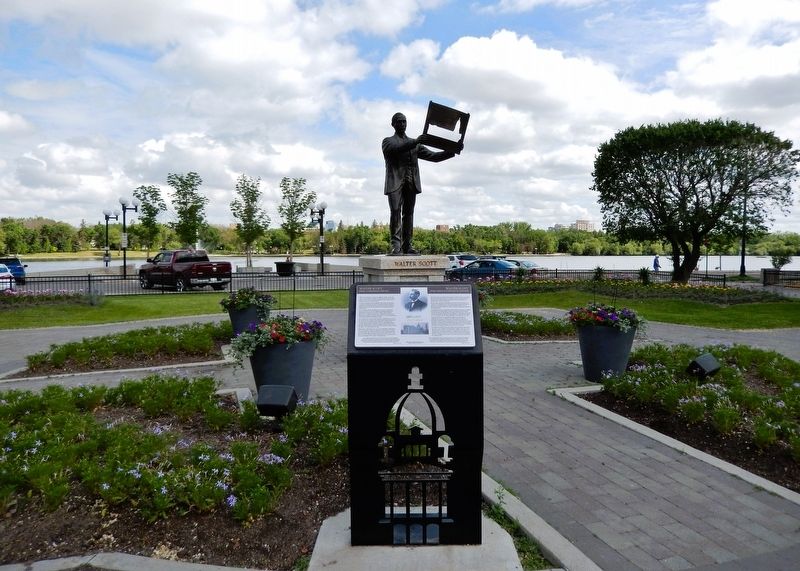
The marker overlooks the statue at the north end of Queen Elizabeth II Gardens. Wascana Lake is in the background.
Les réalisations de Walter Scott sont d'autant plus remarquables, étant donné que toute sa vie il a souffert de trouble bipolaire. Malgré sa lutte contre cette maladie mentale, T.W. Scott a créé le legs à notre province à une époque de changements et de croissance rapides et a remporté chaque élection par une majorité écrasante de 1905 à 1912. En plus de faire valoir son fort leadership, ses travaux témoignent de sa vision et de sa clairvoyance pour la population de la Saskatchewan.
« Je m'engage, dans toute la mesure du possible, et avec l'appui de la population de la Saskatchewan à l'égard des politiques que nous lui proposerons, à offrir à la province un bon gouvernement, un gouvernement honnête et transparent, et tant que J'en aurai l'énergie et la capacité, un gouvernement progressiste. »
—T. Walter Scott, 1905
Topics.
Photographed by Cosmos Mariner, June 20, 2022
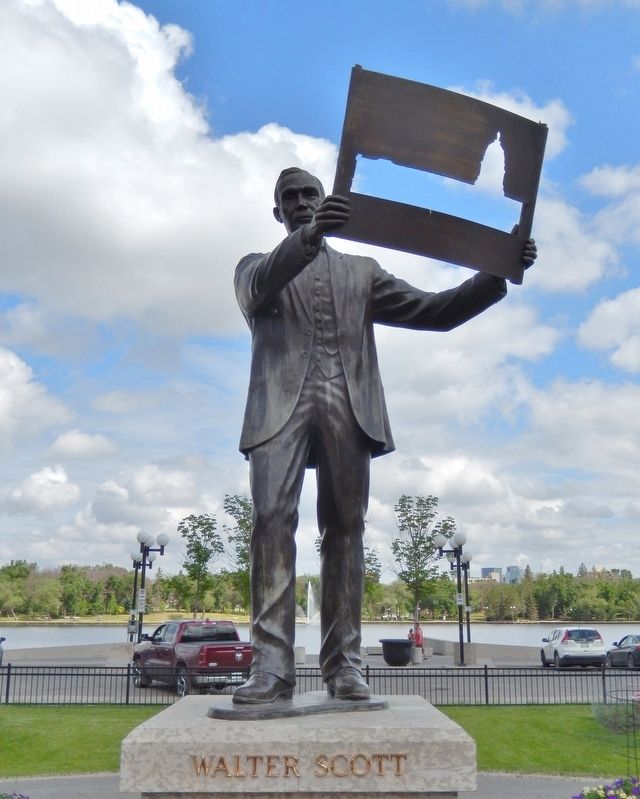
4. Walter Scott Statue
Location. 50° 26.072′ N, 104° 36.911′ W. Marker is in Regina, Saskatchewan, in Sherwood No. 159. It can be reached from Legislative Drive just east of Albert Street (CanAm Highway) (Provincial Highway 6), on the left when traveling east. The marker and statue are at the north end of Queen Elizabeth II gardens, on the north side of the Saskatchewan Legislative Assembly grounds. Touch for map. Marker is at or near this postal address: 2405 Legislative Drive, Regina SK S4S 0B3, Canada. Touch for directions.

Regionally, this marker is in Southeast Saskatchewan. It is also in the Prairies. Globally, it is in North America, the Western Hemisphere, the Western World, and the Anglosphere. Historically, it finds itself in what was once a British colony and also Rupert’s Land.
Other nearby markers. At least 8 other markers are within walking distance of this marker: The Queen's Visit 1973 / La visite de la Reine 1973 (within shouting distance of this marker); The Queen's Visit 1978 / La visite de la Reine 1978
Photographed by Cosmos Mariner, June 20, 2022
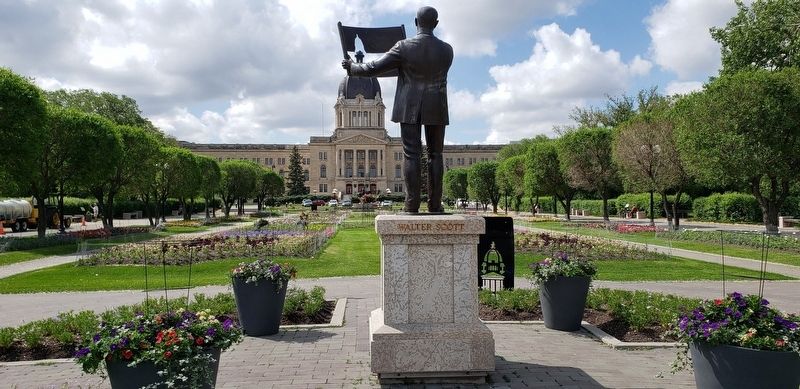
5. Walter Scott Statue, Queen Elizabeth II Gardens and Legislative Assembly Building
Looking south from behind the Walter Scott statue.
Related markers. Click here for a list of markers that are related to this marker. Saskatchewan Legislative Assembly
Also see . . . Thomas Walter Scott (Wikipedia).
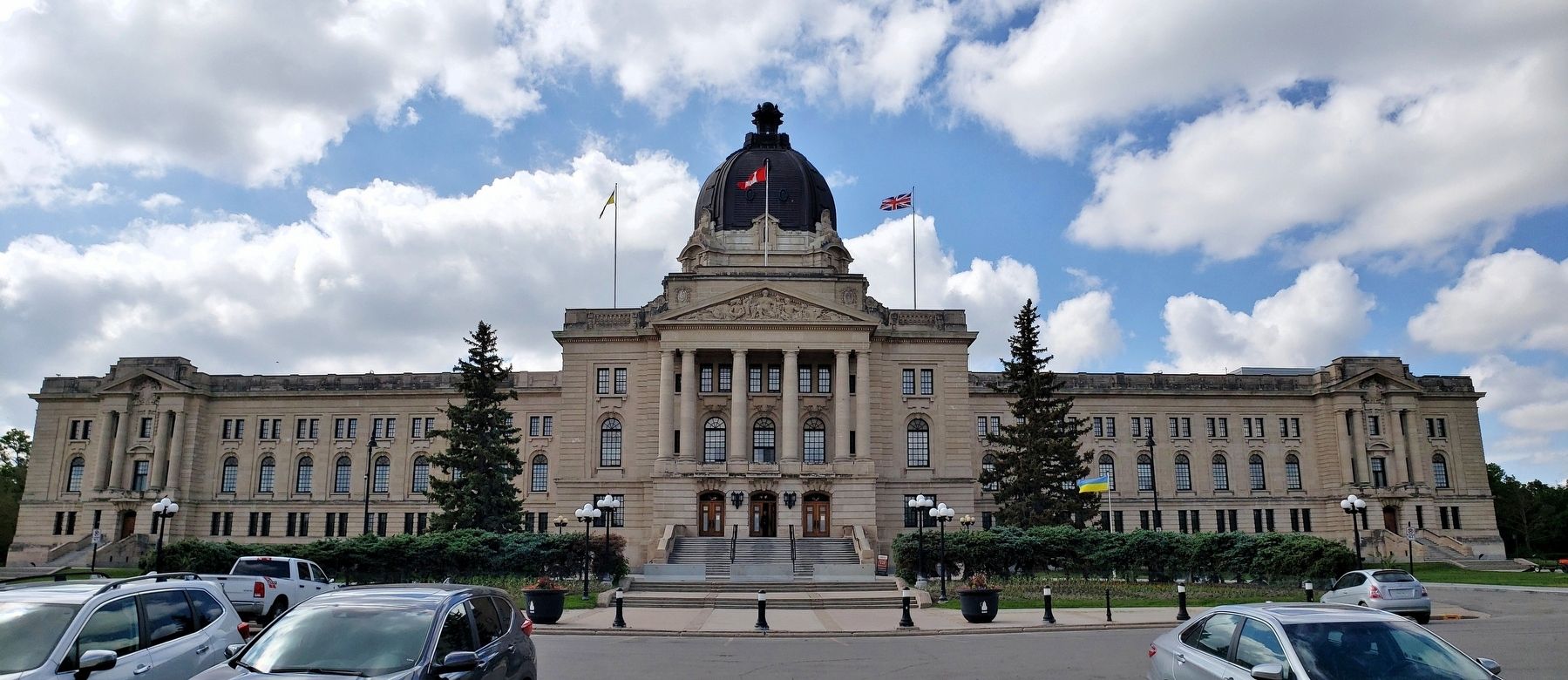
Excerpt: The first premier of Saskatchewan, Scott was Saskatchewan's second longest-serving Premier, serving one continuous term from 1905 to 1916. He led the Saskatchewan Liberal Party in three general elections, winning all three with majority governments before retiring. He was succeeded by William Melville Martin. Scott(Submitted on October 18, 2026, by Cosmos Mariner of Cape Canaveral, Florida.)was also the minister of various departments during his tenure as premier. Prior to the creation of Saskatchewan in 1905, Scott was a Member of Parliament in the federal House of Commons of Canada, elected in the general elections of 1900 and 1904.Photographed by Cosmos Mariner, June 20, 20226. Saskatchewan Legislative Assembly BuildingLooking south from Legislative Drive.
As the province’s first leader, he built its administrative framework and governance structures. He prioritized railway expansion and public works, improving rail transportation and connectivity. Scott was instrumental in developing Saskatchewan’s education system, including funding for schools and teacher training as well as a university. He introduced policies to strengthen local governments, ensuring better services for communities. His leadership encouraged agricultural development, helping Saskatchewan become a key player in Canada’s economy.
Scott, who was the minister of public works in addition to serving as premier, began a search for a suitable location for the new Legislative Building. In late June 1906, his cabinet formally approved the location of the current legislature. They agreed to develop the area around the legislature into a public park (Wascana Park), which is today the largest urban park in North America. Following a design competition, the commission for the new Legislative Building was awarded to Maxwells of Montreal in December 1907.
Credits. This page was last revised on October 18, 2026. It was originally submitted on October 18, 2026, by Cosmos Mariner of Cape Canaveral, Florida. This page has been viewed 3 times since then. Photos: 1, 2, 3, 4, 5, 6. submitted on October 18, 2026, by Cosmos Mariner of Cape Canaveral, Florida.
