Regina in Sherwood No. 159, Saskatchewan — The Prairie Region (North America)
The American Revolution Split the Population of the Thirteen Colonies into Patriots and Loyalists
Photographed by Cosmos Mariner, June 20, 2022
1. The American Revolution Split the Population of the Thirteen Colonies into Patriots and Loyalists
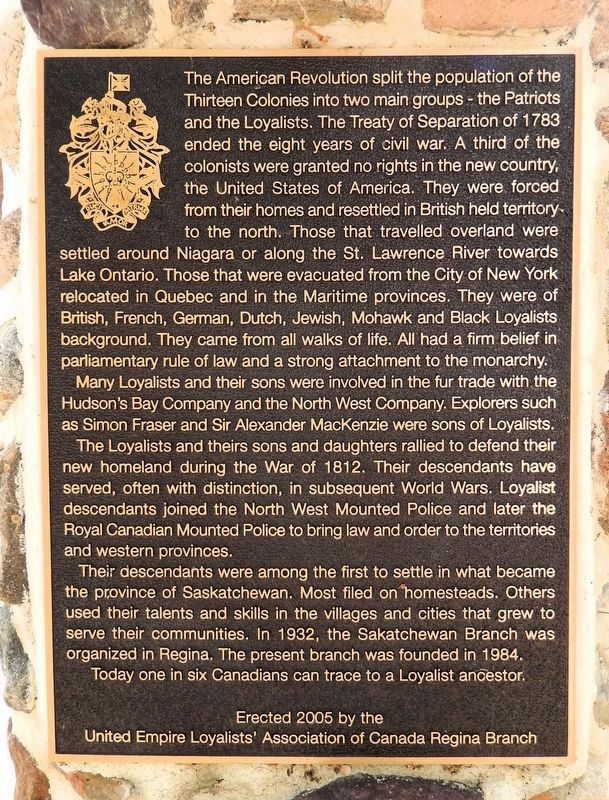
The American Revolution split the population of the Thirteen Colonies into two main groups — the Patriots and the Loyalists. The Treaty of Separation of 1783 ended the eight years of civil war. A third of the colonists were granted no rights in the new country, the United States of America. They were forced from their homes and resettled in British held territory to the north. Those that travelled overland were settled around Niagara or along the St. Lawrence River towards Lake Ontario. Those that were evacuated from the City of New York relocated in Quebec and in the Maritime provinces. They were of British, French, German, Dutch, Jewish, Mohawk and Black Loyalists background. They came from all walks of life. All had a firm belief in parliamentary rule of law and a strong attachment to the monarchy.
Many Loyalists and their sons were involved in the fur trade with the Hudson's Bay Company and the North West Company. Explorers such as Simon Fraser and Sir Alexander MacKenzie were sons of Loyalists.
The Loyalists and their sons and daughters rallied to defend their new homeland during the War of 1812. Their descendants
this page online
Their descendants were among the first to settle in what became the province of Saskatchewan. Most filed on homesteads. Others used their talents and skills in the villages and cities that grew to serve their communities. In 1932, the Saskatchewan Branch was organized in Regina. The present branch was founded in 1984.
Today one in six Canadians can trace to a Loyalist ancestor.
Erected 2005 by United Empire Loyalists' Association of Canada Regina Branch.
Topics. This historical marker is listed in these topic lists: Patriots & Patriotism • Settlements & Settlers • War, US Revolutionary. A significant historical year for this entry is 1783.
Location. 50° 26.035′ N, 104° 36.777′ W. Marker is in Regina, Saskatchewan, in Sherwood No. 159. It is on Walter Scott Way just south of Legislative Drive, on the right when traveling west. Touch for map. Marker is at or near this postal address: 2405 Legislative
Photographed by Cosmos Mariner, June 20, 2022
2. The American Revolution Split the Population of the Thirteen Colonies into Patriots and Loyalists
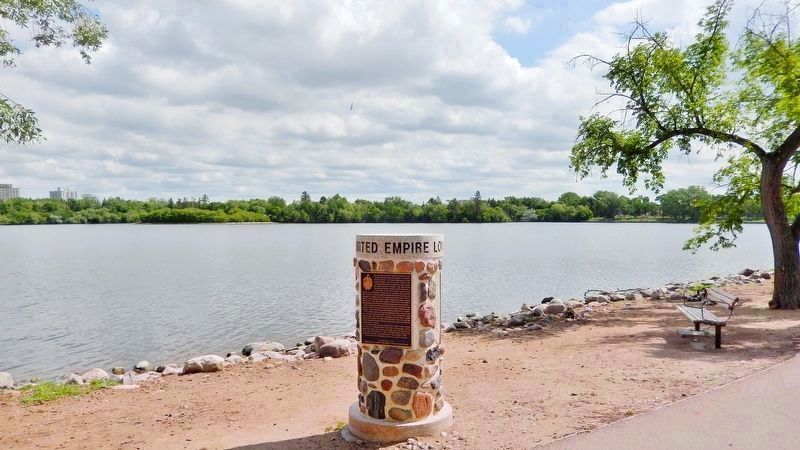
Looking northeast across Wascana Lake. Walter Scott Way and Queen Elizabeth II East Park are beyond this image to the right. This is one of three markers mounted on the United Empire Loyalists Cairn.

Regionally, this marker is in Southeast Saskatchewan. It is also in the Prairies. Globally, it is in North America, the Western Hemisphere, the Western World, and the Anglosphere. Historically, it finds itself in what was once a British colony and also Rupert’s Land.
Other nearby markers. At least 8 other markers are within walking distance of this marker: History of the UELAC in Saskatchewan (here, next to this marker); United Empire Loyalists Cairn (here, next to this marker); The Queen's Visit 1987 / La visite de la Reine 1987 (about 120 meters away, measured in a direct line); The Queen's Visit 2005 / La visite de la Reine 2005 (about 120 meters away); The Queen's Visit 1978 / La visite de la Reine 1978 (about 150 meters away); Queen Elizabeth II Gardens / Les jardins de la reine Elizabeth II (about 150 meters away); Queen Elizabeth II Statue / Statue de la reine Elizabeth II (about 150 meters away); Walter Scott (about 180 meters away). Touch for a list and map of all markers in Regina.
Related markers. Click here for a list of markers that are related to this marker. United Empire Loyalists Cairn
Also see . . . Patriots and Loyalists in the American Revolution: A Detailed Summary (History Crunch).
(Author: B. Millar) Excerpt: When the American Revolution began, the colonists were not united. They were deeply divided over whether to break from Britain or remain loyal to the Crown. Those who supported independence were called Patriots, while those who wished to stay part of Britain were called Loyalists, also known as Tories. A large number of colonists tried to avoid choosing either side altogether. This division turned the Revolutionary War into something more than a conflict between colonies and Britain. In many communities, it became a civil war between neighbors, friends, and even family members.(Submitted on October 19, 2026, by Cosmos Mariner of Cape Canaveral, Florida.)
Loyalists were colonists who believed the thirteen colonies should remain part of the British Empire. They are sometimes called Tories or the King’s Men. Their reasons for loyalty varied widely. Some genuinely believed that British rule was the most stable and beneficial form of government available, and that Parliament had the right to govern the empire as it saw fit. Others had deep personal and economic ties to Britain. Government officials, merchants who depended on British trade, Anglican clergy, and those who had received land grants or royal appointments from the Crown often had strong practical reasons to support the status quo.
Credits. This page was last revised on October 19, 2026. It was originally submitted on October 19, 2026, by Cosmos Mariner of Cape Canaveral, Florida. This page has been viewed 3 times since then. Photos: 1, 2. submitted on October 19, 2026, by Cosmos Mariner of Cape Canaveral, Florida.
