Thetford in Norfolk, England, United Kingdom — Northwestern Europe (the British Isles)
Famous Scripts - Fact and Fiction
Photographed by Ray Gurganus, April 24, 2026
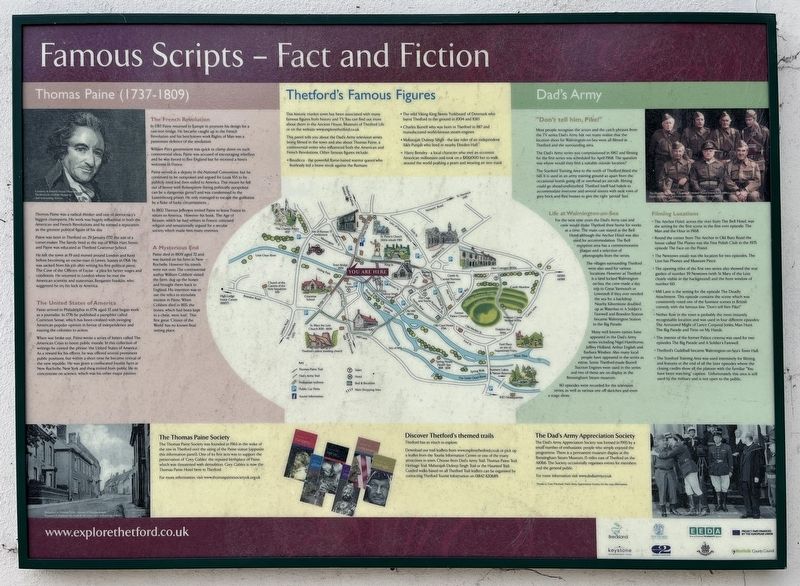
1. Famous Scripts - Fact and Fiction Marker
Thomas Paine (1737-1809)
Thomas Paine was a radical thinker and one of democracy's biggest champions. His work was hugely influential in both the American and French Revolutions and he earned a reputation as the greatest political figure of his day.
Paine was born in Thetford on 29 January 1737, the son of a corset-maker. The family lived at the top of White Hart Street and Paine was educated at Thetford Grammar School.
He left the town at 19 and moved around London and Kent before becoming an excise-man in Lewes, Sussex in 1768. He was sacked from his job after writing his first political piece, The Case of the Officers of Excise - a plea for better wages and conditions. He returned to London where he met the American scientist and statesman, Benjamin Franklin, who suggested he try his luck in America.
The United States of America
Paine arrived in Philadelphia in 1774, aged 37, and began work as a journalist. In 1776 he published a pamphlet called Common Sense, which has been credited with swinging American popular opinion in favour of independence and rousing the colonists to action.
When war broke out,
this page online
The French Revolution
In 1787, Paine returned to Europe to promote his design for a cast-iron bridge. He became caught up in the French Revolution and his best-known work Rights of Man was a passionate defence of the revolution.
William Pitt's government was quick to clamp down on such controversial ideas. Paine was accused of encouraging rebellion and he was forced to flee England but he received a hero's welcome in France.
Paine served as a deputy in the National Convention, but he continued to be outspoken and argued for Louis XVI to be publicly tried and then exiled to America. This meant he fell out of favour with Robespierre (being politically outspoken
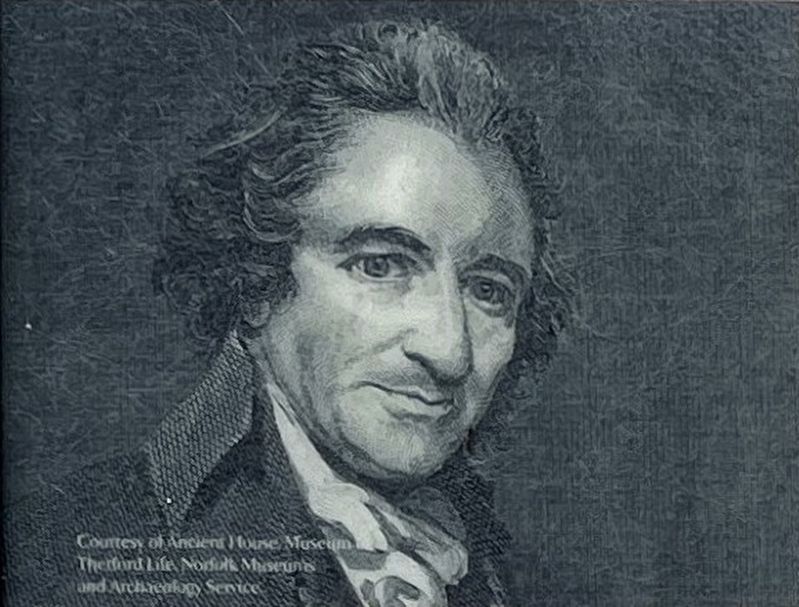
Picture from the marker
2. Thomas Paine
In 1802 Thomas Jefferson invited Paine to leave France to return to America. However his book, The Age of Reason, which he had written in France, criticised religion and sensationally argued for a secular society which made him many enemies.
A Mysterious End
Paine died in 1809 aged 72 and was buried on his farm in New Rochelle. However his travels were not over. The controversial author William Cobbett visited the farm, dug up the bones and brought them back to England. His intention was to use the relics to stimulate interest in Paine. When Cobbett died in 1835, the bones, which had been kept in a chest, were lost! This first great 'Citizen of the World has no known final resting place.
The Thomas Paine Society
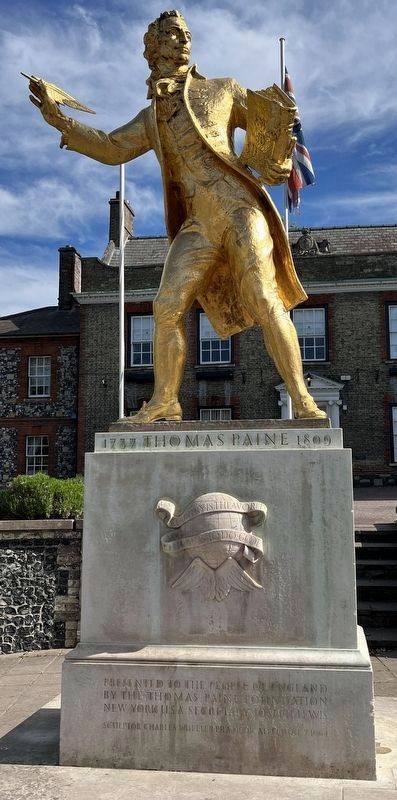
The Thomas Paine Society was founded in 1963 in the wake of the row in Thetford over the siting of the Paine statue (opposite this information panel). One of its first acts was to support the preservation of 'Grey Gables' the reputed birthplace of Paine, which was threatened
Photographed by Ray Gurganus, April 24, 2026
3. Thomas Paine Statue, Thetford
Thetford's Famous Figures
This historic market town has been associated with many famous figures from history and TV. You can find out more about them in the Ancient House, Museum of Thetford Life or on the website www.explorethetford.co.uk
This panel tells you about the Dad's Army television series being filmed in the town and also about Thomas Paine, a controversial writer who influenced both the American and French Revolutions. Other famous figures include:
• Boudicca the powerful flame-haired warrior queen who fearlessly led a brave revolt against the Romans
• The wild Viking King Swein 'Forkbeard of Denmark who burnt Thetford to the ground in 1004 and 1010
• Charles Burrell who was born in Thetford in 1817 and manufactured world-famous steam engines
• Maharajah Duleep Singn - the last ruler of an independent Sikh Punjab who lived in nearby Elveden Hall
• Harry Bensley - a local character who met an eccentric American millionaire and took on a $100,000 bet to walk around the world pushing a pram and wearing an iron mask
Dad's Army
"Don't tell him, Pike!"
Most people recognise the actors and the catch phrases from the TV series Dad's Army but not many realise that the location shots for Walmington-on-Sea were all filmed in Thetford and the surrounding area.
The Dad's Army series was commissioned in 1967 and filming for the first series was scheduled for April 1968. The question was where would they find a suitable outside location?
The Stanford Training Area to the north of Thetford fitted the bill. It is used as an army training ground so apart from the occasional bomb going off or overhead jet aircraft, filming could go ahead undisturbed. Thetford itself had hotels to accommodate everyone and several streets
Photographed by Ray Gurganus, April 24, 2026
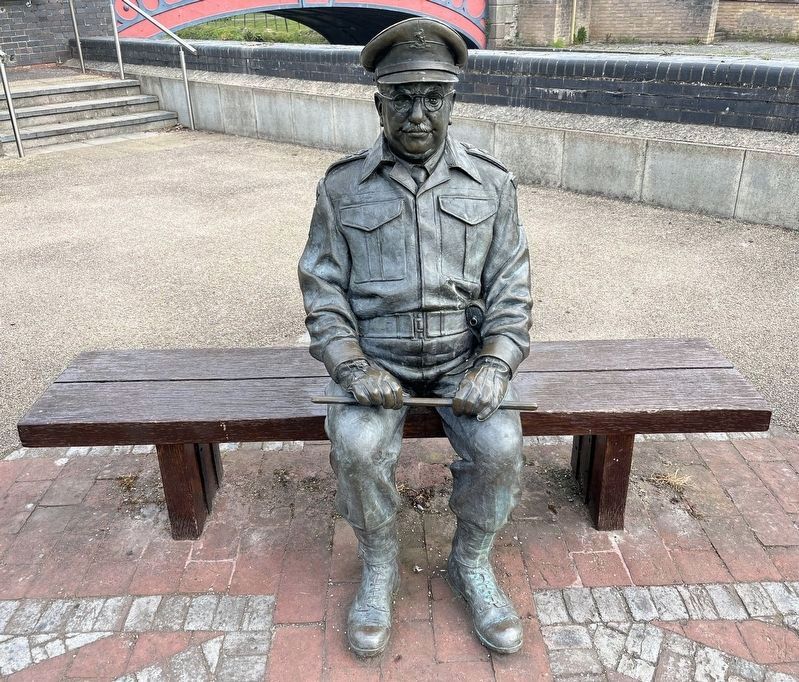
4. Dad's Army Statue
Life at Walmington-on-Sea
For the next nine years the Dad's Army cast and crew would make Thetford their home for weeks at a time. The main cast stayed at the Bell Hotel although the Anchor Hotel was also used for accommodation. The Bell reception area has a commemorative plaque and a selection of photographs from the series.
The villages surrounding Thetford were also used for various locations. However as Thetford is a land locked Walmington-on-Sea, the crew made a day trip to Great Yarmouth or Lowestoft if they ever needed the sea for a backdrop. Nearby Kilverstone doubled up as Waterloo in A Soldier's Farewell and Brandon Station became Walmington Station in the Big Parade.
Many well known names have appeared in the Dad's Army series including Nigel Hawthorne, Jeffrey Holland. Arthur English and Barbara Windsor. Also many local people have appeared in the series as extras. Some Thetford-made Burrell Traction Engines were used in the series and two of these are on display at the Bressingham Steam museum.
80 episodes were recorded for the television series, as well as various one off sketches and even a stage show.
Filming Locations
The Anchor Hotel, across the river from The Bell Hotel, was the setting for the first scene in the first ever episode, The Man and the Hour in 1968.
Round the corner from The Anchor in Old Bury Road the house called The Planes was the Free Polish Club in the 1975 episode The Face on the Poster.
The Newtown estate was the location for two episodes. The Lion has Phones and Museum Piece.
The opening titles of the first two series also showed the rear garden of number 59 Newtown (with St Mary of the Less clearly visible in the background) and the front window of number 60.
Mill Lane is the setting for the episode The Deadly Attachment. This episode contains the scene which was consistently voted one of the funniest scenes in British comedy, with the famous line "Don't tell him Pike!"
Nether Row in the town is probably the most instantly recognisable location and was used in four different episodes: The Armoured Might of Lance Corporal Jones, Man Hunt. The Big Parade and Time on My Hands.
The interior of the former Palace cinema was used for two episodes The Big Parade and A Soldier's Farewell.
Thetford's Guildhall became Walmington-on-Sea's Town Hall.
The Stanford Training Area was used intensively for filming and features at the end of all the later episodes where the closing credits show all the platoon with the familiar You have been watching" caption. Unfortunately this area is still used by the military and is not open to the public.
The Dad's Army Appreciation Society
The Dad's Army Appreciation Society was formed in 1993 by a small number of enthusiastic people who simply enjoyed the programme. There is a permanent museum display at the Bressingham Steam Museum, 15 miles east of Thetford on the A1066. The Society occasionally organises events for members and the general public.
For more information visit www.dadsarmy.co.uk
Topics. This historical marker is listed in these topic lists: Arts, Letters, Music • Entertainment • Patriots & Patriotism.
Location. 52° 24.855′ N, 0° 44.831′ E. Marker is in Thetford, England, in Norfolk. It is on King Street. Touch for map. Marker is at or near this postal address: 49 King Stret, Thetford, England IP24 1BN, United Kingdom. Touch for directions.

Regionally, this marker is in East Anglia. Globally, it is on the Atlantic Ocean, in the North Atlantic Region, in Europe, in Atlantic Europe, on one of the British Isles, in the Western World, and in the Anglosphere. Historically, it finds itself in what was once the Roman Empire.
Other nearby markers. At least 8 other markers are within walking distance of this marker: Ancient Capital of East Anglia (within shouting distance of this marker); St. Peter's Church (within shouting distance of this marker); Captain Mainwaring's Statue (about 90 meters away, measured in a direct line); Maharajah Duleep Singh (about 150 meters away); Thetford Priory (approx. 0.3 kilometers away); St. Mary the Less (approx. 0.3 kilometers away); The Refectory (approx. 0.4 kilometers away); Thetford Priory - The Church and Nave (approx. 0.4 kilometers away). Touch for a list and map of all markers in Thetford.
Credits. This page was last revised on October 24, 2026. It was originally submitted on October 21, 2026, by Ray Gurganus of Washington, District of Columbia. This page has been viewed 4 times since then. Photos: 1, 2, 3, 4. submitted on October 21, 2026, by Ray Gurganus of Washington, District of Columbia. • Andrew Ruppenstein was the editor who published this page.
Editor’s want-list for this marker. photo of the marker within its surroundings • Can you help?
