Downtown in Regina in Sherwood No. 159, Saskatchewan — The Prairie Region (North America)
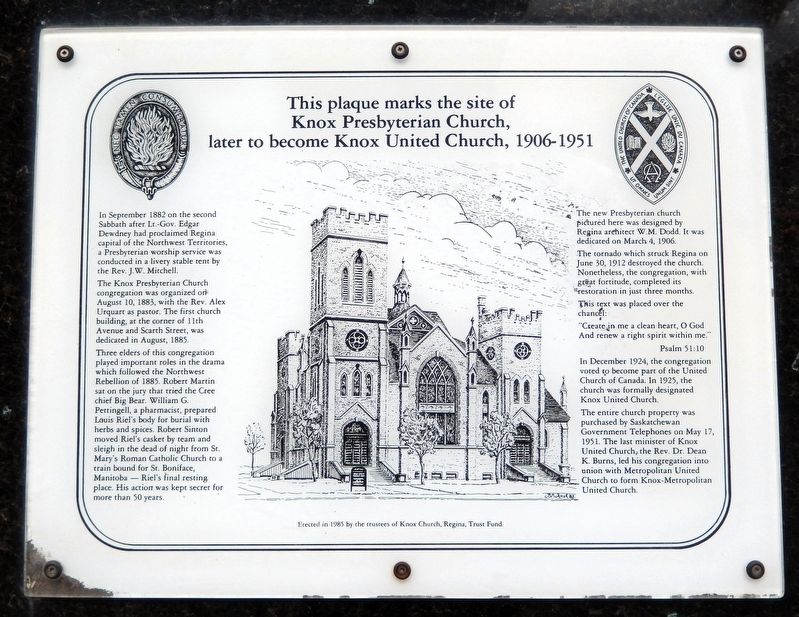
This plaque marks the site of Knox Presbyterian Church, later to become Knox United Church
1906 — 1951
Photographed by Cosmos Mariner, June 19, 2022
1. This plaque marks the site of Knox Presbyterian Church, later to become Knox United Church
In September 1882 on the second Sabbath after Lt.-Gov. Edgar Dewdney had proclaimed Regina capital of the Northwest Territories, a Presbyterian worship service was conducted in a livery stable tent by the Rev. J.W. Mitchell.
The Knox Presbyterian Church congregation was organized on August 10, 1883, with the Rev. Alex Urquart as pastor. The first church building, at the corner of 11th Avenue and Scarth Street, was dedicated in August, 1885.
Three elders of this congregation played important roles in the drama which followed the Northwest Rebellion of 1885. Robert Martin sat on the jury that tried the Cree chief Big Bear. William G. Pettingell, a pharmacist, prepared Louis Riel's body for burial with herbs and spices. Robert Sinton moved Riel's casket by team and sleigh in the dead of night from St. Mary's Roman Catholic Church to a train bound for St. Boniface, Manitoba — Riel's final resting place. His action was kept secret for more than 50 years.
The new Presbyterian church pictured here was designed by Regina architect W.M. Dodd. It was dedicated on March 4, 1906.
The tornado which struck Regina on June 30, 1912 destroyed
this page online
This text was placed over the chancel:
“Create in me a clean heart, O God
And renew a right spirit within me.”
Psalm 51:10
In December 1924, the congregation voted to become part of the United Church of Canada. In 1925, the church was formally designated Knox United Church.
The entire church property was purchased by Saskatchewan Government Telephones on May 17, 1951. The last minister of Knox United Church, the Rev. Dr. Dean K. Burns, led his congregation into union with Metropolitan United Church to form Knox-Metropolitan United Church.
Erected 1985 by The trustees of Knox Church, Regina, Trust Fund.
Topics. This historical marker is listed in these topic lists: Architecture • Disasters • Religion & Religious Structures • Settlements & Settlers. A significant historical date for this entry is March 4, 1906.
Location. 50° 26.937′ N, 104° 36.814′ W. Marker is in Regina, Saskatchewan, in Sherwood No. 159. It is in Downtown. It is at the intersection of Lorne Street and 12 Avenue, on the right when traveling north on
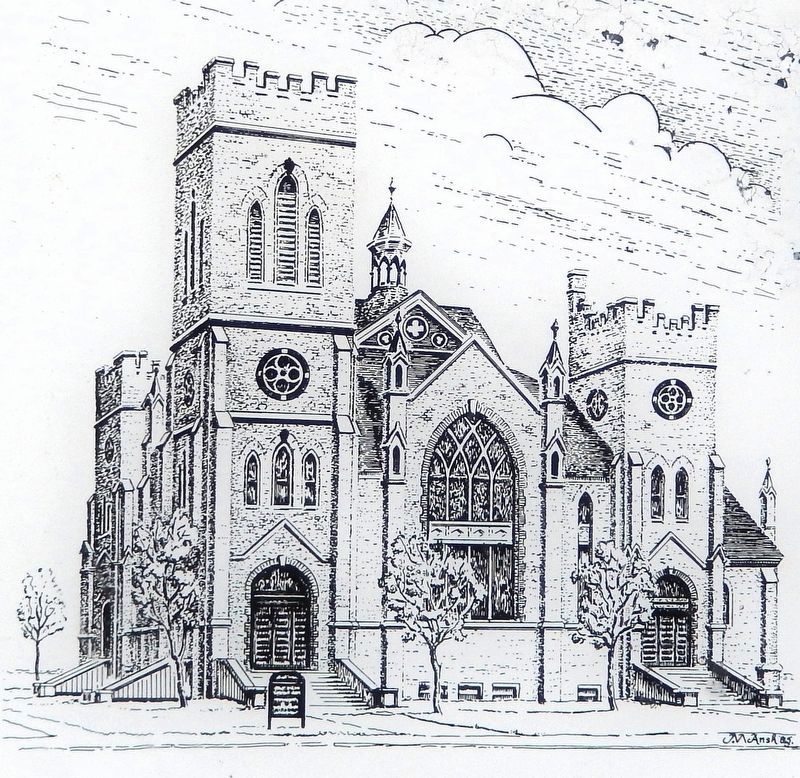
2. Marker detail: Knox Presbyterian Church

Regionally, this marker is in Southeast Saskatchewan. It is also in the Prairies. Globally, it is in North America, the Western Hemisphere, the Western World, and the Anglosphere. Historically, it finds itself in what was once a British colony and also Rupert’s Land.
Other nearby markers. At least 8 other markers are within walking distance of this marker: Saskatchewan Revenue Building (about 90 meters away, measured in a direct line); The Knox-Metropolitan United Church (about 150 meters away); Glockenspiel (about 180 meters away); Creation of the Province of Saskatchewan (about 180 meters away); Hon. Walter Scott (about 180 meters away); St Paul's Anglican Cathedral (about 180 meters away); Frederick W. Hill Mall (about 210 meters away); Regina Land Titles Building (about 210 meters away). Touch for a list and map of all markers in Regina.
Related markers. Click here for a list of markers
Photographed by Cosmos Mariner, June 19, 2022
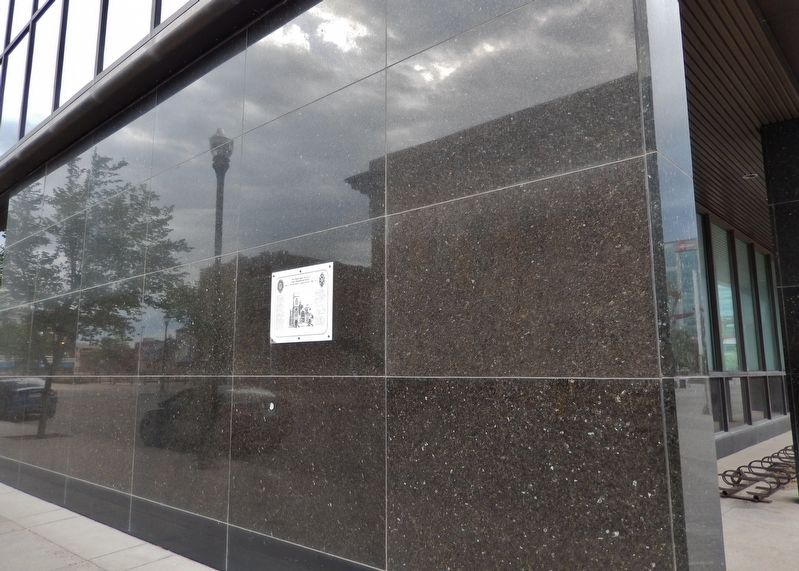
3. This plaque marks the site of Knox Presbyterian Church, later to become Knox United Church
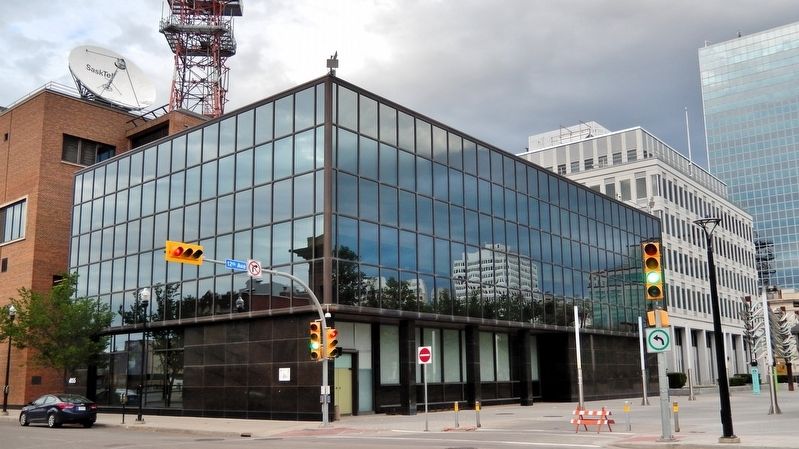
The marker is mounted at eye level near the southwest corner of the SaskTel office building at this location today, facing Lorne Street.
Also see . . .
1. Knox-Metropolitan United Church (Wikipedia).
Excerpt: Both Knox Presbyterian and Metropolitan Methodist’s buildings were destroyed by the Regina Cyclone of 1912. The congregational website in 2012 mentioned it, “We have a lot of history behind us at the corner of Victoria Avenue and Lorne Street in Regina. Our building was once knocked down by the tornado of 1912, but we got back up again.” Both church buildings were soon rebuilt before the economic demands of the First World War, which erupted in 1914 and which Canada immediately joined.(Submitted on October 21, 2026, by Cosmos Mariner of Cape Canaveral, Florida.)
The congregations of the two churches, having become United Church of Canada in 1925, were merged in 1951 and the Knox building was demolished, the merged congregation thereafter generally referred to as Knox-Met and occupying the Metropolitan building.
2. Regina Cyclone of 1912 (Wikipedia).
Excerpt: On Sunday, June 30, 1912, a violent and deadly tornado devastated the city of Regina, Saskatchewan, Canada. The tornado, also known as the(Submitted on October 21, 2026, by Cosmos Mariner of Cape Canaveral, Florida.)Regina Cyclone or the Regina tornado of 1912, remains the deadliest tornado in Canadian history with a total of 28 fatalities and about 300 people injured. At about 4:50 p.m., green funnel clouds formed and touched down south of the city, tearing through the residential area between Wascana Lake and Victoria Avenue, and continuing through the downtown business district, rail yards, warehouse district, and northern residential area.Photographed by Cosmos Mariner, June 19, 20224. SakTel International building (southwest elevation)The marker is visible near the southwest corner of the SaskTel International building at this location today.
The tornado formed 18 km south of the city and was roughly 150 metres wide by the time it reached Regina. The tornado's wind velocity has been estimated at 250 mph, making it the equivalent of a high-end F4 on the Fujita Scale. It left 2,500 people homeless, out of a population of about 30,213 (in 1911). Around 500 buildings were destroyed or damaged. Property damage was quantified at $1.2 million CAD, and it would be forty years before the $4.5 million CAD private and public debt incurred to rebuild and repair was repaid.
Credits. This page was last revised on October 21, 2026. It was originally submitted on October 21, 2026, by Cosmos Mariner of Cape Canaveral, Florida. This page has been viewed 5 times since then. Photos: 1, 2, 3, 4. submitted on October 21, 2026, by Cosmos Mariner of Cape Canaveral, Florida.
