Liverpool Waterfront in Merseyside, England, United Kingdom — Northwestern Europe (the British Isles)
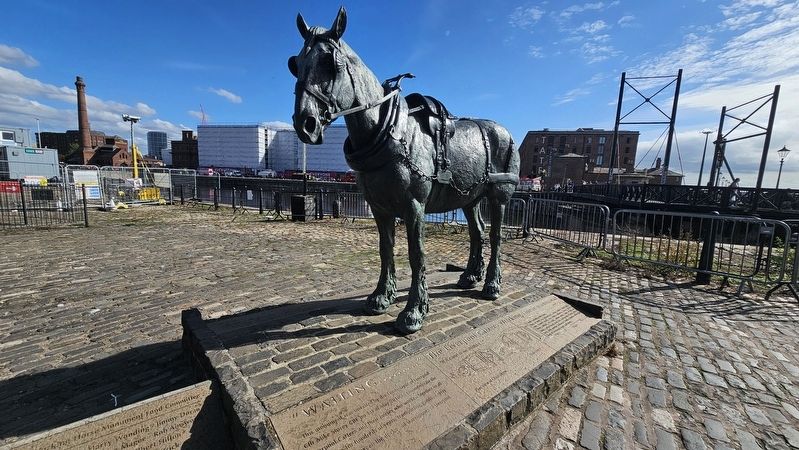
The Liverpool Carters Working Horse Monument
Photographed by Ian Lefkowitz, September 13, 2026
1. The Liverpool Carters Working Horse Monument Marker
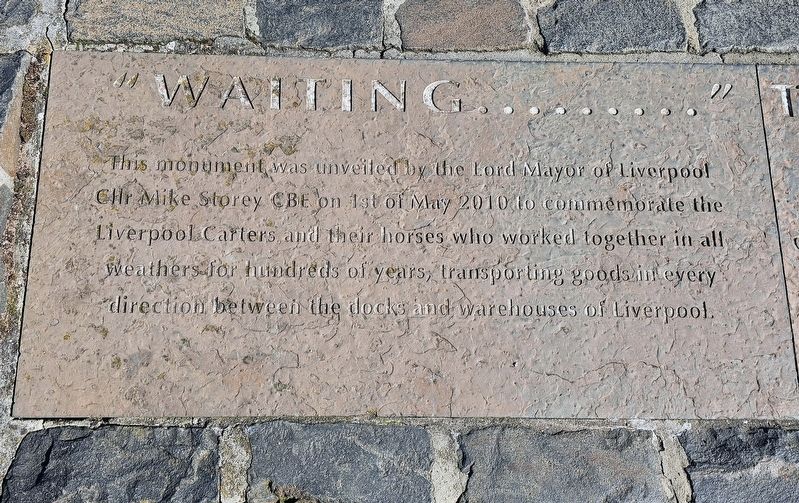
“Waiting………” The Liverpool Carters Working Horse Monument
This monument was unveiled by the Lord Mayor of Liverpool Cllr Mike Storey CBE on 1st of May 2010 to commemorate the Liverpool Carters and their horses who worked together in all weathers for hundreds of years, transporting goods in every direction between the docks and warehouses of Liverpool.
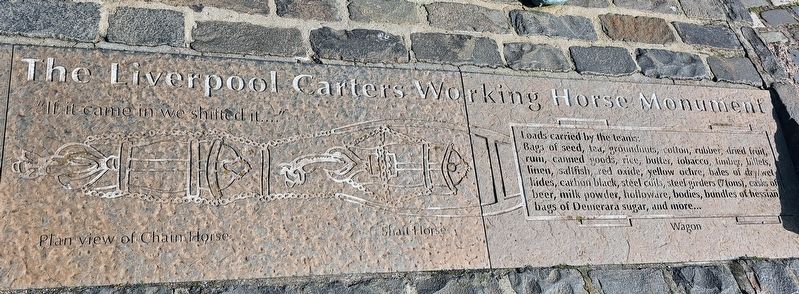
“If it came in we shifted it…”
Plan view of Chain Horse — Shaft Horse — Wagon
Loads carried by the teams:
Bags of seed, tea, groundnuts, cotton, rubber, dried fruit, rum, canned goods, rice, butter, tobacco, timber, billets, linen, saltfish, red oxide, yellow ochre, bales of dry/wet hides, carbon black, steel coils, steel girders (7 tons), casks of beer, milk powder, holloware, bodies, bundles of hessian, bags of Demerara sugar, and more…
(reverse side)
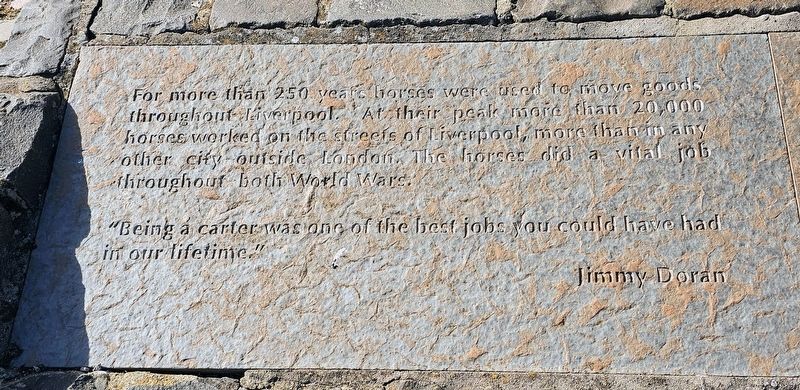
For more than 250 years horses were used to move goods throughout Liverpool. At their peak more than 20,000 horses worked on the streets of Liverpool, more than in any other city outside London. The horses did a vital job throughout both World Wars.
“Being a carter was one of the best jobs you could have had in our lifetime.”
Jimmy
this page online
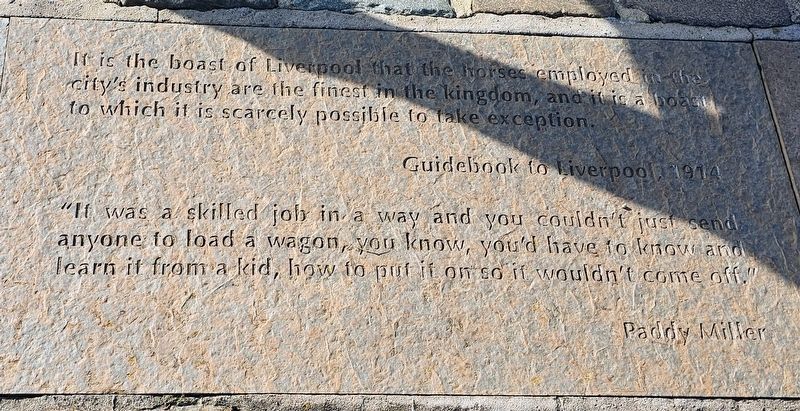
It is the boast of Liverpool that the horses employed in the city’s industry are the finest in the kingdom, and it is a boast to which it is scarcely possible to take exception.
Guidebook to Liverpool, 1914
“It was a skilled job in a way and you couldn’t just send anyone to load a wagon, you know, you’d have to know and learn it from a kid, how to put it on so it wouldn’t come off.”
Paddy Miller
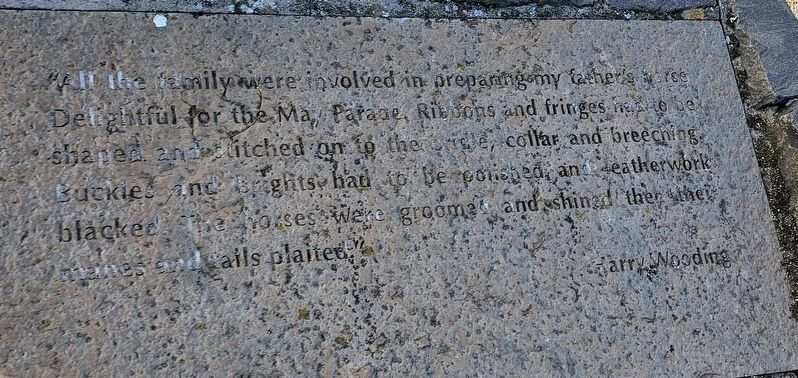
“All the family were involved in preparing my father’s horse Delightful for the May Parade. Ribbons and fringes had to be shaped and stitched on to the bridle, collar and breeching. Buckles and brights had to be polished, and leatherwork blacked. The horses were groomed and shined, then their manes and tails plaited.”
Harry Wooding
(next to monument)
This monument has been funded through generous public donations and with special thanks to:
Liverpool City Council • The Lord Mayor of Liverpool 2009–2010, Cllr Mike Storey CBE • Lord Vestey KCVO DL • Charles and WH Taylor Ltd • Lynette Fairclough Beardwood • Billy Murphy • Young’s Brewery • The Duke of Westminster KG CB OBE TD CD DL • The Lord Mayor of Liverpool 2008–2009, Cllr Steve Rotherham
Photographed by Ian Lefkowitz, September 13, 2026
2. (Panel 1)
Liverpool Carters Working Horse Monument Fund Committee
Joe Hartley • Ethel Wooding • Harry Wooding • Jimmy Doran • Bobby Sargeant • Norman Taylor • Joe Magee • Rob Ainsworth • Sharon Brown • Albert Sargeant • Albert Hilton • Paddy Miller • Jimmy Smith • Billy Fitzpatrick
“Waiting..”
The Shaft Horse, sculpted by
Judy Boyt MA, FRBS, SEA. Castle Fine Art Foundry Ltd.
Erected 2010 by Liverpool Retired Carters Association.
Topics. This historical marker and monument is listed in these topic lists: Animals • Industry & Commerce.
Location. 53° 24.126′ N, 2° 59.693′ W. Marker is in Liverpool, England, in Merseyside. It is in Liverpool Waterfront. It is on Mann Island north of King's Parade, on the right when traveling south. Touch for map. Marker is at or near this postal address: 25a Mann Island, Liverpool, England L3 1BP, United Kingdom. Touch for directions.

Regionally, this marker and monument is in North West England. Globally, it is on
Photographed by Ian Lefkowitz, September 13, 2026
3. (Panel 1)
Other nearby markers. At least 8 other markers are within walking distance of this marker: Waiting (here, next to this marker); Lusitania Propeller, 1909 (a few steps from this marker); Liverpool Pilot Office (within shouting distance of this marker); Billy Fury (within shouting distance of this marker); The Beatles (approx. 0.3 kilometers away); The Oceanic Navigation Steam Company (approx. 0.3 kilometers away); Albion House (approx. 0.3 kilometers away); Albert Dock (approx. 0.4 kilometers away). Touch for a list and map of all markers in Liverpool.
Another marker is no longer nearby. Sculpture of Billy Fury (1940–1983) (was within shouting distance of this marker but has been confirmed missing).
Photographed by Ian Lefkowitz, September 13, 2026
4. (Panel 2)
Photographed by Ian Lefkowitz, September 13, 2026
5. (Panel 3)
Photographed by Ian Lefkowitz, September 13, 2026
6. (Panel 4)
Credits. This page was last revised on October 23, 2026. It was originally submitted on October 21, 2026, by Ian Lefkowitz of New York, New York. This page has been viewed 7 times since then. Photos: 1, 2, 3, 4, 5, 6. submitted on October 21, 2026, by Ian Lefkowitz of New York, New York. • Andrew Ruppenstein was the editor who published this page.
