Fort Scott in Bourbon County, Kansas — The American Midwest (Upper Plains)
True Renaissance Man
Gordon Parks (1912-2006)
| — | Lowell Milken Center for Unsung Heroes | — |
Photographed by Jason Voigt, September 21, 2026
1. True Renaissance Man Marker
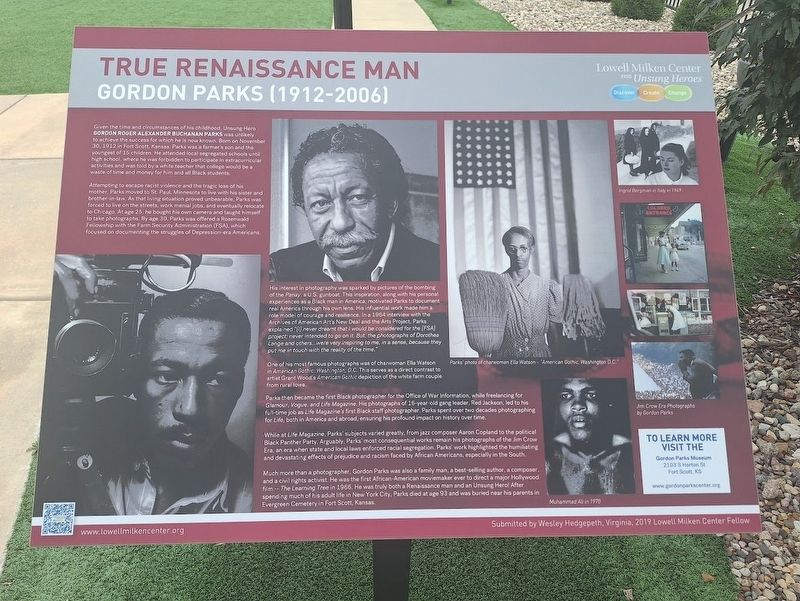
Given the time and circumstances of his childhood, Unsung Hero Gordon Roger Alexander Buchanan Parks was unlikely to achieve the success for which he is now known. Born on November 30, 1912 in Fort Scott, Kansas. Parks was a farmer's son and the youngest of 15 children. He attended local segregated schools until high school, where he was forbidden to participate in extracurricular activities and was told by a white teacher that college would be a waste of time and money for him and all Black students.
Attempting to escape racist violence and the tragic loss of his mother, Parks moved to St. Paul, Minnesota to live with his sister and brother-in-law. As that living situation proved unbearable, Parks was forced to live on the streets, work menial jobs, and eventually relocate to Chicago. At age 25, he bought his own camera and taught himself to take photographs. By age 30, Parks was offered a Rosenwald Fellowship with the Farm Security Administration (FSA), which focused on documenting the struggles of Depression-era Americans.
His interest in photography was sparked by pictures of the bombing of the Panay, a U.S.
this page online
One of his most famous photographs was of chairwoman Ella Watson in American Gothic: Washington, D.C. This serves as a direct contrast to artist Grant Wood's American Gothic depiction of the white farm couple from rural Iowa.
Parks then became the first Black photographer for the Office of War Information, while freelancing for Glamour, Vogue, and Life Magazine. His photographs of 16-year-old gang leader, Red Jackson, led to his full-time job as Life Magazine's first Black staff photographer. Parks spent over two decades photographing for Life, both in America and abroad,
Photographed by Jason Voigt, September 21, 2026
2. True Renaissance Man Marker
While at Life Magazine, Parks' subjects varied greatly, from jazz composer Aaron Copland to the political Black Panther Party. Arguably, Parks' most consequential works remain his photographs of the Jim Crow Era, an era when state and local laws enforced racial segregation. Parks' work highlighted the humiliating and devastating effects of prejudice and racism faced by African Americans, especially in the South.
Much more than a photographer, Gordon Parks was also a family man, a best-selling author, a composer, and a civil rights activist. He was the first African-American moviemaker ever to direct a major Hollywood film -- The Learning Tree in 1966. He was truly both a Renaissance man and an Unsung Hero! After spending much of his adult life in New York City, Parks died at age 93 and was buried near his parents in Evergreen Cemetery in Fort Scott, Kansas.
Erected by Lowell Milken Center for Unsung Heroes.
Topics. This historical marker is listed in these topic lists: African Americans • Arts, Letters, Music • Entertainment. A significant historical date for this entry is November 30, 1912.
Location. 37° 50.496′ N,
Photographed by Jason Voigt, September 21, 2026
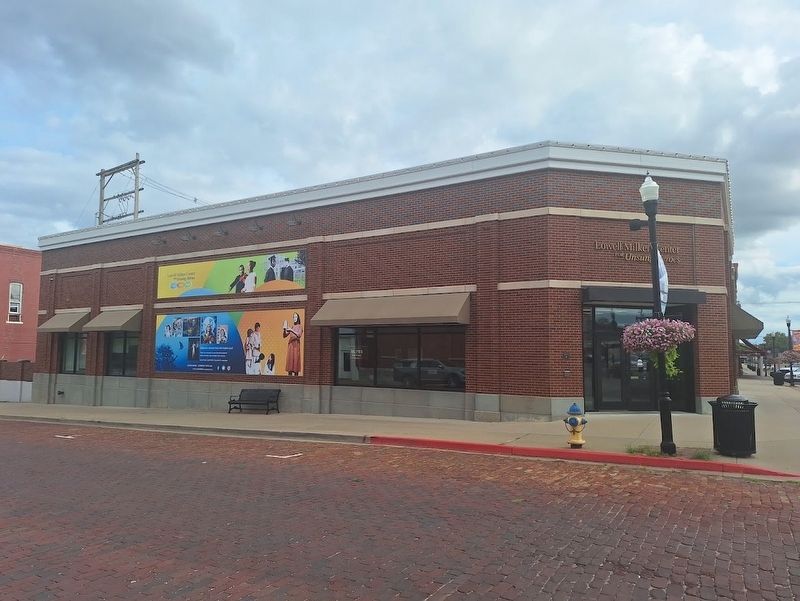
3. Lowell Milken Center for Unsung Heroes

Regionally, this marker is in Eastern Kansas and specifically in Bleeding Kansas Border War Country. It is also in the American Midwest, in the Corn Belt, on the prairies, and on the Southern Plains. Globally, it is in North America, the Western Hemisphere, the Western World, and the Anglosphere. Historically, it finds itself in what was once the Louisiana Purchase.
Other nearby markers. At least 8 other markers are within walking distance of this marker: Ashes on the Moon (here, next to this marker); Measuring the Sky (a few steps from this marker); The Father of Modern Education (a few steps from this marker); The Stout Building (a few steps from this marker); Jurassic Mary (a few steps from this marker); The Man Who Saved a Billion Lives (a few steps from this marker); WWII Navajo Code Talker (within shouting distance of this marker); The Unbreakable Code (within shouting distance of this marker). Touch for a list and map of all markers in Fort Scott.
Also see . . .
1. Gordon Parks on Wikipedia. (Submitted on October 21, 2026, by Jason Voigt of Glen Carbon, Illinois.)
2. Lowell Milken Center for Unsung Heroes (official website). (Submitted on October 21, 2026, by Jason Voigt of Glen Carbon, Illinois.)
Credits. This page was last revised on October 21, 2026. It was originally submitted on October 21, 2026, by Jason Voigt of Glen Carbon, Illinois. This page has been viewed 2 times since then. Photos: 1, 2, 3. submitted on October 21, 2026, by Jason Voigt of Glen Carbon, Illinois.
