Mitte in Hannover in Region Hannover, Lower Saxony, Germany — Central Europe
Geschichte des Ballhofs
⎯⎯⎯
History of the Ballhof
Photographed by James Hulse, October 7, 2026
1. Geschichte des Ballhofs / History of the Ballhof Marker

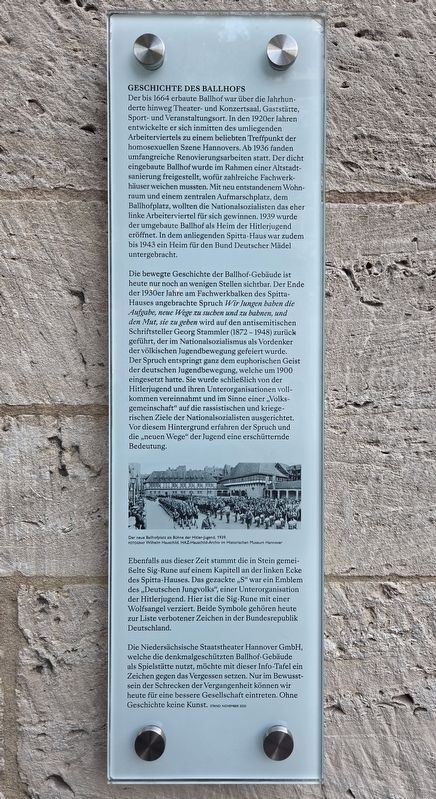
Der bis 1664 erbaute Ballhof war über die Jahrhunderte hinweg Theater- und Konzertsaal, Gaststätte, Sport- und Veranstaltungsort. In den 1920er Jahren entwickelte er sich inmitten des umliegenden Arbeiterviertels zu einem beliebten Treffpunkt der homosexuellen Szene Hannovers. Ab 1936 fanden umfangreiche Renovierungsarbeiten statt. Der dicht eingebaute Ballhof wurde im Rahmen einer Altstadtsanierung freigestellt, wofür zahlreiche Fachwerkhäuser weichen mussten. Mit neu entstandenem Wohnraum und einem zentralen Aufmarschplatz, dem Ballhofplatz, wollten die Nationalsozialisten das eher linke Arbeiterviertel für sich gewinnen. 1939 wurde der umgebaute Ballhof als Heim der Hitlerjugend eröffnet. In dem anliegenden Spitta-Haus war zudem bis 1943 ein Heim für den Bund Deutscher Mädel untergebracht.
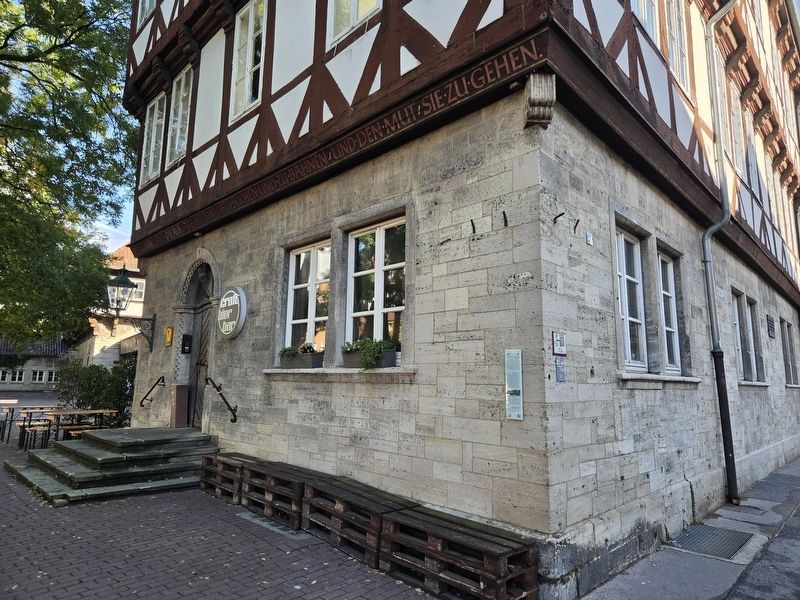
Die bewegte Geschichte der Ballhof-Gebäude ist heute nur noch an wenigen Stellen sichtbar. Der Ende der 1930er Jahre am Fachwerkbalken des Spitta-Hauses angebrachte Spruch Wir Jungen haben die Aufgabe, neue Wege zu suchen und zu bahnen, und den Mut, sie zu gehen wird auf den antisemitischen Schriftsteller Georg Stammler (1872–1948) zurückgeführt, der im Nationalsozialismus als Vordenker der völkischen Jugendbewegung gefeiert wurde. Der Spruch entspringt ganz dem euphorischen Geist der deutschen Jugendbewegung, welche um 1900 eingesetzt hatte. Sie wurde schließlich von der Hitlerjugend und ihren Unterorganisationen vollkommen vereinnahmt und im Sinne einer „Volksgemeinschaft“ auf die rassistischen und kriegerischen Ziele der Nationalsozialisten ausgerichtet. Vor diesem Hintergrund erfahren der Spruch und die „neuen Wege“ der Jugend eine erschütternde Bedeutung.
Der neue Ballhofplatz als Bühne der Hitler-Jugend, 1939.
Fotograf Wilhelm Hauschild. HAZ-Hauschild-Archiv im Historischen Museum Hannover
Ebenfalls
this page online
Die Niedersächsische Staatstheater Hannover GmbH, welche die denkmalgeschützten Ballhof-Gebäude als Spielstätte nutzt, möchte mit dieser Info-Tafel ein Zeichen gegen das Vergessen setzen. Nur im Bewusstsein der Schrecken der Vergangenheit können wir heute für eine bessere Gesellschaft eintreten. Ohne Geschichte keine Kunst.
History of the Ballhof
Completed by 1664, the Ballhof served over the centuries as a theater and concert hall, restaurant, sports facility and event venue. During the 1920s, it became a popular meeting place for Hannover’s homosexual community amid the surrounding working-class neighborhood. Extensive renovation began in 1936. As part of Old Town redevelopment, numerous half-timbered houses were demolished to open up the densely built-up
Photographed by James Hulse, October 8, 2026
2. Geschichte des Ballhofs / History of the Ballhof Marker
Today, only a few visible traces remain of the Ballhof buildings’ turbulent history. The saying We young people have the task of seeking and opening up new paths, and the courage to follow them, placed on a timber beam of the Spitta House in the late 1930s, is attributed to the antisemitic writer Georg Stammler (1872–1948). Under National Socialism, he was celebrated as an intellectual pioneer of the ethnic-nationalist youth movement. The saying fully reflects the euphoric spirit of the German youth movement that began around 1900. This movement was eventually absorbed by the Hitler Youth and its affiliated organizations and directed toward the National Socialists’ racist and militaristic goals in the name of a “national community.” Against this background, the saying and the “new paths”
Photographed by James Hulse, October 7, 2026
3. Geschichte des Ballhofs / History of the Ballhof Marker
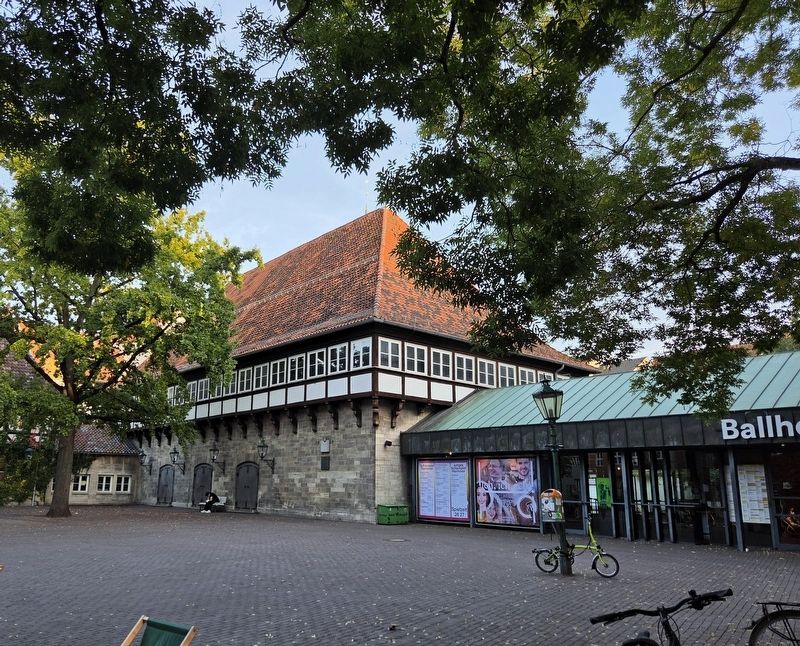
A view of the Ballhofs Platz
The new Ballhofplatz as a stage for the Hitler Youth, 1939.
Photographer: Wilhelm Hauschild. HAZ-Hauschild Archive at the Hannover Historical Museum
The Sig rune carved into a stone capital at the left corner of the Spitta House also dates from this period. The jagged “S” was an emblem of the “Deutsches Jungvolk,” a subdivision of the Hitler Youth. Here, the Sig rune is decorated with a Wolfsangel symbol. Both symbols are now included among the prohibited symbols in the Federal Republic of Germany.
Niedersächsische Staatstheater Hannover GmbH, which uses the protected Ballhof buildings as performance venues, intends this information panel as a statement against forgetting. Only by remaining aware of the horrors of the past can we work toward a better society today. Without history, there is no art.
Erected 2020 by Niedersächsische Staatstheater Hannover GmbH.
Topics. This historical marker is listed in these topic lists: Arts, Letters, Music • Entertainment • Sports • War, World II. A significant historical year for this entry is 1664.
Location. 52° 22.337′ N, 9° 43.936′ E. Marker is in Hannover, Niedersachsen (Lower Saxony), in Region Hannover. It is in Mitte. It is at the intersection of Burgstraße and Ballhofpl., on the right when traveling north on Burgstraße. Touch for map. Marker is at or near this postal address: Burgstraße 23, Hannover NI 30159, Germany. Touch for directions.

Regionally, it is in Europe, the European Union, Atlantic Europe, Central Europe, the Schengen Area, Western Europe, and the Western World. Historically, it finds itself in what was once the Holy Roman Empire and also the former West Germany.
Other nearby markers. At least 8 other markers are within walking distance of this marker: Karl Johann Philipp Spitta (a few steps from this marker); Fachwerkhäuser der Altstadt / Half-timbered houses in the old town (a few steps from this marker); Hier lebte Herschel Grünspan (within shouting distance of this marker); Ballhof (within shouting distance of this marker); Verband der Fabrikarbeiter Deutschlands / Association of Factory Workers of Germany (within shouting distance of this marker); Ballhofplatz / Ballhof Square (within shouting distance of this marker); Tor des Marstalls (within shouting distance of this marker); Historisches Museum am Hohen Ufer / Historical Museum on the Hohe Ufer (within shouting distance of this marker). Touch for a list and map of all markers in Hannover.
Credits. This page was last revised on October 27, 2026. It was originally submitted on October 26, 2026, by James Hulse of Medina, Texas. This page has been viewed 6 times since then. Photos: 1, 2, 3. submitted on October 27, 2026, by James Hulse of Medina, Texas.
