Ernzen in Eifelkreis Bitburg-Prüm, Rhineland-Palatinate, Germany — Central Europe
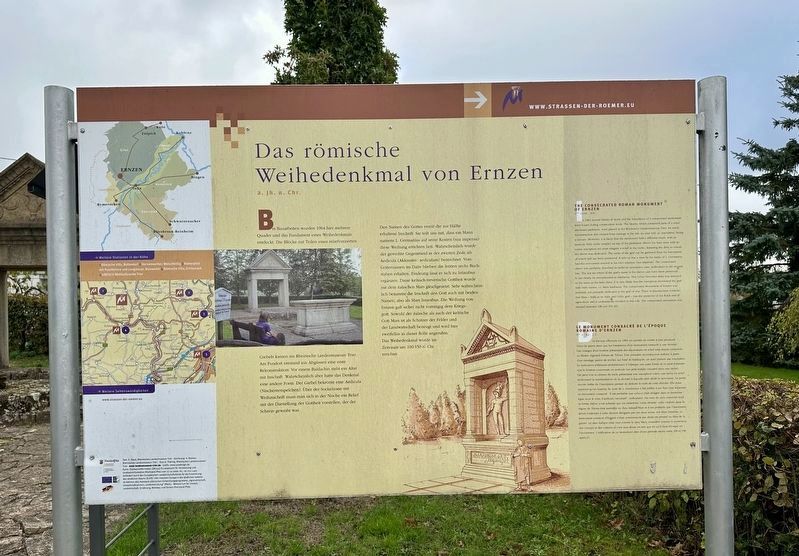
Das römische Weihedenkmal von Ernzen
⎯⎯⎯
The Consecrated Roman Monument of Ernzen
Le Monument Consacré de l'Époque Romaine d'Ernzen
Photographed by Andrew Ruppenstein, October 22, 2026
1. Das römische Weihedenkmal von Ernzen / The Consecrated Roman Monument of Ernzen Marker

2. Jh. n. Chr.
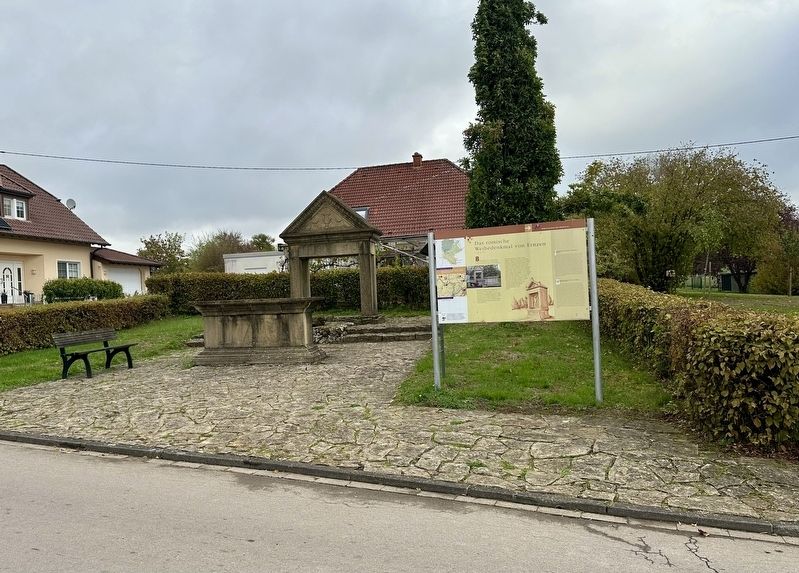
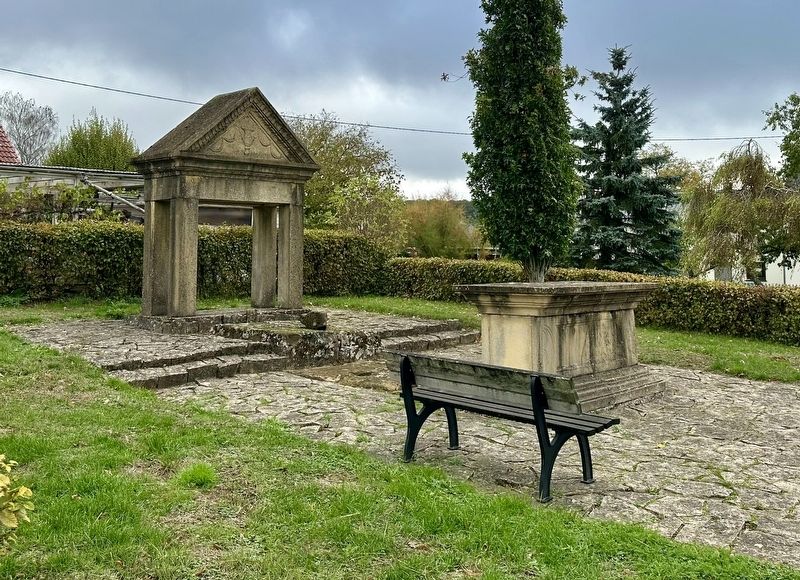
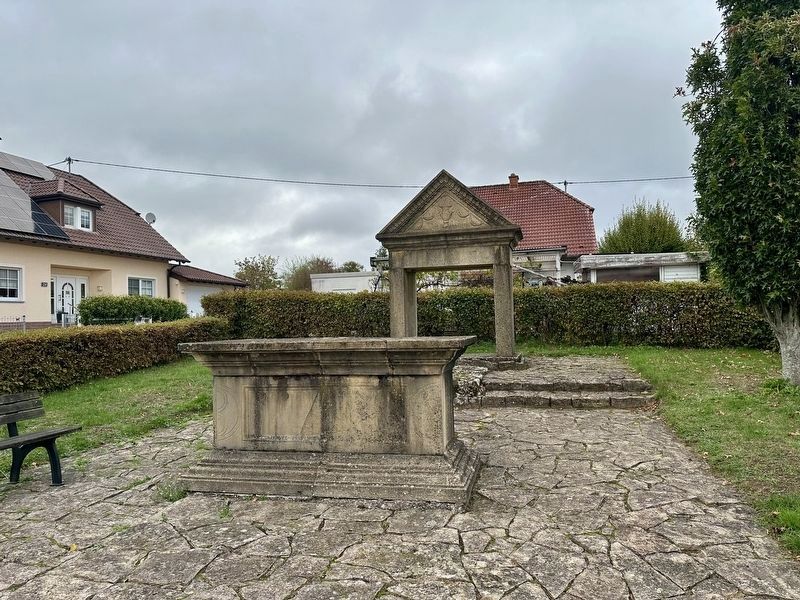
Bei Bauarbeiten wurden 1964 hier mehrere Quader und das Fundament eines Weihedenkmals entdeckt. Die Blöcke mit Teilen eines reliefverzierten Giebels kamen ins Rheinische Landesmuseum Trier. Am Fundort entstand aus Abgüssen eine erste Rekonstruktion: Vor einem Baldachin steht ein Altar mit Inschrift. Wahrscheinlich aber hatte das Denkmal eine andere Form: Der Giebel bekrönte eine Aedicula (Nischentempelchen). Über der Sockelzone mit Weihinschrift muss man sich in der Nische ein Relief. mit der Darstellung der Gottheit vorstellen, der der Schrein geweiht war.
Den Namen des Gottes verrät die zur Hälfte erhaltene Inschrift. Sie teilt uns mit, dass ein Mann namens L. Germanius auf seine Kosten (sua impensa) diese Weihung errichten ließ. Wahrscheinlich wurde der geweihte Gegenstand in der zweiten Zeile als Aedicula (Akkusativ: aediculam) bezeichnet. Vom Götternamen im Dativ blieben die letzten sechs Buch- staben erhalten. Eindeutig lässt er sich zu Intarabus ergänzen. Diese keltisch-treverische Gottheit wurde mit dem italischen Mars gleichgesetzt.
this page online
2nd cent. AD
In 1964 several blocks of stone and the foundation of a consecrated monument were found during construction work. The blocks, which contained parts of a relief-decorated pediment, were placed in the Rheinische Landesmuseum Trier. An initial reconstruction was created from castings at the site: an altar with an inscription, facing a canopy. However, it is likely that the monument had a different shape, with an aedicula (little niche temple) on top of the pediment. Above the base zone with its votive inscription we must imagine a relief in the niche, depicting the deity to whom the shrine was dedicated. The name of the god can be gathered from the inscription, of which half has been
Photographed by Andrew Ruppenstein, October 22, 2026
2. Das römische Weihedenkmal / The Consecrated Monument Marker
11 s. ap. J.C.
Ces travaux effectués en 1964 ont permis de mettre à jour plusieurs blocs de pierre ainsi que les fondations d'un monument consacré à une divinité. Ces vestiges d'un fronton présentant des décorations en relief sont depuis conservés au Musée
Photographed by Andrew Ruppenstein, October 22, 2026
3. Das römische Weihedenkmal / The Consecrated Monument / Le Monument Consacré
Photographed by Andrew Ruppenstein, October 22, 2026
4. Das römische Weihedenkmal / The Consecrated Monument / Le Monument Consacré
Topics. This historical marker is listed in this topic list: Religion & Religious Structures. A significant historical year for this entry is 1964.
Location. 49° 50.6′ N, 6° 25.418′ E. Marker is in Ernzen, Rheinland-Pfalz (Rhineland-Palatinate), in Eifelkreis Bitburg-Prüm. It is on Messeweg, on the right when traveling north. Touch for map. Marker is at or near this postal address: Messeweg 24, Ernzen RP 54668, Germany. Touch for directions.

Regionally, this marker is in the German Rhineland and in the Eifel. Globally, it is in Europe, the European Union, Atlantic Europe, Central Europe, the Schengen Area, Western Europe, and the Western World. Historically, it finds itself in what was once the Roman Empire, the Holy Roman Empire, and the former West Germany.
Other nearby markers. At least 8 other markers are within 10 kilometers of this marker, measured as the crow flies: First Electric Lighting (approx. 3.3 kilometers away in Luxembourg); Victor Hugo (approx. 3.4 kilometers away in Luxembourg); Neckel Welschbillig (approx. 3.6 kilometers away in Luxembourg); Chapelle Notre-Dame / Muttergotteskappelle / Chapel of Notre Dame (approx. 3.9 kilometers away in Luxembourg); Hill 313 Memorial (approx. 6 kilometers away in Luxembourg); Raymond Petit (approx. 6 kilometers away in Luxembourg); 10th US Armored Division Memorial (approx. 6.8 kilometers away in Luxembourg); “CHARLY” Narrow-Gauge Railway (1904-1954) (approx. 9.8 kilometers away in Luxembourg).
Also see . . . Straßen der Römer (in German). Website devoted to Roman-related sites in the region (Submitted on October 28, 2026.)
Credits. This page was last revised on October 28, 2026. It was originally submitted on October 28, 2026, by Andrew Ruppenstein of Lamorinda, California. This page has been viewed 3 times since then. Photos: 1, 2, 3, 4. submitted on October 28, 2026, by Andrew Ruppenstein of Lamorinda, California.
