Grace in Asheville in Buncombe County, North Carolina — The American South (South Atlantic)
Joseph Lane
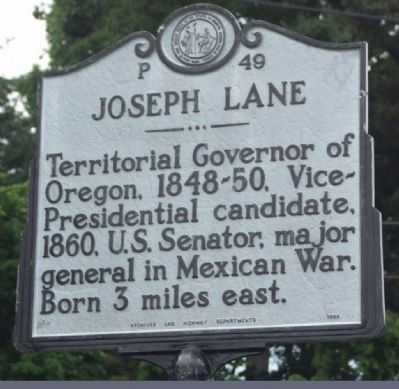
Photographed by Mike Stroud, 2010
1. Joseph Lane Marker
Erected 1959 by Archives and Highways Departments. (Marker Number P-49.)
Topics and series. This historical marker is listed in this topic list: War, Mexican-American. In addition, it is included in the North Carolina Division of Archives and History series list. A significant historical year for this entry is 1860.
Location. 35° 37.758′ N, 82° 33.154′ W. Marker is in Asheville, North Carolina, in Buncombe County. It is in Grace. It is at the intersection of Merrimon Avenue (U.S. 25) and Beaverdam Road (North Carolina Highway 2230), on the right when traveling north on Merrimon Avenue. Touch for map. Marker is in this post office area: Asheville NC 28804, United States of America. Touch for directions.

Regionally, this marker is in North Carolina’s Mountains. It is also in the American South, specifically in the Upper South, in Appalachia, and specifically in Southern Appalachia. Globally, it is in North America, the Western Hemisphere, the Western World, and the
this page online
Other nearby markers. At least 8 other markers are within 2 miles of this marker, measured as the crow flies: Francis Asbury (a few steps from this marker); David L. Swain (within shouting distance of this marker); Saint Mary's Parish - 1914 (approx. 1.3 miles away); The University of North Carolina at Asheville (approx. 1.4 miles away); Battle of Asheville (approx. 1½ miles away); Buncombe Turnpike (approx. 1½ miles away); a different marker also named Battle of Asheville (approx. 1½ miles away); Zelda Fitzgerald (approx. 1½ miles away). Touch for a list and map of all markers in Asheville.
Regarding Joseph Lane. In 1860, Lane was named vice-presidential candidate for the Democratic ticket headed by John C. Breckenridge. After an unsuccessful campaign, Lane returned to North Carolina for the first time since childhood, visiting his father’s birthplace near Raleigh and the Joel Lane
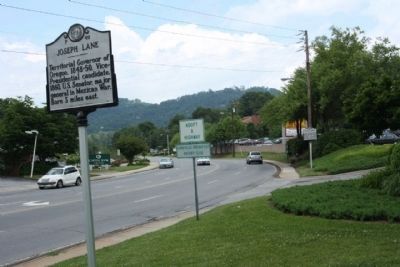
Photographed by Mike Stroud, May 22, 2010
2. Joseph Lane Marker, looking north along US 25, Merrimon Avenue
Also see . . . Joseph Lane from Wikipedia. He was appointed by President James Polk to be governor of Oregon Territory in 1848. 1860 alongside Presidential candidate John C. Breckinridge, the most ardently pro-slavery candidate in the election. ... With his defeat as Vice President and the beginning of the Civil War, Lane's pro-slavery and pro-secessionist sympathies effectively ended his political career.... (Submitted on June 5, 2010, by Mike Stroud of Bluffton, South Carolina.)
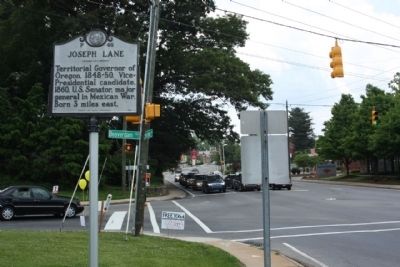
Photographed by Mike Stroud, May 22, 2010
3. Joseph Lane Marker at intersection Merrimon Avenue and Beaverdam Road
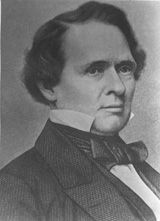
North Carolina Office of Archives & History — Department of Cultural Resources
4. Joseph Lane
Credits. This page was last revised on June 1, 2025. It was originally submitted on June 5, 2010, by Mike Stroud of Bluffton, South Carolina. This page has been viewed 1,168 times since then and 18 times this year. Photos: 1, 2, 3, 4. submitted on June 5, 2010, by Mike Stroud of Bluffton, South Carolina.
