Chorlton-on-Medlock in Manchester in Greater Manchester, England, United Kingdom — Northwestern Europe (the British Isles)
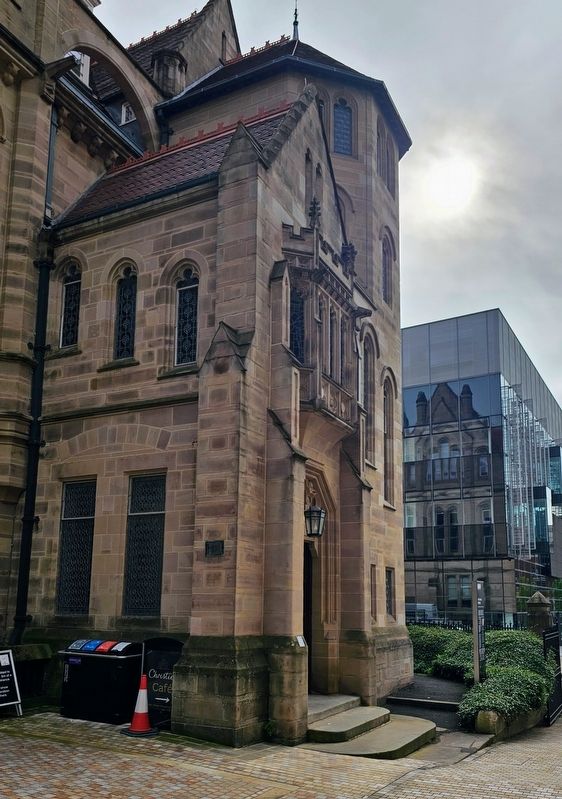
The Christie Building
Photographed by Ian Lefkowitz, September 14, 2026
1. The Christie Building Marker
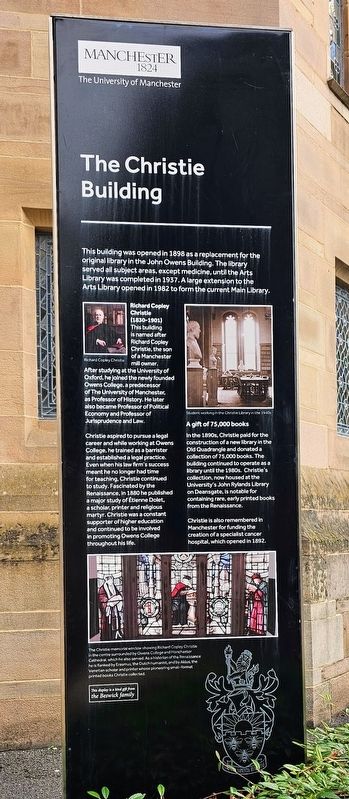
Richard Copley Christie (1830–1901)
This building is named after Richard Copley Christie, the son of a Manchester mill owner. After studying at the University of Oxford, he joined the newly founded Owens College, a predecessor of The University of Manchester, as Professor of History. He later also became Professor of Political Economy and Professor of Jurisprudence and Law.
Christie aspired to pursue a legal career and while working at Owens College, he trained as a barrister and established a legal practice. Even when his law firm’s success meant he no longer had time for teaching, Christie continued to study. Fascinated by the Renaissance, in 1880 he published a major study of Étienne Dolet, a scholar, printer and religious martyr. Christie was a constant supporter of higher education and continued to be involved in promoting Owens College throughout his life.
A gift of 75,000 books
In the 1890s, Christie paid for the construction of a new library in the Old Quadrangle and donated a collection of 75,000 books. The building continued to operate as a library until the 1980s. Christie’s collection, now housed at the University’s John Rylands Library on Deansgate, is notable for containing rare, early printed books from the Renaissance.
Christie is also remembered in Manchester for funding the creation of a specialist cancer hospital, which opened in 1892.
(Captions)
Richard Copley Christie
Student working in the Christie Library in the 1940s
The Christie memorial window showing Richard Copley Christie in the centre surrounded by Owens College and Manchester Cathedral, which he also served. As a historian of the Renaissance he is flanked by Erasmus, the Dutch humanist, and by Aldus, the Venetian scholar and printer whose pioneering small-format printed books Christie collected.
Erected by The
this page online
Topics. This historical marker is listed in these topic lists: Arts, Letters, Music • Education. A significant historical year for this entry is 1898.
Location. 53° 27.906′ N, 2° 14.03′ W. Marker is in Manchester, England, in Greater Manchester. It is in Chorlton-on-Medlock. It is at the intersection of Oxford Road and Burlington Street, on the left when traveling north on Oxford Road. This marker is located on the Old Quadrangle. Touch for map. Marker is at or near this postal address: 202 Oxford Road, Manchester, England M13 9PS, United Kingdom. Touch for directions.

Regionally, this marker is in North West England. Globally, it is on the Atlantic Ocean, in the North Atlantic Region, in Europe, in Atlantic Europe, on one of the British Isles, in the Western World, and in the Anglosphere. Historically, it finds itself in what was once the Roman Empire.
Other nearby markers. At least 8 other markers are within walking distance of this marker: The Whitworth Hall (within shouting distance of this marker); The John Owens Building (within shouting distance of this marker); Ellen Wilkinson (within
Photographed by Ian Lefkowitz, September 14, 2026
2. The Christie Building Marker
The marker is located at the entrance to Christie's Cafe.
Also see . . . The Christie Library (University of Manchester).
The Christie Library was built in 1895–8. It was the gift of Richard Copley Christie – historian, bibliophile, lawyer and executor of Joseph Whitworth.(Submitted on October 31, 2026, by Ian Lefkowitz of New York, New York.)
Credits. This page was last revised on October 31, 2026. It was originally submitted on October 31, 2026, by Ian Lefkowitz of New York, New York. This page has been viewed 8 times since then. Photos: 1, 2. submitted on October 31, 2026, by Ian Lefkowitz of New York, New York. • Andrew Ruppenstein was the editor who published this page.
