Chorlton-on-Medlock in Manchester in Greater Manchester, England, United Kingdom — Northwestern Europe (the British Isles)
Samuel Alexander Building
Photographed by Ian Lefkowitz, September 14, 2026
1. Samuel Alexander Building Marker - Side One
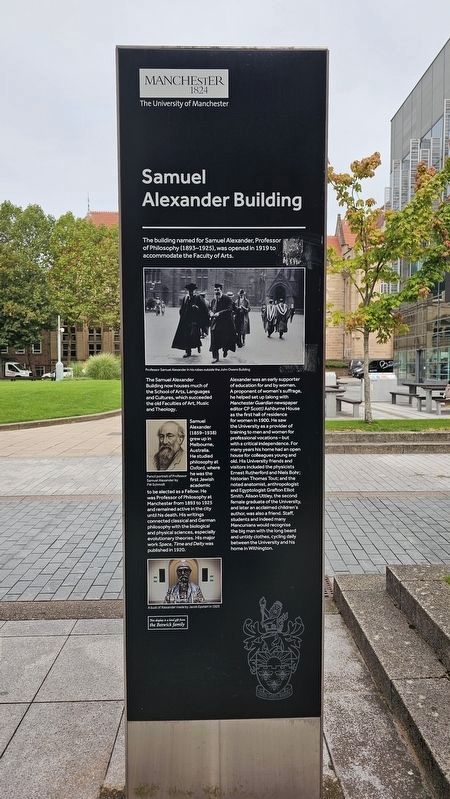
The building named for Samuel Alexander, Professor of Philosophy (1893–1925), was opened in 1919 to accommodate the Faculty of Arts.
The Samuel Alexander Building now houses much of the School of Arts, Languages and Cultures, which succeeded the old Faculties of Art, Music and Theology.
Samuel Alexander (1859–1938) grew up in Melbourne, Australia. He studied philosophy at Oxford, where he was the first Jewish academic to be elected as a Fellow. He was Professor of Philosophy at Manchester from 1893 to 1925 and remained active in the city until his death. His writings connected classical and German philosophy with the biological and physical sciences, especially evolutionary theories. His major work Space, Time and Deity was published in 1920.
Alexander was an early supporter of education for and by women. A proponent of women’s suffrage, he helped set up (along with Manchester Guardian newspaper editor CP Scott) Ashburne House as the first hall of residence for women in 1900. He saw the University as a provider of training to men and women for professional vocations — but with a critical independence. For many years his home had an open house for colleagues young and old. His University friends and visitors included the physicists Ernest Rutherford and Niels Bohr; historian Thomas Tout; and the noted anatomist, anthropologist and Egyptologist Grafton Elliot Smith. Alison Uttley, the second female graduate of the University, and later an acclaimed children’s author, was also a friend. Staff, students and indeed many Mancunians would recognise the big man with the long beard and untidy clothes, cycling daily between the University and his home in Withington.
(Captions)
Professor Samuel Alexander in his robes outside the John Owens Building
Pencil portrait of Professor Samuel Alexander by FW Schmidt
A bust of Alexander made by Jacob Epstein in 1925
(side two)
The
this page online
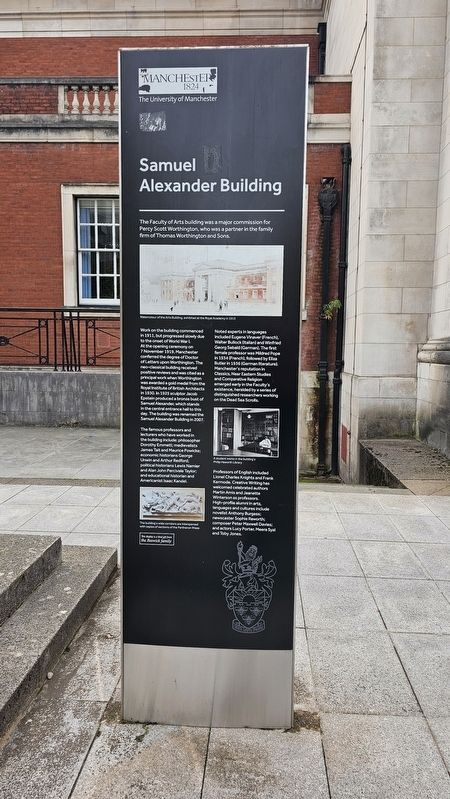
Work on the building commenced in 1911, but progressed slowly due to the onset of World War I. At the opening ceremony on 7 November 1919, Manchester conferred the degree of Doctor of Letters upon Worthington. The neo-classical building received positive reviews and was cited as a principal work when Worthington was awarded a gold medal from the Royal Institute of British Architects in 1930. In 1925 sculptor Jacob Epstein produced a bronze bust of Samuel Alexander, which stands in the central entrance hall to this day. The building was renamed the Samuel Alexander Building in 2007.
The famous professors and lecturers who have worked in the building include: philosopher Dorothy Emmett; medievalists James Tait and Maurice Powicke; economic historians George Unwin and Arthur Redford; political historians Lewis Namier and Alan John Percivale Taylor; and educational historian and Americanist Isaac Kandel.
Noted experts in languages included Eugene Vinaver (French), Walter Bullock (Italian) and Winfried
Photographed by Ian Lefkowitz, September 14, 2026
2. Samuel Alexander Building Marker - Side Two
Professors of English included Lionel Charles Knights and Frank Kermode. Creative Writing has welcomed celebrated authors Martin Amis and Jeanette Winterson as professors. High-profile alumni in arts, languages and cultures include novelist Anthony Burgess; newscaster Sophie Raworth; composer Peter Maxwell Davies; and actors Lucy Porter, Meera Syal and Toby Jones.
(Captions)
Watercolour of the Arts Building, exhibited at the Royal Academy in 1913
A student works in the building’s Philip Haworth Library
The building’s wide corridors are interspersed with copies of sections of the Parthenon frieze
Erected by The University of Manchester.
Topics. This historical marker is listed in this topic list: Education. A significant historical year for this entry is 1919.
Location. 53° 27.871′ N, 2° 14.011′ W. Marker is in Manchester, England, in Greater Manchester. It is in Chorlton-on-Medlock. It is on Lime Grove west of Oxford Road, on the left when traveling west. Touch for map. Marker is at or near this postal address: 1796 Lime Grove, Manchester, England M13 9PP, United Kingdom. Touch for directions.

Regionally, this marker is in North West England. Globally, it is on the Atlantic Ocean, in the North Atlantic Region, in Europe, in Atlantic Europe, on one of the British Isles, in the Western World, and in the Anglosphere. Historically, it finds itself in what was once the Roman Empire.
Other nearby markers. At least 8 other markers are within walking distance of this marker:
Photographed by Ian Lefkowitz, September 14, 2026
3. Samuel Alexander Building Marker
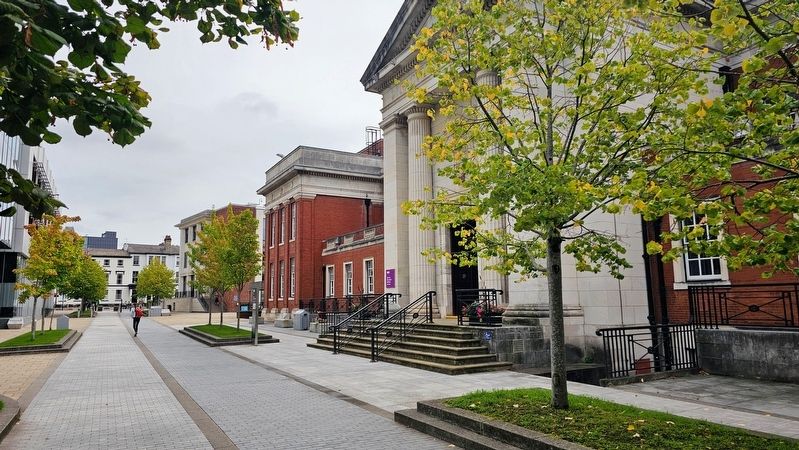
The neo-classical building was completed in 1919. The marker is located near the stairway leading to the building entrance.
Also see . . . Samuel Alexander Building (The University of Manchester).
The building named for Samuel Alexander, Professor of Philosophy (1893–1925), was opened in 1919 to accommodate the Faculty of Arts.(Submitted on October 31, 2026, by Ian Lefkowitz of New York, New York.)
Credits. This page was last revised on October 31, 2026. It was originally submitted on October 31, 2026, by Ian Lefkowitz of New York, New York. This page has been viewed 10 times since then. Photos: 1, 2, 3. submitted on October 31, 2026, by Ian Lefkowitz of New York, New York. • Andrew Ruppenstein was the editor who published this page.
