Macon in Bibb County, Georgia — The American South (South Atlantic)
Carl Vinson
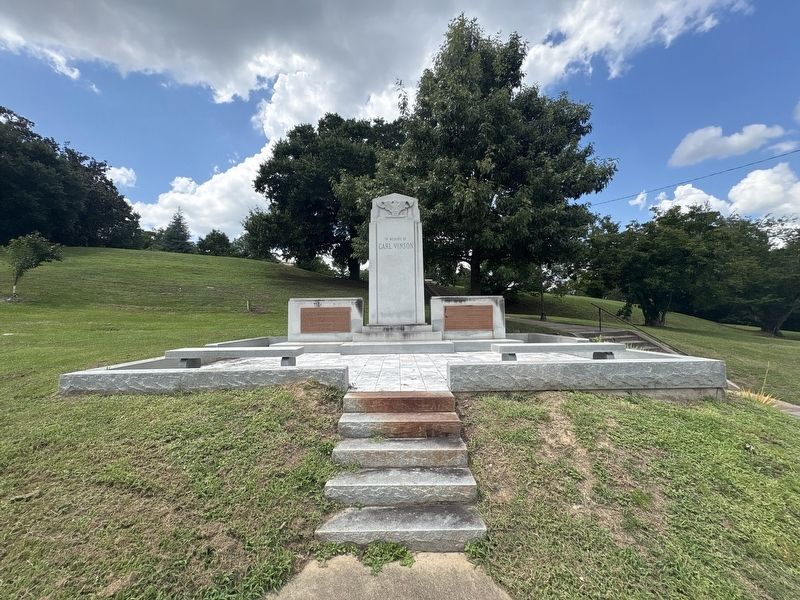
Photographed by Darren Jefferson Clay, July 18, 2026
1. Carl Vinson Memorial
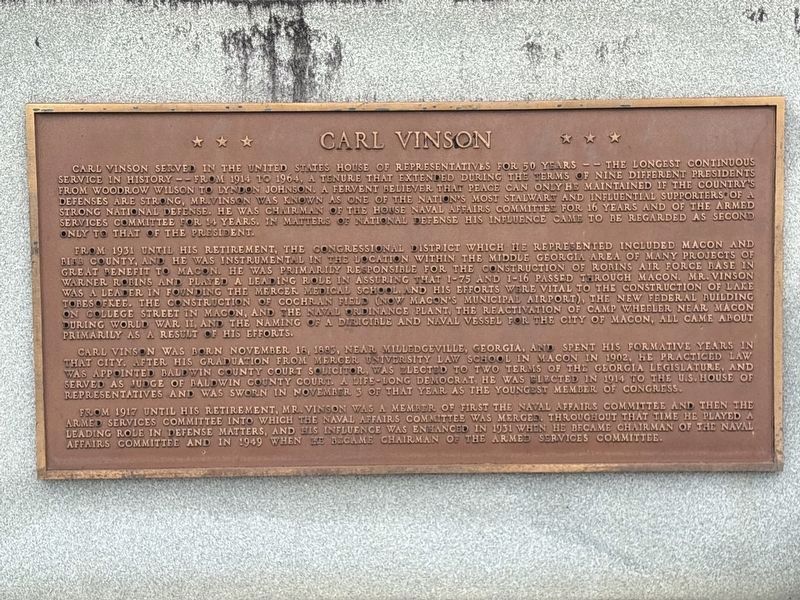
(left panel)
Carl Vinson served in the United States House of Representatives for 50 years -- the longest continuous service in history -- from 1914 to 1964. A tenure that extended during the terms of nine different presidents from Woodrow Wilson to Lyndon Johnson. A fervent believer that peace can only be maintained if the country's defenses are strong, Mr. Vinson was known as one of the nation's most stalwart and influential supporters of a strong national defense. He was chairman of the House Naval Affairs Committee for 16 years and of the Armed Services Committee for 14 years. In matters of national defense his influence came to be regarded as second only to that of the president.
(rght panel)
From 1931 until his retirement, the congressional district he represented included Macon and Bibb County, and he was instrumental in the location within the Middle Georgia area of many projects of great benefit to Macon. He was primarily responsible for the construction of Robins Air Force Base in Warner Robins and played a leading role in assuring that I-75 and I-16 passed through Macon. Mr. Vinson was a leader in founding
this page online
Carl Vinson was born November 18, 1883, near Milledgeville, Georgia, and spent his formative years in that city. After his graduation from Mercer University Las School in Macon in 1902, he practiced law was appointed Baldwin County Court Solicitor, was elected to two terms of the Georgia legislature, and served as judge of Baldwin County Court. A life-long Democrat, he was elected in 1914 to the U.S. House of Representatives and was sworn in November 3 of that year as the youngest member of congress.
From 1917 until his retirement, Mr. Vinson was a member of first the Naval Affairs Committee and then the Armed Services Committee into which the Naval Affairs Committee was merged. Throughout that time he
Photographed by Darren Jefferson Clay, July 18, 2026
2. Carl Vinson Memorial (right panel)
Not only did Mr. Vinson believe that a strong national defense is essential to peace, he regarded national defense as a non-partisan matter:
"...my country and its safety come ahead of any party..."These two principles and his relief in civilian control of the military guided him throughout his career.
Between 1931 and 1940, as a result of bills passed through Chairman Vinson's Naval Affairs Committee, the Navy was almost completely rebuilt, greatly increasing its preparedness for World War II. So influential was he in Naval Affairs that he often referred to "My Navy" and others often referred to him as "The Admiral". When World War II came Mr. Vinson sponsored and guided through the House a myriad of bills dealing with all aspects of the war effort. In speaking of his accomplishments between 1935 and 1945, Admiral William D. Leahy said,
"In my opinion, the Georgia representative had, in the past decade, contributedMr. Vinson was among the first to recognize the importance of air power and worked throughout his career to strengthen military aviation. Later he supported the establishment of a separate Air Force, the founding of the Air Force Academy, and the maintenance of a strong strategic air arm.more to the national defense than any other single person, except the president himself."Photographed by Darren Jefferson Clay, July 18, 20263. Carl Vinson Memorial (left panel)
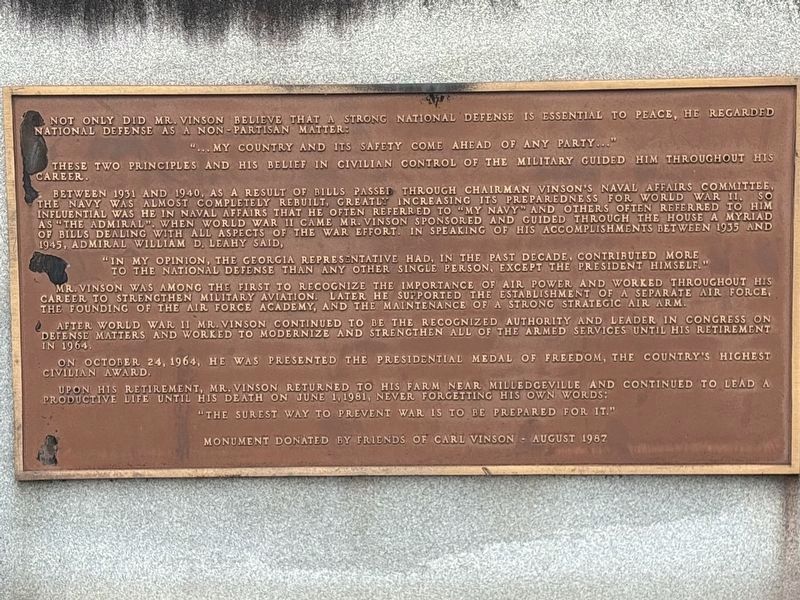
After World War II Mr. Vinson continued to be the recognized authority and leader in Congress on defense matters and worked to modernize and strengthen all of the Armed Services until his retirement in 1964.
On October 24, 1964, he was presented the Presidential Medal of Freedom, the country's highest civilian award.
Upon his retirement, Mr. Vinson returned to his farm near Milledgeville and continued to lead a productive life until his death on June 1, 1981, never forgetting his own words:
"The surest way to prevent war is to be prepared for it."Monument donated by Friends of Carl Vinson - August 1987
Erected 1987 by Friends of Carl Vinson.
Topics. This historical marker is listed in this topic list: Government & Politics.
Location. 32° 50.474′ N, 83° 37.99′ W. Marker is in Macon, Georgia, in Bibb County. It is at the intersection of Spring Street and Georgia Avenue, on the left when traveling north on Spring Street. Located in Coleman Hill Park. Touch for map. Marker is at or near this postal address: 285 Spring St, Macon GA 31201, United States of America. Touch for directions.

Regionally, this marker is in the Piedmont. It is also in the American South and specifically in the Deep South. Globally, it is in North America, the Western Hemisphere, the Western World, and the Anglosphere. Historically, it finds itself in what was once the territory of the Mississippian Culture, one of the original Thirteen Colonies, one of the Confederate States of America, and the Antebellum South.
Other nearby markers. At least 8 other markers are within walking distance of this marker: In Memory of General LaFayette's Visit to Macon (within shouting distance of this marker); World War II Memorial Magnolias (about 300 feet away, measured in a direct line); P.L. Hay House (about 300 feet away); Jefferson Davis (about 400 feet away); Cowles-Bond House (about 400 feet away); Harris-Hall-Bennett House (about 400 feet away); Judge Asa Holt House (about 500 feet away); Fencing from Findlay Foundry (about 600 feet away). Touch for a list and map of all markers in Macon.
Credits. This page was last revised on November 12, 2026. It was originally submitted on November 1, 2026, by Darren Jefferson Clay of Duluth, Georgia. This page has been viewed 7 times since then. Photos: 1, 2, 3. submitted on November 7, 2026, by Darren Jefferson Clay of Duluth, Georgia. • Bernard Fisher was the editor who published this page.
