Prati in Roma in Città metropolitana di Roma Capitale, Latium, Rome, Italy — Central Italy (Tyrrhenian Coast)
Corte Suprema di Cassazione
Palazzo di Giustizia (1911)
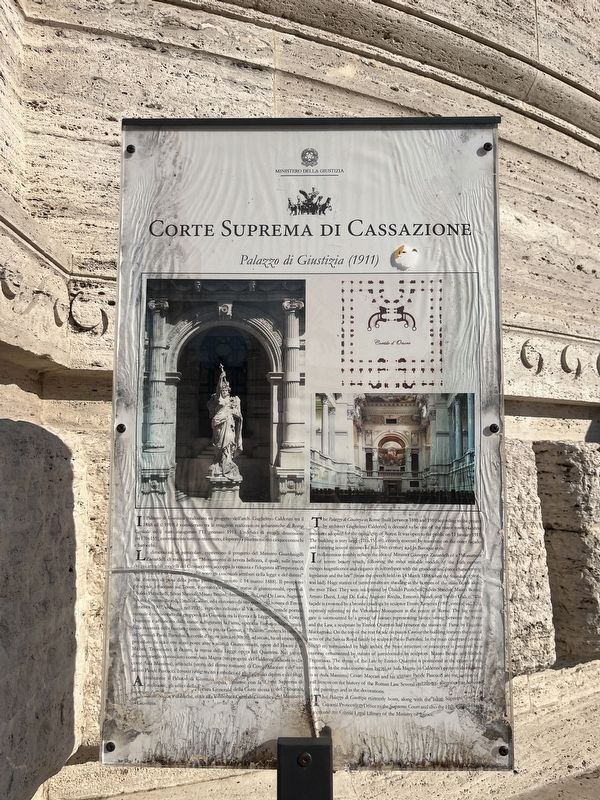
Photographed by Adam Margolis, June 26, 2026
1. Corte Suprema di Cassazione Marker
Its dimension notably reflects the idea of Minister Giuseppe Zanardelli of a "Monument of severe beauty which, following the most imitable models of the 16th century, merges magnificence and elegance in accordance with the grandeur and force characterising legislation and the law" (from the speech held on 14 March 1888 when the found was laid). Huge statues of jurisconsults are standing at the bottom of the main façade along the river Tiber. They were sculptured by Ubaldo Pizzichelli, Silvio Sbricoli, Mauro Benini, Arturo Dazzi, Luigi De Luca, Augusto Rivalalta, Ernesto Biondi and Emilio Gallori. The façade is crowned by a bronze quadriga by sculptor Ettore Ximenes (1907, erected 1925), expressly referring
this page online
The Palazzo di Gustizia currently hosts, along with the Italian Supreme and General Prosecution Office to the Supreme Court and also the High Court
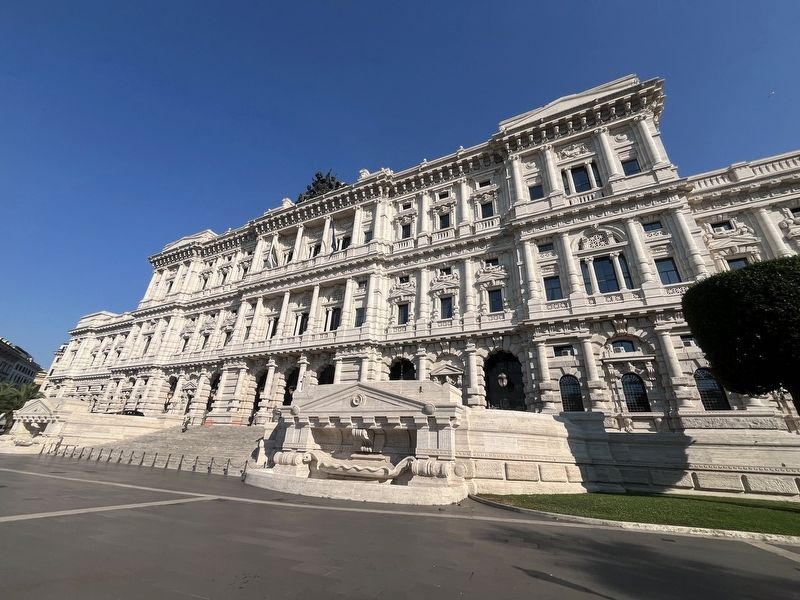
Photographed by Adam Margolis, June 26, 2026
2. Corte Suprema di Cassazione Marker
Marker is near the left of image, at the bottom of the stairs
(Italian not transcribed)
Erected by Minestero Della Giustizia.
Topics. This historical marker is listed in these topic lists: Architecture • Arts, Letters, Music. A significant historical date for this entry is March 14, 1888.
Location. 41° 54.301′ N, 12° 28.209′ E. Marker is in Roma, Lazio (Latium, Rome), in Città metropolitana di Roma Capitale. It is in Prati. It is on Piazza Cavour. Touch for map. Marker is at or near this postal address: Piazza Cavour 3, Roma, Lazio 00193, Italy. Touch for directions.

Regionally, it is in Europe, the European Union, the Schengen Area, a coastal Mediterranean country, and the Western World. Historically, it finds itself in what was once the Roman Empire.
Other nearby markers. At least 8 other markers are within walking distance of this marker: Monumento a Camillo Benso Conte di Cavour / Monument to Camillo Benso Count of Cavour (a few steps from this marker); Ponte Umberto I / Umberto I Bridge (about 210 meters away, measured in a direct line); Chiesa di Santa Maria in Porta Paradisi / Church of Saint Mary in the Gate of Paradise
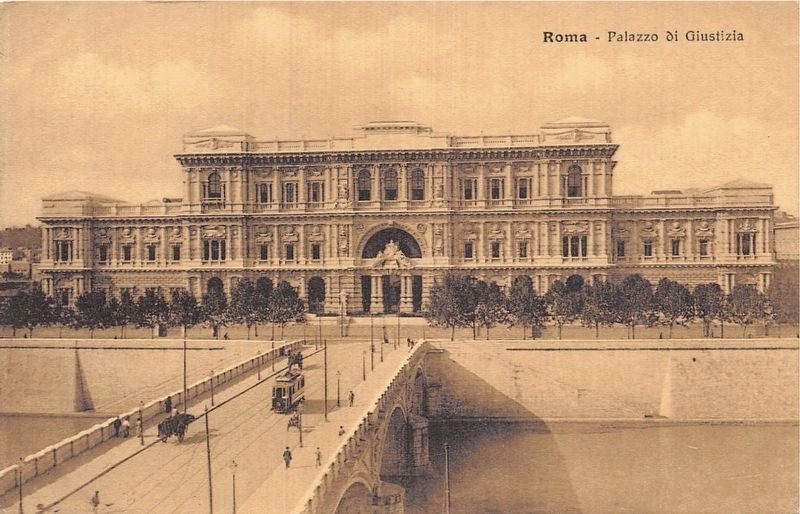
circa 1920
3. Palazzo di Giustizia
Note the lack of the quadriga, meaning the photo was taken before 1926.
Also see . . . Palace of Justice, Rome (Wikipedia). (Submitted on November 13, 2026.)
Credits. This page was last revised on November 13, 2026. It was originally submitted on November 1, 2026, by Adam Margolis of Mission Viejo, California. This page has been viewed 7 times since then. Photos: 1, 2. submitted on November 1, 2026, by Adam Margolis of Mission Viejo, California. 3. submitted on November 13, 2026. • Andrew Ruppenstein was the editor who published this page.
