St Kilda in Port Phillip, Victoria, Australia — Oceania
Earth
The Planet of Life
| — | Solar System Trail | — |
Photographed by Dean Barton-Ancliffe, September 29, 2026
1. Earth Marker
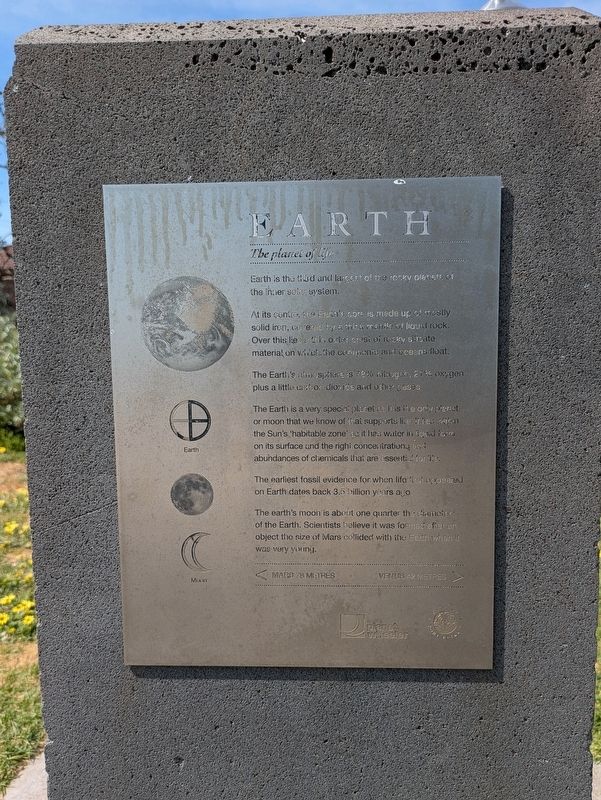
At its centre, the Earth's core is made up of mostly solid iron, covered by a thick mantle of liquid rock. Over this lies a thin outer crust of rocky silicate material on which the continents and oceans float.
The Earth's atmosphere is 78% nitrogen, 21% oxygen plus a little carbon dioxide and other gases.
The Earth is a very special planet as it is the only planet or moon that we know of that supports life. It lies within the Sun's 'habitable zone' as it has water in liquid form on its surface and the right concentrations and abundances of chemicals that are essential for life.
The earliest fossil evidence for when life first appeared on Earth dates back 3.5 billion years ago.
The earth's moon is about one quarter the diameter of the Earth. Scientists believe it was formed after an object the size of Mars collided with the Earth when it was very young.
< Mars 78 Metres - Venus 42 Metres >
(Left Side Plaque)
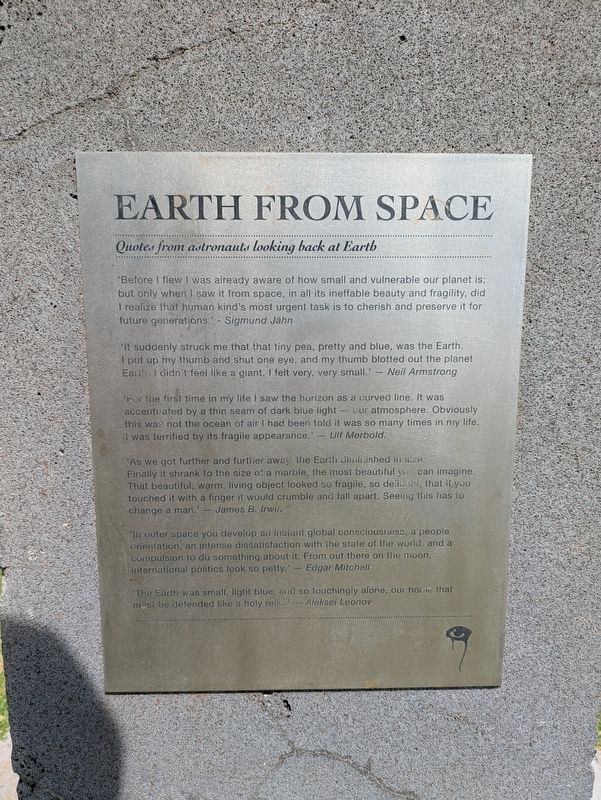
Earth from Space
Quotes from astronauts looking back at Earth
'Before I flew I was already aware of how small
this page online
'It suddenly struck me that that tiny pea, pretty and blue, was the Earth. I put up my thumb and shut one eye, and my thumb blotted out the planet Earth. I didn't feel like a giant. I felt very, very small.' - Neil Armstrong
'For the first time in my life I saw the horizon as a curved line. It was accentuated by a thin seam of dark blue light - our atmosphere. Obviously this was not the ocean of air I had been told it was so many times in my life. I was terrified by its fragile appearance.' - Ulf Merbold.
'As we got further and further away, the Earth diminished in size. Finally it shrank to the size of a marble, the most beautiful you can imagine. That beautiful, warm, living object looked so fragile, so delicate, that if you touched it with a finger it would crumble and fall apart. Seeing this has to change a man.' - James B. Irwin
'In outer space you develop an instant global consciousness, a people
Photographed by Dean Barton-Ancliffe, September 29, 2026
2. Earth Marker - Left Side
The Earth was small, light blue, and so touchingly alone, our home that must be defended like a holy relic.' - Aleksei Leonov
Erected by Planet Wheeler and City of Port Phillip. (Marker Number 4.)
Topics and series. This historical marker is listed in these topic lists: Air & Space • Exploration. In addition, it is included in the Melbourne Solar System Trail series list.
Location. 37° 52.251′ S, 144° 58.559′ E. Marker is in St Kilda, Victoria, in Port Phillip. It can be reached from Marine Parade (Victoria Route 33) 0.2 kilometers north of Blessington Street. Touch for map. Marker is at or near this postal address: 19 Marine Parade, St Kilda VIC 3182, Australia. Touch for directions.

Regionally, it is in Oceania, in Australasia, in the Pacific Ocean, in South Pacific, on the Pacific Rim, in the Western World, and in the Anglosphere. Historically, it finds itself in
Photographed by Dean Barton-Ancliffe, September 29, 2026
3. Earth Marker - Right Side
Other nearby markers. At least 8 other markers are within walking distance of this marker: Venus (within shouting distance of this marker); Mars (within shouting distance of this marker); Mercury (about 90 meters away, measured in a direct line); Sun (about 150 meters away); Proxima Centauri (about 150 meters away); Great Scenic Railway (approx. 0.4 kilometers away); Councillor Edward O'Donnell (approx. 0.4 kilometers away); Lieut. J.M. Bennett (approx. 0.4 kilometers away). Touch for a list and map of all markers in St Kilda.
Also see . . . Solar System Trail. Walks in Port Phillip
Navigate the solar system from the sun to the outer planets by following the bike and walking trail on the City of Port Phillip’s foreshore.(Submitted on November 4, 2026, by Dean Barton-Ancliffe of Rowville, Victoria.)
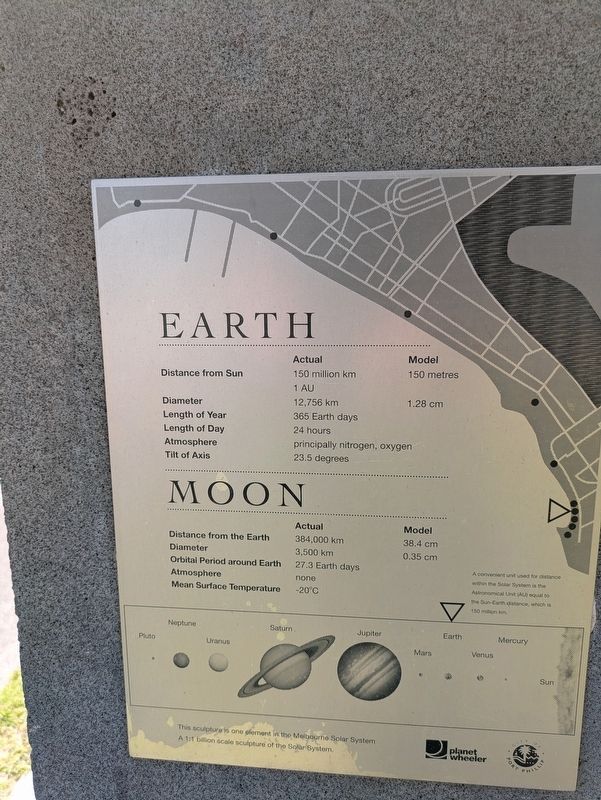
In 2008 artists and scientists constructed a model of our solar system to a scale of one to one billion between St Kilda and Port Melbourne. Instead of navigating 4.5 billion kilometres from the sun to Neptune, and 5.9 billion kilometres from the sun to Pluto, you only travel 4.5 kilometres and 5.9 kilometres.
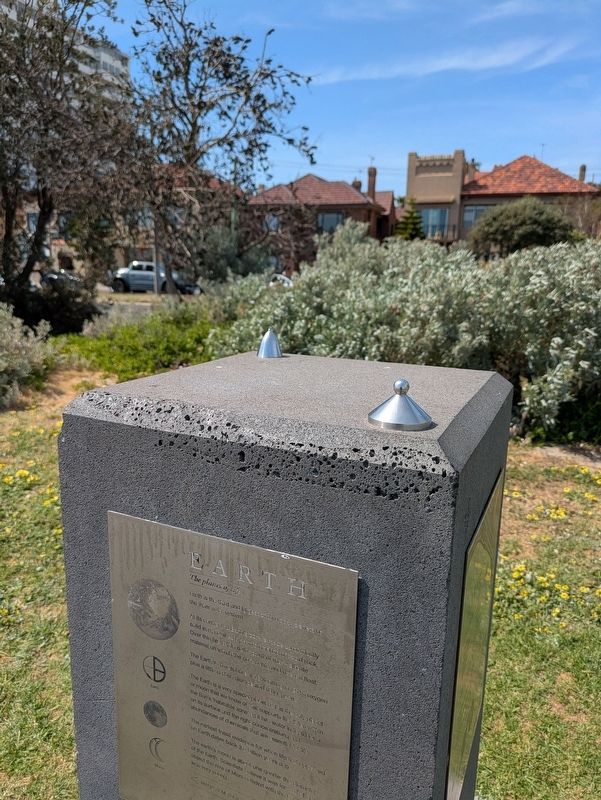
The foreshore has always been a superb location to viewthe sun setting on the western horizon. Port Phillip Bay’s crescent shape is perfect for a model where the ‘sun’ can be viewed from every one of the nine model locations.Photographed by Dean Barton-Ancliffe, September 29, 20264. Earth Marker - The Earth and Moon
Credits. This page was last revised on November 5, 2026. It was originally submitted on November 4, 2026, by Dean Barton-Ancliffe of Rowville, Victoria. This page has been viewed 7 times since then. Photos: 1, 2, 3, 4. submitted on November 4, 2026, by Dean Barton-Ancliffe of Rowville, Victoria. • Andrew Ruppenstein was the editor who published this page.
