St Kilda in Port Phillip, Victoria, Australia — Oceania
Venus
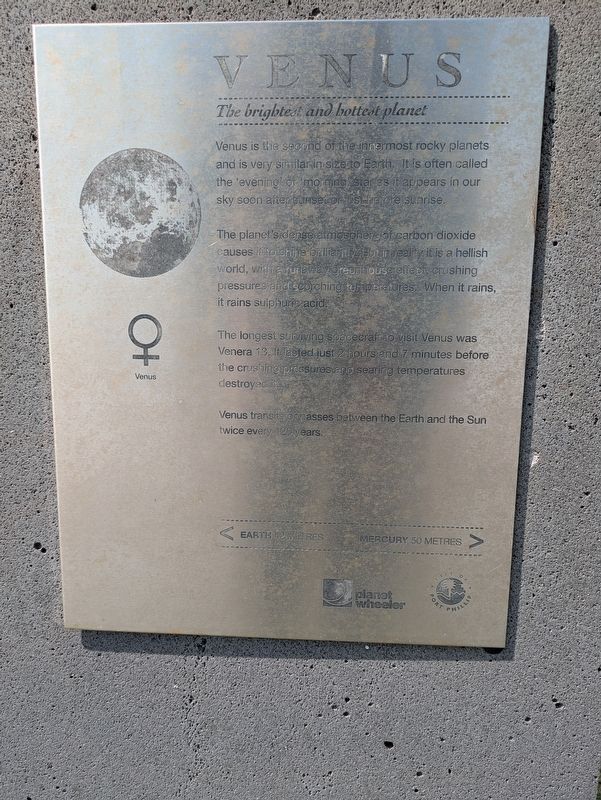
The brightest and the hottest planet
| — | Solar System Trail | — |
Photographed by Dean Barton-Ancliffe, September 29, 2026
1. Venus Marker
The planet's dense atmosphere of carbon dioxide causes it to shine brilliantly But in reality it is a hellish world, with a runaway greenhouse effect, crushing pressures and scorching temperatures. When it rains, it rains sulphuric acid.
The longest surviving spacecraft to visit Venus was Venera 13. It lasted just 2 hours and 7 minutes before the crushing pressures and searing temperatures destroyed it.
Venus transits or passes between the Earth and the Sun twice every 120 years.
< Earth 42 Metres - Mercury 50 Metres >
Erected by Planet Wheeler and City of Port Phillip. (Marker Number 3.)
Topics and series. This historical marker is listed in these topic lists: Air & Space • Exploration. In addition, it is included in the Melbourne Solar System Trail series list.
Location. 37° 52.272′ S, 144° 58.559′ E. Marker is in St Kilda, Victoria, in Port Phillip.
this page online

Regionally, it is in Oceania, in Australasia, in the Pacific Ocean, in South Pacific, on the Pacific Rim, in the Western World, and in the Anglosphere. Historically, it finds itself in what was once a British colony.
Other nearby markers. At least 8 other markers are within walking distance of this marker: Earth (within shouting distance of this marker); Mercury (within shouting distance of this marker); Sun (about 90 meters away, measured in a direct line); Mars (about 120 meters away); Proxima Centauri (about 120 meters away); Great Scenic Railway (approx. 0.4 kilometers away); Councillor Edward O'Donnell (approx. 0.4 kilometers away); Lieut. J.M. Bennett (approx. half a kilometer away). Touch for a list and map of all markers in St Kilda.
Also see . . . Solar System Trail. Walks in Port Phillip
Navigate the solar system from the sun to the outer planets by following the bike and walking(Submitted on November 5, 2026, by Dean Barton-Ancliffe of Rowville, Victoria.)trail on the City of Port Phillip’s foreshore.Photographed by Dean Barton-Ancliffe, September 29, 20262. Venus Marker - Side Plaque
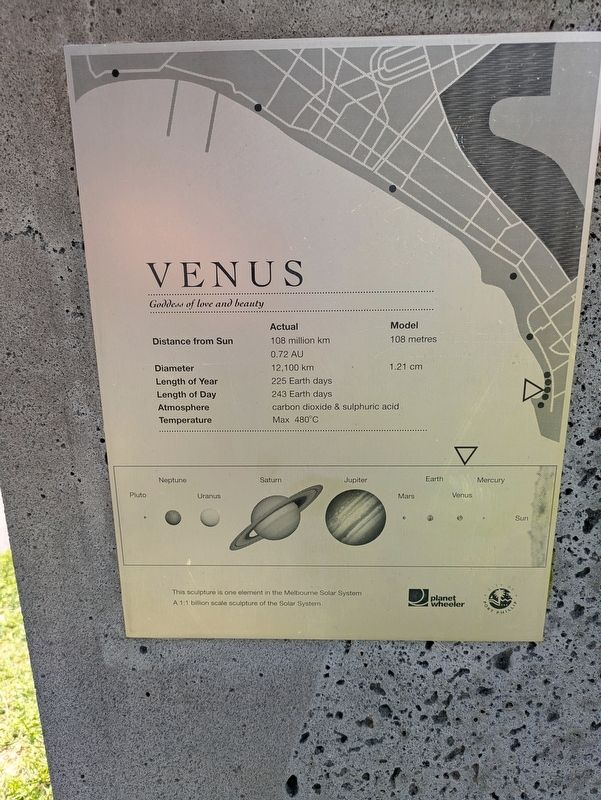
In 2008 artists and scientists constructed a model of our solar system to a scale of one to one billion between St Kilda and Port Melbourne. Instead of navigating 4.5 billion kilometres from the sun to Neptune, and 5.9 billion kilometres from the sun to Pluto, you only travel 4.5 kilometres and 5.9 kilometres.
The foreshore has always been a superb location to view the sun setting on the western horizon. Port Phillip Bay’s crescent shape is perfect for a model where the ‘sun’ can be viewed from every one of the nine model locations.
Photographed by Dean Barton-Ancliffe, September 29, 2026
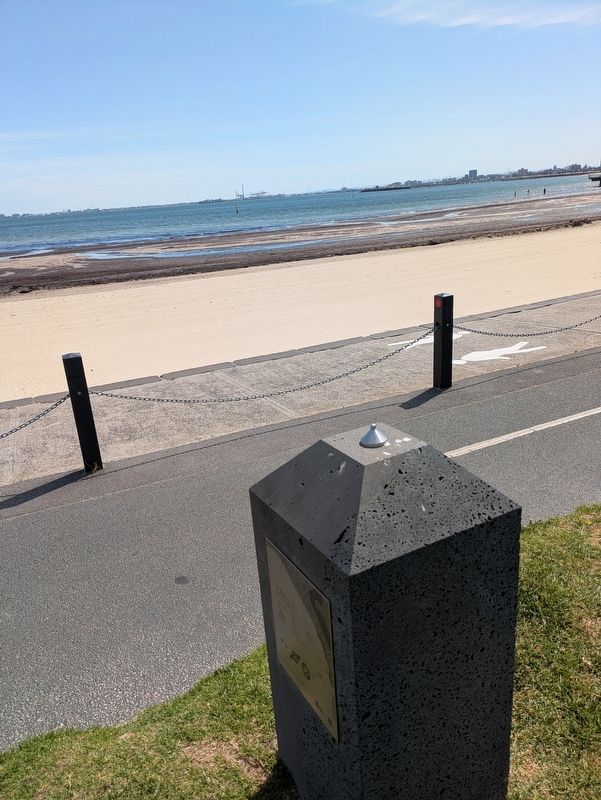
3. Venus Marker along the Bay Trail
Credits. This page was last revised on November 6, 2026. It was originally submitted on November 5, 2026, by Dean Barton-Ancliffe of Rowville, Victoria. This page has been viewed 6 times since then. Photos: 1, 2, 3. submitted on November 5, 2026, by Dean Barton-Ancliffe of Rowville, Victoria. • Andrew Ruppenstein was the editor who published this page.
