St Kilda in Port Phillip, Victoria, Australia — Oceania
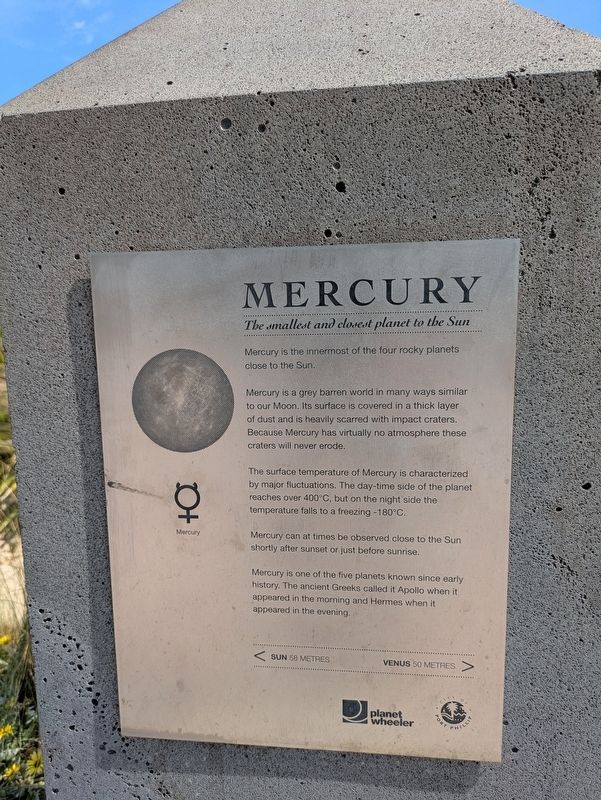
Mercury
The smallest and closest planet to the Sun
| — | Solar System Trail | — |
Photographed by Dean Barton-Ancliffe, September 29, 2026
1. Mercury Marker
Mercury is a grey barren world in many ways similar to our Moon. Its surface is covered in a thick layer of dust and is heavily scarred with impact craters. Because Mercury has virtually no atmosphere these craters will never erode.
The surface temperature of Mercury is characterized by major fluctuations. The day-time side of the planet reaches over 400°C, but on the night side the temperature falls to a freezing -180°C.
Mercury can at times be observed close to the Sun shortly after sunset or just before sunrise.
Mercury is one of the five planets known since early history. The ancient Greeks called it Apollo when it appeared in the morning and Hermes when it appeared in the evening.
< Sun 58 Metres - Venus 50 Metres >
Erected by Planet Wheeler and City of Port Phillip. (Marker Number 2.)
Topics and series. This historical marker is listed in these topic lists: Air & Space • Exploration. In addition, it is included in the Melbourne Solar System Trail series list.
Location. 37° 52.301′ S, 144° 58.555′ E.
this page online

Regionally, it is in Oceania, in Australasia, in the Pacific Ocean, in South Pacific, on the Pacific Rim, in the Western World, and in the Anglosphere. Historically, it finds itself in what was once a British colony.
Other nearby markers. At least 8 other markers are within walking distance of this marker: Sun (within shouting distance of this marker); Venus (within shouting distance of this marker); Proxima Centauri (within shouting distance of this marker); Earth (about 90 meters away, measured in a direct line); Mars (about 180 meters away); Great Scenic Railway (approx. half a kilometer away); Councillor Edward O'Donnell (approx. half a kilometer away); Lieut. J.M. Bennett (approx. half a kilometer away). Touch for a list and map of all markers in St Kilda.
Also see . . . Solar System Trail. Walks in Port Phillip
Navigate the solar(Submitted on November 5, 2026, by Dean Barton-Ancliffe of Rowville, Victoria.)system from the sun to the outer planets by following the bike and walking trail on the City of Port Phillip’s foreshore.Photographed by Dean Barton-Ancliffe, September 29, 20262. Mercury Marker - Side Panel
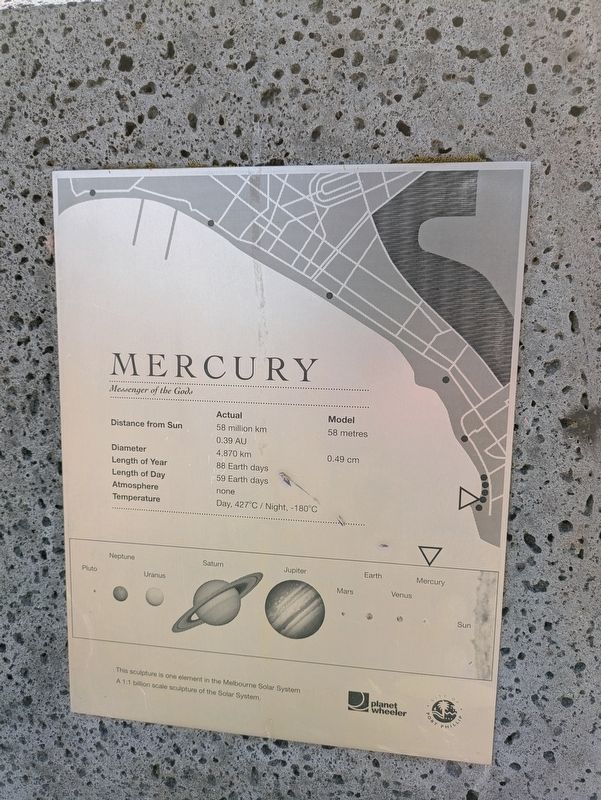
In 2008 artists and scientists constructed a model of our solar system to a scale of one to one billion between St Kilda and Port Melbourne. Instead of navigating 4.5 billion kilometres from the sun to Neptune, and 5.9 billion kilometres from the sun to Pluto, you only travel 4.5 kilometres and 5.9 kilometres.
The foreshore has always been a superb location to view the sun setting on the western horizon. Port Phillip Bay’s crescent shape is perfect for a model where the ‘sun’ can be viewed from every one of the nine model locations.
Photographed by Dean Barton-Ancliffe, September 29, 2026
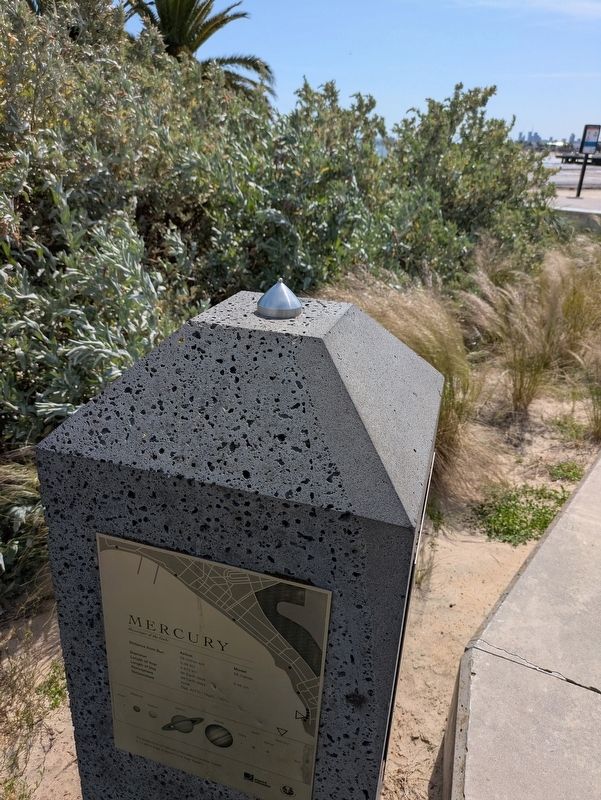
3. Mercury Marker along the Bay Trail
Credits. This page was last revised on November 6, 2026. It was originally submitted on November 5, 2026, by Dean Barton-Ancliffe of Rowville, Victoria. This page has been viewed 6 times since then. Photos: 1, 2, 3. submitted on November 5, 2026, by Dean Barton-Ancliffe of Rowville, Victoria. • Andrew Ruppenstein was the editor who published this page.
