St Kilda in Port Phillip, Victoria, Australia — Oceania
Sun
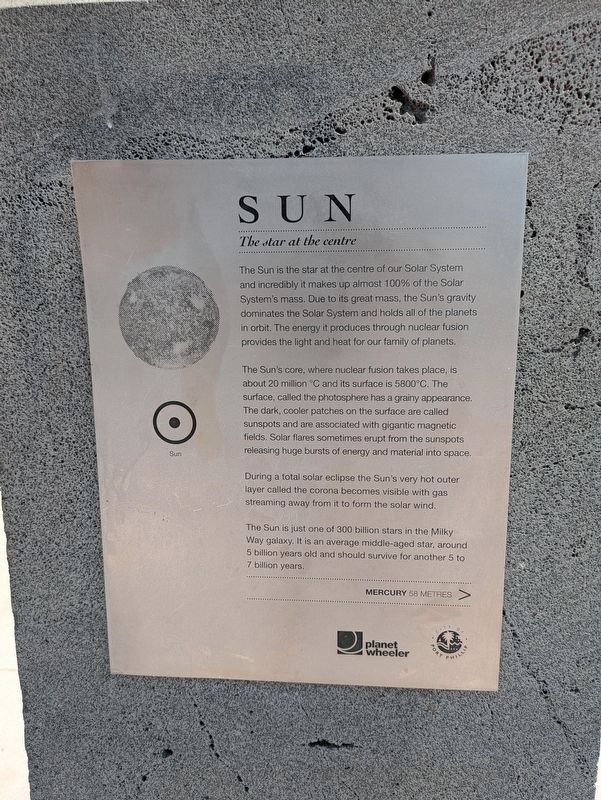
The star at the centre
| — | Solar System Trail | — |
Photographed by Dean Barton-Ancliffe, September 29, 2026
1. Sun Marker
The Sun's core, where nuclear fusion takes place, is about 20 million °C and its surface is 5800°C. The surface, called the photosphere has a grainy appearance. The dark, cooler patches on the surface are called sunspots and are associated with gigantic magnetic fields. Solar flares sometimes erupt from the sunspots releasing huge bursts of energy and material into space.
During a total solar eclipse the Sun's very hot outer layer called the corona becomes visible with gas streaming away from it to form the solar wind.
The Sun is just one of 300 billion stars in the Milky Way galaxy. It is an average middle-aged star, around 5 billion years old and should survive for another 5 to 7 billion years.
Mercury 58 Metres >
(Side Plaque)
The Solar System
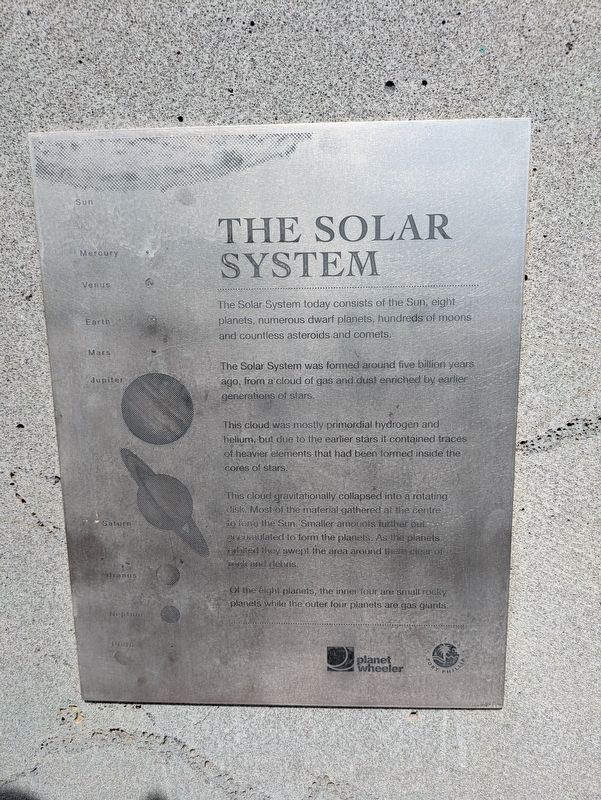
The Solar System today consists
this page online
The Solar System was formed around five billion years ago, from a cloud of gas and dust enriched by earlier generations of stars.
This cloud was mostly primordial hydrogen and helium, but due to the earlier stars it contained traces of heavier elements that had been formed inside the cores of stars.
This cloud gravitationally collapsed into a rotating disk. Most of the material gathered at the centre to form the Sun. Smaller amounts further out accumulated to form the planets. As the planets orbited they swept the area around them clear of rock and debris.
Of the eight planets, the inner four are small rocky planets while the outer four planets are gas giants.
(Series Plaque)
The Melbourne Solar System
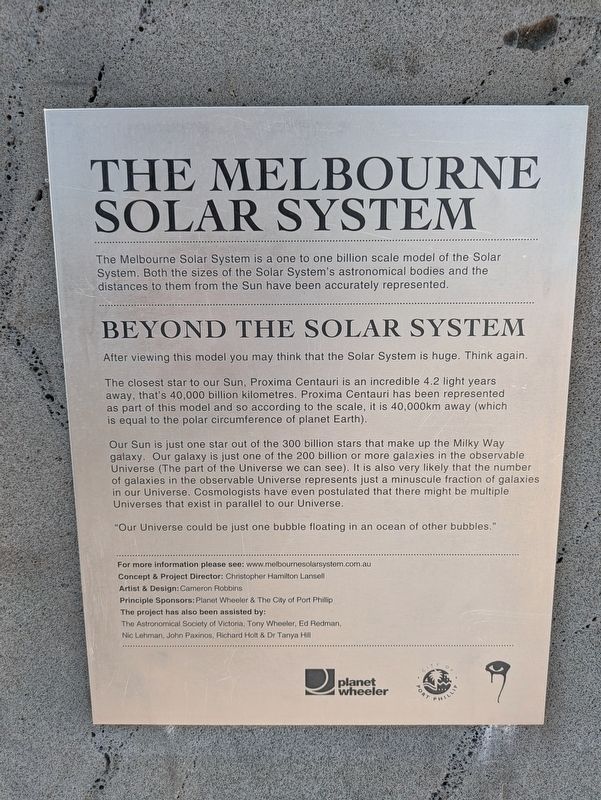
The Melbourne Solar System is a one to one billion scale model of the Solar System. Both the sizes of the Solar System's astronomical bodies and the distances to them from the Sun have been accurately represented.
Beyond the Solar System
After viewing this model you may think that the Solar System is huge.
Photographed by Dean Barton-Ancliffe, September 29, 2026
2. Sun Marker - Solar System Plaque
The closest star to our Sun, Proxima Centauri is an incredible 4.2 light years away, that's 40,000 billion kilometres. Proxima Centauri has been represented as part of this model and so according to the scale, it is 40,000km away (which is equal to the polar circumference of planet Earth).
Our Sun is just one star out of the 300 billion stars that make up the Milky Way galaxy. Our galaxy is just one of the 200 billion or more galaxies in the observable Universe (The part of the Universe we can see). It is also very likely that the number of galaxies in the observable Universe represents just a minuscule fraction of galaxies in our Universe. Cosmologists have even postulated that there might be multiple Universes that exist in parallel to our Universe.
"Our Universe could be just one bubble floating in an ocean of other bubbles."
Erected by Planet Wheeler and City of Port Phillip. (Marker Number 1.)
Topics and series. This historical marker is listed in these topic lists: Air & Space • Exploration. In addition, it is included in the Melbourne Solar System Trail series list.
Location. 37° 52.329′ S,
Photographed by Dean Barton-Ancliffe, September 29, 2026
3. Sun Marker - Series Plaque

Regionally, it is in Oceania, in Australasia, in the Pacific Ocean, in South Pacific, on the Pacific Rim, in the Western World, and in the Anglosphere. Historically, it finds itself in what was once a British colony.
Other nearby markers. At least 8 other markers are within walking distance of this marker: Proxima Centauri (a few steps from this marker); Mercury (within shouting distance of this marker); Venus (about 90 meters away, measured in a direct line); Earth (about 150 meters away); Mars (about 210 meters away); Great Scenic Railway (approx. half a kilometer away); Councillor Edward O'Donnell (approx. 0.6 kilometers away); Lieut. J.M. Bennett (approx. 0.6 kilometers away). Touch for a list and map of all markers in St Kilda.
Also see . . . Solar System Trail.
Photographed by Dean Barton-Ancliffe, September 29, 2026
4. Sun Marker - Side Plaque
Navigate the solar system from the sun to the outer planets by following the bike and walking trail on the City of Port Phillip’s foreshore.(Submitted on November 5, 2026, by Dean Barton-Ancliffe of Rowville, Victoria.)
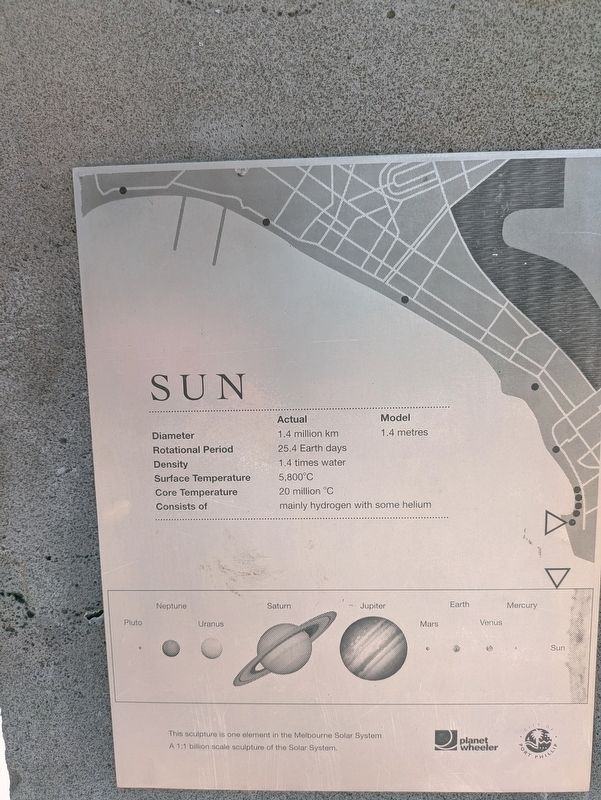
In 2008 artists and scientists constructed a model of our solar system to a scale of one to one billion between St Kilda and Port Melbourne. Instead of navigating 4.5 billion kilometres from the sun to Neptune, and 5.9 billion kilometres from the sun to Pluto, you only travel 4.5 kilometres and 5.9 kilometres.
The foreshore has always been a superb location to view the sun setting on the western horizon. Port Phillip Bay’s crescent shape is perfect for a model where the ‘sun’ can be viewed from every one of the nine model locations.
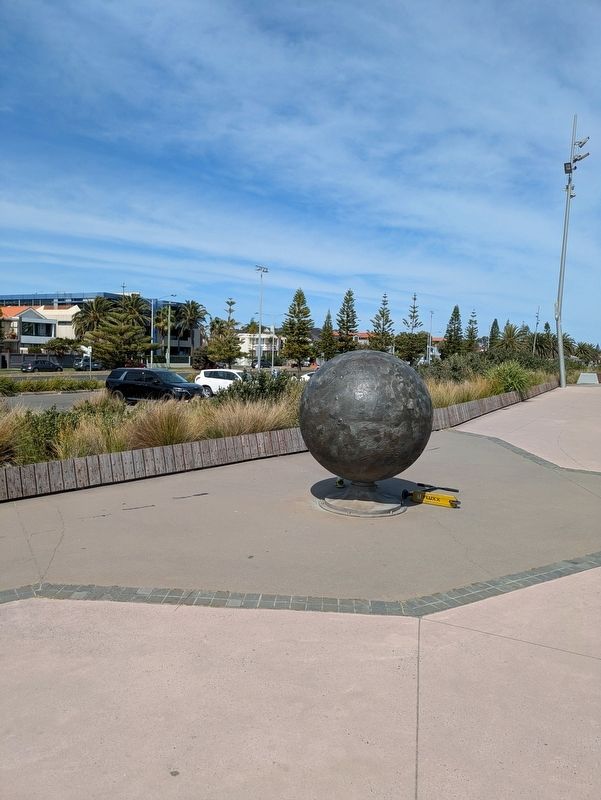
Photographed by Dean Barton-Ancliffe, September 29, 2026
5. The Sun Model to scale. 5m South of the Sun Marker
Credits. This page was last revised on November 6, 2026. It was originally submitted on November 5, 2026, by Dean Barton-Ancliffe of Rowville, Victoria. This page has been viewed 9 times since then. Photos: 1, 2, 3, 4, 5. submitted on November 5, 2026, by Dean Barton-Ancliffe of Rowville, Victoria. • Andrew Ruppenstein was the editor who published this page.
