Trevi in Roma in Città metropolitana di Roma Capitale, Latium, Rome, Italy — Central Italy (Tyrrhenian Coast)
Hotel Accademia
Photographed by Adam Margolis, June 26, 2026
1. Hotel Accademia Marker

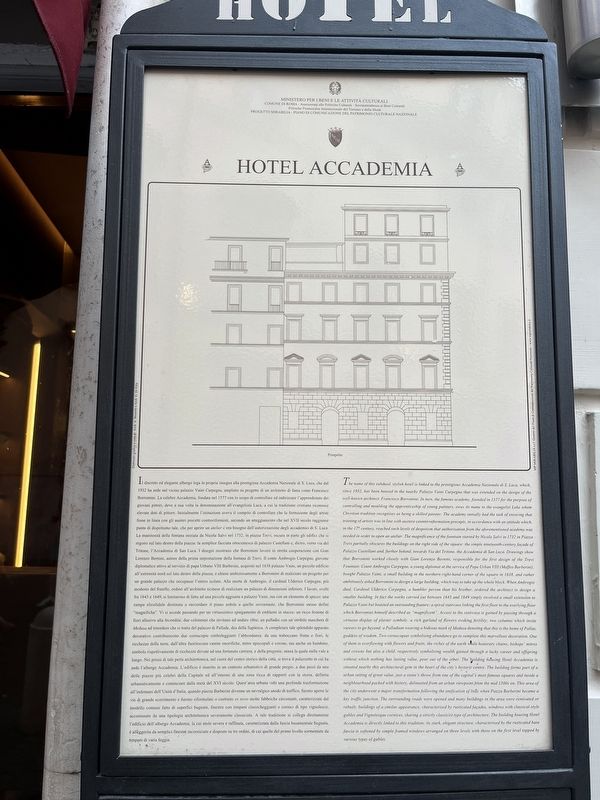
The name of this subdued, stylish hotel is linked to the prestigious Accademia Nazionale di S. Luca, hhich, since 1932, has been housed in the nearby Palazzo Vaini Carpegna that was extended on the design of the well-known architect, Francesco Borromini. In turn, the famous academy, founded in 1577 for the purpose of controlling and moulding the apprenticeship of young painters, owes its name to the evangelist Luke whom Christian tradition recognises as being a skilled painter. The academy initially had the task of ensuring that training of artists was in line with austere counterreformation precepts, in accordance with an attitude which. in the 17th century, reached such levels of despotism that authorisation from the aforementioned academy was needed in order to open an atelier. The magnificence of the fountain started by Nicola Salvi in 1732 in Piazza Trevi partially obscures the buildings on the right side of the square: the simple nineteenth-century façade of Palazzo Castellani and, further behind, towards Via del Tritone, the Accademia di San Luca. Drawings show that Borromini worked closely with
this page online
Photographed by Adam Margolis, June 26, 2026
2. Hotel Accademia Marker
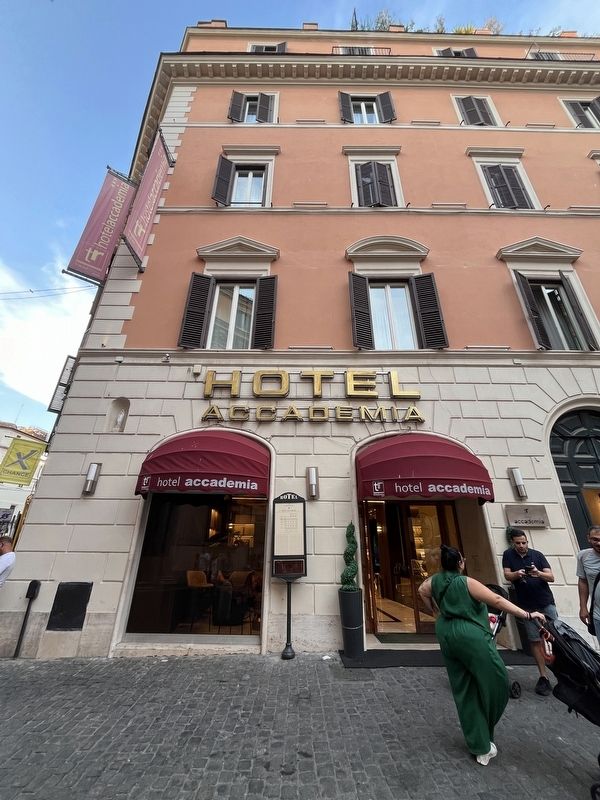
Il discreto ed elegante albergo lega la propria insegna alla prestigiosa Accademia Nazionale di S. Luca, che dal 1932 ha sede nel vicino palazzo Vaini Carpegna, ampliato su progetto di un architetto di fama come Francesco Borromini. La celebre Accademia, fondata nel 1577 con lo scopo di controllare ed indirizzare l'apprendistato dei giovani pittori, deve a sua volta la denominazione all'evangelista Luca, a cui la tradizione cristiana riconosce elevate doti di pittore. Inizialmente l'istituzione aveva il compito di controllare che la formazione degli artisti fosse in linea con gli austeri precetti controriformisti, secondo un atteggiamento che nel XVII secolo raggiunse punte di dispotismo tale, che per aprire un atelier c'era bisogno dell'autorizzazione degli accademici di S. Luca. La maestosità della fontana iniziata da Nicola Salvi nel 1732, in piazza Trevi, oscura in parte gli edifici che si ergono sul lato destro della piazza: la semplice facciata ottocentesca di palazzo Castellani e, dietro, verso via del Tritone, l'Accademia di San Luca. I disegni mostrano che Borromini lavorò in stretta cooperazione con Gian Lorenzo Bernini, autore della prima impostazione della fontana di Trevi. Il conte Ambrogio Carpegna, giovane diplomatico attivo al servizio di papa Urbano VIII Barberini, acquistò nel 1638 palazzo Vaini, un piccolo edificio all'estremità nord sul lato destro della piazza, e chiese ambiziosamente a Borromini di realizzare un progetto per un grande palazzo che occupasse l'intero isolato. Alla morte di Ambrogio, il cardinal Ulderico Carpegna, più modesto del fratello, ordinò all'architetto ticinese di realizzare un palazzo di dimensioni inferiori. I lavori, svolti fra 1643 e 1649, si limitarono di fatto ad una piccola aggiunta a palazzo Vaini, ma con un elemento di spicco: una rampa elicoidale destinata a raccordare il piano nobile a quello sovrastante, che Borromini stesso definì “magnificha”. Vi si accede passando per un virtuosistico spiegamento di emblemi in stucco: un ricco festone di fiori allusivo alla fecondità; due colonnine che invitano ad andare oltre; un palladio con un'orribile maschera di Medusa ad intendere che si tratta del palazzo di Pallade, dea della Sapienza. A completare tale splendido apparato decorativo contribuiscono due cornucopie simboleggianti l'abbondanza: da una traboccano frutta e fiori, le ricchezze della terra; dall'altra fuoriescono catene onorifiche, mitre episcopali e corone, ma anche un bambino, simbolo rispettivamente di ricchezze dovute ad una fortunata carriera, e della progenie, senza la quale nulla vale a lungo. Nei pressi di tale perla architettonica, nel cuore del centro storico della città, si trova il palazzetto in cui ha sede l'albergo Accademia. L'edificio è inserito in un contesto urbanistico di grande pregio, a due passi da una delle piazze più celebri della Capitale ed all'interno di una zona ricca di rapporti con la storia, definita urbanisticamente a cominciare dalla metà del XVI secolo. Quest'area urbana subì una profonda trasformazione all'indomani dell'Unità d'Italia, quando piazza Barberini divenne un nevralgico snodo di traffico, furono aperte le vie di grande scorrimento e furono riformulate o costruite ex novo molte fabbriche circostanti, caratterizzate dal modello comune fatto di superfici bugnate, finestre con timpani classicheggianti e cornici di tipo vignolesco, accomunate da una tipologia architettonica severamente classicista. A tale tradizione si collega direttamente l'edificio dell'albergo Accademia, la cui mole severa e raffinata, caratterizzata dalla fascia basamentale bugnata, è alleggerita da semplici finestre incorniciate e disposte su tre ordini, di cui quelle del primo livello sormontate da timpani di varia foggia.
Topics. This historical marker is listed in these topic lists: Architecture • Arts, Letters, Music • Industry & Commerce. A significant historical year for this entry is 1932.
Location. 41° 54.111′ N, 12° 29.023′ E. Marker is in Roma, Lazio (Latium, Rome), in Città metropolitana di Roma Capitale. It is in Trevi. It is at the intersection of Piazza Accademia di San Luca and Via della Stamperia, on the right when traveling north on Piazza Accademia di San Luca. Touch for map. Marker is at or near this postal address: Piazza Accademia di S Luca 77, Roma, Lazio 00187, Italy. Touch for directions.

Regionally, it is in Europe, the European Union, the Schengen Area, a coastal Mediterranean country, and the Western World. Historically, it finds itself in what was once the Roman Empire.
Other nearby markers. At least 8 other markers are within walking distance of this marker: Sandro Pertini (about 90 meters away, measured in a direct line); Chiesa di Santa Maria in Trivio / Church of Santa Maria in Trivio (about 120 meters away); Trevi-Pantheon Route (about 120 meters away); Giuseppe Celani (about 150 meters away); Hotel White (about 150 meters away); Chiesa di Sant'Andrea delle Fratte / Church of Sant'Andrea delle Fratte (about 180 meters away); a different marker also named Trevi-Pantheon Route (about 180 meters away); Alessandro Verri (about 180 meters away). Touch for a list and map of all markers in Roma.
Credits. This page was last revised on November 12, 2026. It was originally submitted on November 9, 2026, by Adam Margolis of Mission Viejo, California. This page has been viewed 11 times since then. Photos: 1, 2. submitted on November 9, 2026, by Adam Margolis of Mission Viejo, California. • Andrew Ruppenstein was the editor who published this page.
