
Financial District in Boston in Suffolk County, Massachusetts — The American Northeast (New England)
The Great Fire of November 9-10, 1872
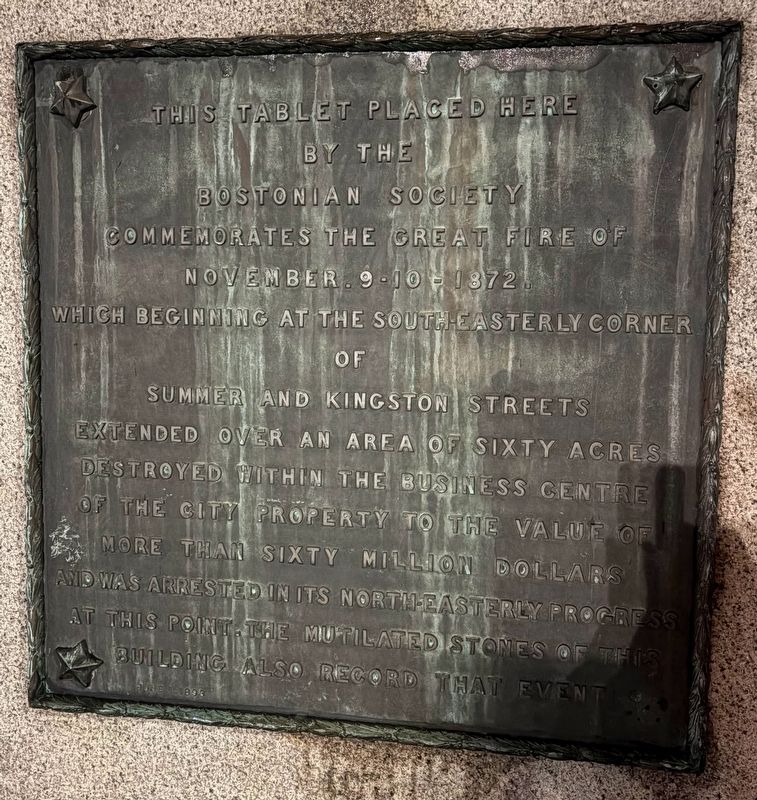
Photographed by Sean P. Flynn, November 6, 2026
1. The Great Fire of November 9-10, 1872 Marker
Erected 1893 by The Bostonian Society.
Topics. This historical marker is listed in this topic list: Disasters. A significant historical date for this entry is November 9, 1872.
Location. 42° 21.413′ N, 71° 3.432′ W. Marker is in Boston, Massachusetts, in Suffolk County. It is in the Financial District. It is at the intersection of Milk Street and Devonshire Street, on the left when traveling east on Milk Street. The marker is near the southwest corner of the John W. McCormack Post Office and Courthouse. Touch for map. Marker is at or near this postal address: 5 Post Office Square, Boston MA 02108, United States of America. Touch for directions.

Regionally, this marker is in Historic Boston. It
this page online
Other nearby markers. At least 8 other markers are within walking distance of this marker: Site of the House of Robert Treat Paine (within shouting distance of this marker); 45 Milk Street (within shouting distance of this marker); Federal Building (within shouting distance of this marker); The Great Spring (about 300 feet away, measured in a direct line); Winthrop Building (about 300 feet away); George Thorndike Angell (about 300 feet away); Old South Meeting House (about 300 feet away); Spring Lane (about 300 feet away). Touch for a list and map of all markers in Boston.
More about this marker. First organized as the Boston Antiquarian Club in 1879 and renamed in 1881, the Bostonian Society was founded as a historic preservation group dedicated to saving the Old State House, which had been slated to be dismantled and moved to Chicago,
Photographed by Sean P. Flynn, November 6, 2026
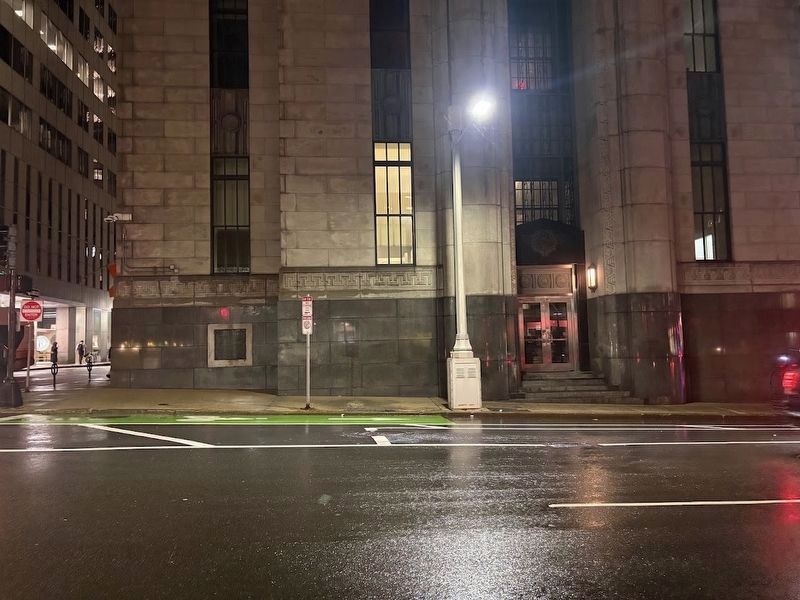
2. Marker for the Great Fire at the southwest corner of the post office
The "mutilated stones of this building" reference the United States Post Office and Sub-Treasury Building, which was under construction at this spot at the time of the Great Fire, and survived largely intact due to its use of fireproof materials.
The Boston Daily Globe reported on April 12, 1893, that the Bostonian Society was planning to erect a memorial at the post office at the corner of Devonshire and Milk to honor the spot where the fire was halted. It is assumed (but could not be confirmed) that the plaque was indeed dedicated there sometime that year. The old post office was torn down in 1929 and replaced four years later by the current structure, the John W. McCormack Post Office and Courthouse, where the tablet is embedded into the wall near its southeast corner,
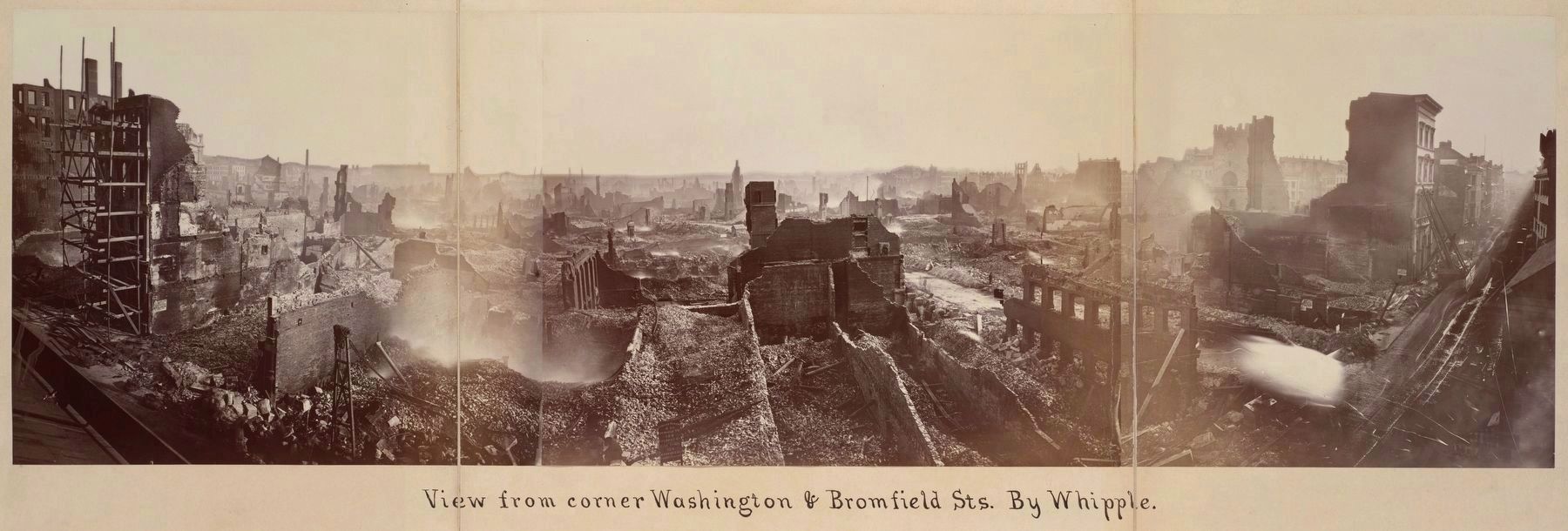
Photo by John Adams Whipple, courtesy of the Boston Public Library, 1872
3. A view of the fire's destruction
Regarding The Great Fire of November 9-10, 1872. The most destructive fire in Boston's history began on Nov. 9, 1872, in the basement of a warehouse housing dry goods, about a ¼-mile south of this plaque. Similar to the conditions in Chicago during its destructive fire just a year earlier, Boston's buildings were made primarily of wood, and its building codes were not enforced. Over the course of about 18 hours on Nov. 9, the fire spread across Downtown Boston, destroying 776 buildings and more than 65 acres of land, including most of the Financial District. The fire was quelled during the afternoon of November 10 near the new post office building that was under construction, the site of this plaque, which is only about 150 yards from the Old South Meeting House. Somewhere around 30 people are believed to have died in the conflagration, and property losses were estimated to be equal to roughly $2 billion in 2026 value.
Also see . . .
1. The Great Boston Fire of 1872. A history of the fire by the Boston Public Library.
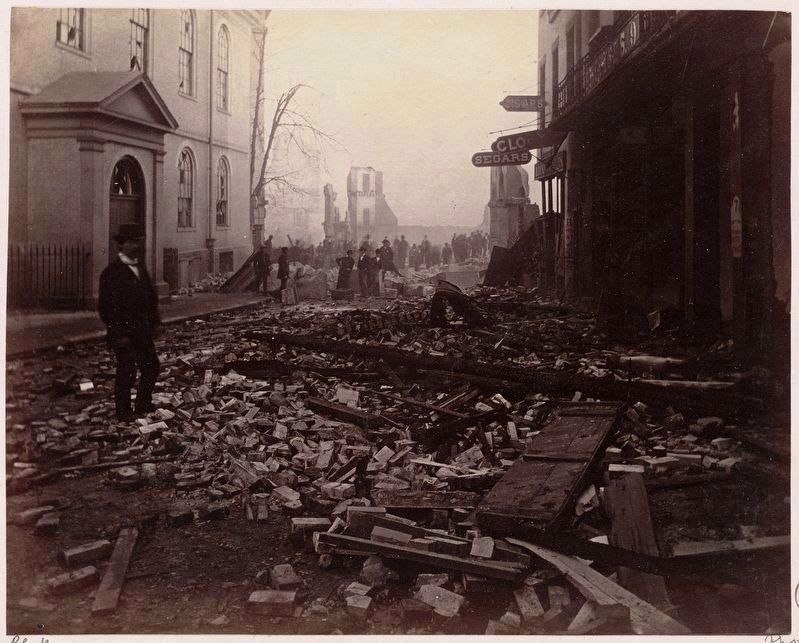
Excerpt: "In the aftermath of the fire, a Commission was appointed to investigate(Submitted on November 12, 2026, by Sean P. Flynn of Oak Park, Illinois.)the 'cause and management of the Great Fire in Boston.' The immediate cause of the fire was never discovered, but the Commission compiled a detailed report that highlighted the factors that had turned the fire into a catastrophe. As many of the buildings had been heavily insured, work to rebuild the area started quickly, but changes were introduced when planning the section so that the 'perfect storm' of circumstances that had produced the Great Boston Fire would never happen again."Photo by James Wallace Black, courtesy of Boston Public Library, 18724. After the fire: Milk Street near Old South Meeting HouseOld South Meeting House (its southeast corner visible in this photo) was spared in the fire, which was put out nearby during the afternoon of November 10, 1872. The site of the present-day historical marker commemorating the fire is about 125 yards in the distance.
2. History of Revolutionary Spaces.
Excerpt: "In 1879 a group of determined citizens formed the Boston Antiquarian Club to preserve and steward the Old State House. Two years later, the Boston Antiquarian Club reorganized as the Bostonian Society and created a museum of Boston’s history inside the Old State House."(Submitted on November 12, 2026, by Sean P. Flynn of Oak Park, Illinois.)
Credits. This page was last revised on November 12, 2026. It was originally submitted on November 12, 2026, by Sean P. Flynn of Oak Park, Illinois. This page has been viewed 11 times since then. Photos: 1, 2, 3, 4. submitted on November 12, 2026, by Sean P. Flynn of Oak Park, Illinois.
Editor’s want-list for this marker. This one could probably use a better, daytime photo of the marker's location at the Post Office. • Can you help?
