
King's Lynn in Norfolk, England, United Kingdom — Northwestern Europe (the British Isles)
Greyfriars Tower
Photographed by Ray Gurganus, April 29, 2026
1. Greyfriars Tower Marker
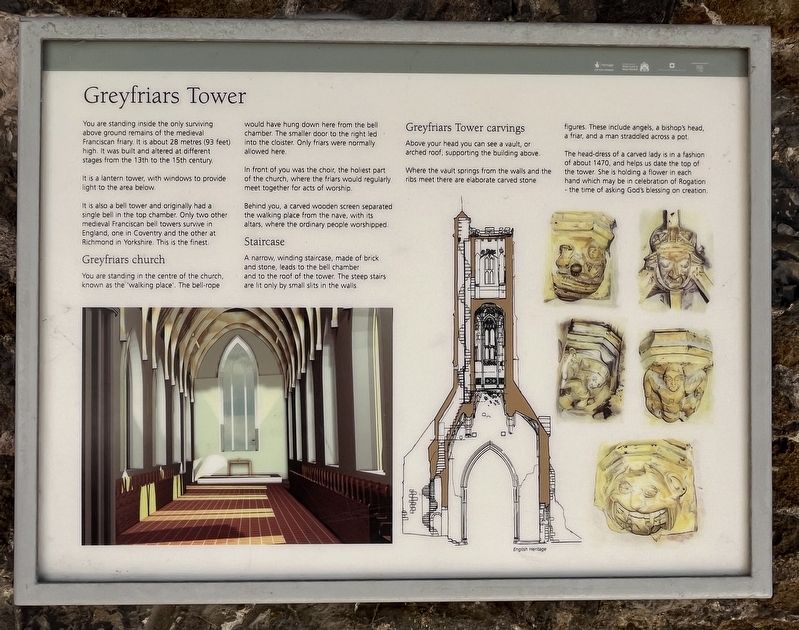
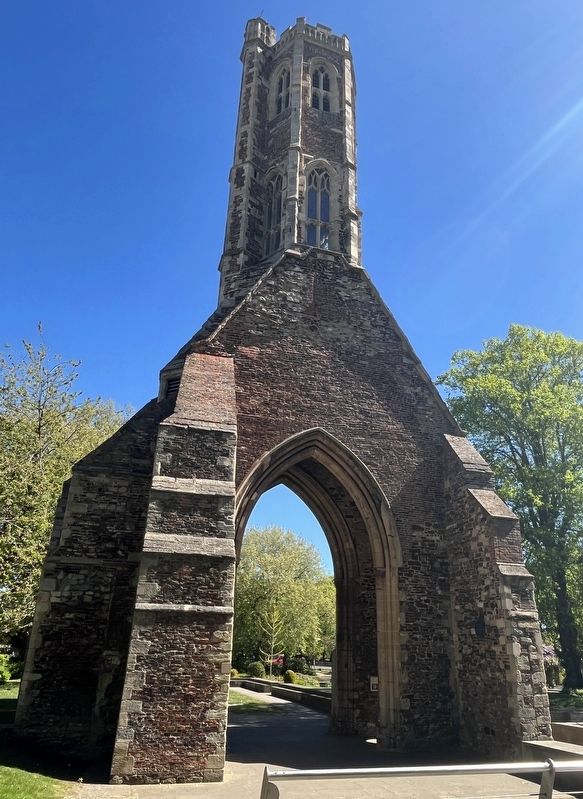
It is a lantern tower, with windows to provide light to the area below.
It is also a bell tower and originally had a single bell in the top chamber. Only two other medieval Franciscan bell towers survive in England, one in Coventry and the other at Richmond in Yorkshire. This is the finest.
Greyfriars church
You are standing in the centre of the church, known as the 'walking place. The bell-rope would have hung down here from the bell chamber. The smaller door to the right led into the cloister. Only friars were normally allowed here.
In front of you was the choir, the holiest part of the church, where the friars would regularly meet together for acts of worship.
Behind you, a carved wooden screen separated the walking place from the nave, with its altars, where the ordinary people worshipped.
Staircase
A narrow, winding staircase, made of brick and stone, leads to the bell chamber and to
this page online
Greyfriars Tower carvings
Above your head you can see a vault, or arched roof, supporting the building above.
Where the vault springs from the walls and the ribs meet there are elaborate carved stone figures. These include angels, a bishop's head, a friar, and a man straddled across a pot.
The head-dress of a carved lady is in a fashion of about 1470, and helps us date the top of the tower. She is holding a flower in each hand which may be in celebration of Rogation - the time of asking God's blessing on creation.
Erected by Borough Council of King's Lynn & West Norfolk.
Topics. This historical marker is listed in this topic list: Religion & Religious Structures.
Location. 52° 45.084′ N, 0° 23.943′ E. Marker is in King's Lynn, England, in Norfolk. It can be reached from Saint James Street, on the right when traveling east. The tower is located in Tower Gardens; the marker is located within the walkway in the tower. Touch for map. Marker is in this post office area: King's Lynn, England
Photographed by Ray Gurganus, April 29, 2026
2. Greyfriars Tower

Regionally, this marker is in East Anglia. Globally, it is on the Atlantic Ocean, in the North Atlantic Region, in Europe, in Atlantic Europe, on one of the British Isles, in the Western World, and in the Anglosphere. Historically, it finds itself in what was once the Roman Empire and also the Hanseatic League.
Other nearby markers. At least 8 other markers are within walking distance of this marker: Greyfriars, King's Lynn (a few steps from this marker); King's Lynn Greyfriars 1538 (within shouting distance of this marker); Tower Gardens (within shouting distance of this marker); Exploring Greyfriars Tower (within shouting distance of this marker); St James' Chapel (about 90 meters away, measured in a direct line); St James' Park (about 90 meters away); All Saints Church (about 180 meters away); Ladybridge (about 180 meters away). Touch for a list and map of all markers in King's Lynn.
Also see . . . List of buildings in King's Lynn (Wikipedia). Greyfriars Tower:
The Greyfriars Tower is the only remaining part of the Franciscan monastery on this site, and one of only three surviving Franciscan monastery towers in England and is considered to be the finest. It is a Grade I listed building.(Submitted on November 12, 2026.)
Following the Dissolution of the Monasteries by Henry VIII, nearly all such monasteries were demolished. The tower at Lynn remained because it was considered to be a useful seamark by sailors entering the town, still being clearly visible on the town's skyline to this day.
The tower is informally referred to as 'the leaning tower of Lynn'as it leans dramatically to the west. At its worst, the lean was 67.5 centimetres – which given its height of more than 28 metres is just over 1 degree. This compares to 3.98 degrees on the Leaning Tower of Pisa.
Credits. This page was last revised on November 12, 2026. It was originally submitted on November 12, 2026, by Ray Gurganus of Washington, District of Columbia. This page has been viewed 11 times since then. Photos: 1, 2. submitted on November 12, 2026, by Ray Gurganus of Washington, District of Columbia. • Andrew Ruppenstein was the editor who published this page.
