
Mitte in Hannover in Region Hannover, Lower Saxony, Germany — Central Europe
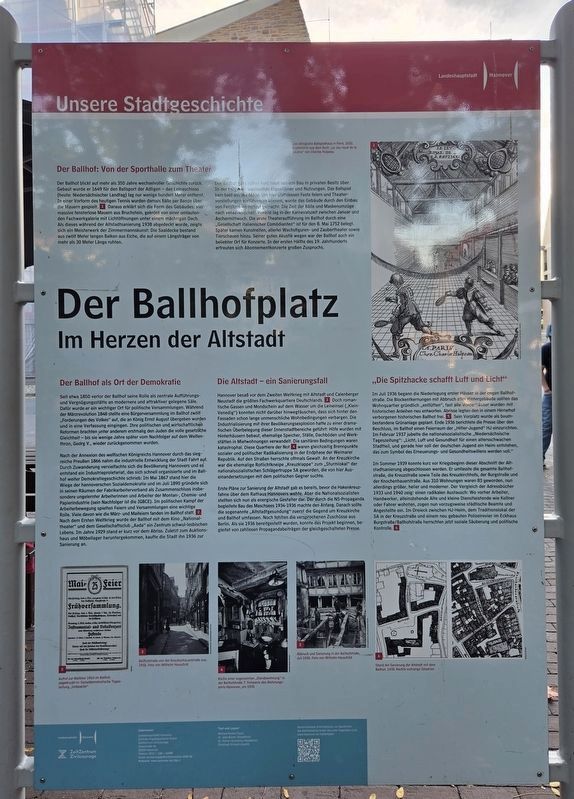
Der Ballhofplatz
Im Herzen der Altstadt
⎯⎯⎯
In the Heart of the Old Town
Photographed by James Hulse, October 7, 2026
1. Der Ballhofplatz Marker

Der Ballhofplatz
Im Herzen der Altstadt
Der Ballhof: Von der Sporthalle zum Theater
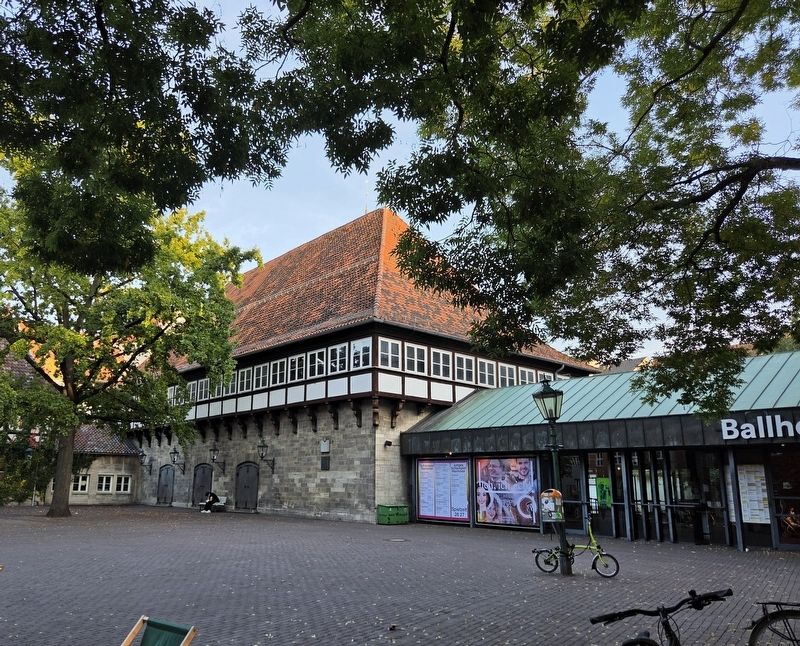
Der Ballhof blickt auf mehr als 350 Jahre wechselvoller Geschichte zurück. Gebaut wurde er 1649 für den Ballsport der Adligen – das Leineschloss (heute: Niedersächsischer Landtag) lag nur wenige hundert Meter entfernt. In einer Vorform des heutigen Tennis wurden damals Bälle per Bande über die Mauern gespielt. [1] Daraus erklärt sich die Form des Gebäudes: vier massive fensterlose Mauern aus Bruchstein, gekrönt von einer umlaufenden Fachwerkgalerie mit Lichtöffnungen unter einem mächtigen Dach. Als dieses während der Altstadtsanierung 1938 abgedeckt wurde, zeigte sich ein Meisterwerk der Zimmermannskunst: Die Saaldecke bestand aus zwölf Meter langen Balken aus Eiche, die auf einem Längsträger von mehr als 30 Meter Länge ruhten.
Der Ballhof ging schon kurz nach seinem Bau in privaten Besitz über. In der Folgezeit wechselten Eigentümer und Nutzungen. Das Ballspiel kam bald aus der Mode. Um hier stattdessen Feste feiern und Theater- vorstellungen vorführen zu können, wurde das Gebäude durch
this page online
Der Ballhof als Ort der Demokratie
Seit etwa 1850 verlor der Ballhof seine Rolle als zentrale Aufführungs- und Vergnügungsstätte an modernere und attraktiver gelegene Säle. Dafür wurde er ein wichtiger Ort für politische Versammlungen. Während der Märzrevolution 1848 stellte eine Bürgerversammlung im Ballhof zwölf 'Forderungen des Volkes' auf, die an König Ernst August übergeben wurden und in eine Verfassung eingingen. Ihre politischen und wirtschaftlichen Reformen brachten unter anderem erstmalig den Juden die volle gesetzliche Gleichheit – bis sie wenige Jahre später
Photographed by James Hulse, October 7, 2026
2. Der Ballhofplatz Marker
Nach der Annexion des welfischen Königreichs Hannover durch das sieg- reiche Preußen 1866 nahm die industrielle Entwicklung der Stadt Fahrt auf. Durch Zuwanderung vervielfachte sich die Bevölkerung Hannovers und es entstand ein Industrieproletariat, das sich schnell organisierte und im Ball- hof weiter Demokratiegeschichte schrieb: Im Mai 1867 stand hier die Wiege der hannoverschen Sozialdemokratie und im Juli 1890 gründete sich in seinen Räumen der Fabrikarbeiterverband als Zusammenschluss insbe- sondere ungelernter Arbeiterinnen und Arbeiter der Montan-, Chemie- und Papierindustrie (sein Nachfolger ist die IGBCE). Im politischen Kampf der Arbeiterbewegung spielten Feiern und Versammlungen eine wichtige Rolle. Viele davon wie die Winter- und Maifeiern fanden im Ballhof statt. [2] Nach dem Ersten Weltkrieg wurde der Ballhof mit dem Kino 'National- theater' und dem Gesellschaftsclub 'Aada' ein Zentrum schwul-lesbischen Lebens. Im Jahre 1929 stand er kurz vor dem Abriss. Zuletzt zum Auktions- haus und Möbellager heruntergekommen, kaufte die
Photographed by James Hulse, October 7, 2026
3. Der Ballhofplatz Marker
Die Altstadt – ein Sanierungsfall
Hannover besaß vor dem Zweiten Weltkrieg mit Altstadt und Calenberger Neustadt die größten Fachwerkquartiere Deutschlands. [3] Doch roman- tische Gassen und Mondschein auf dem Wasser um die Leineinsel ('Klein- Venedig') konnten nicht darüber hinwegtäuschen, dass sich hinter den Fassaden schon lange unmenschliche Wohnbedingungen verbargen. Die Industrialisierung mit ihrer Bevölkerungsexplosion hatte zu einer drama- tischen Überbelegung dieser Innenstadtbereiche geführt: Höfe wurden mit Hinterhäusern bebaut, ehemalige Speicher, Ställe, Dachböden und Werk- stätten in Mietwohnungen verwandelt. Die sanitären Bedingungen waren katastrophal. Diese Quartiere der Not [4] waren gleichzeitig Brennpunkte sozialer und politischer Radikalisierung in der Endphase der Weimarer Republik. Auf den Straßen herrschte oftmals Gewalt. An der Kreuzkirche war die ehemalige Rotlichtkneipe 'Kreuzklappe' zum 'Sturmlokal' der nationalsozialistischen Schlägertruppe SA geworden, die von hier Aus- einandersetzungen mit dem politischen Gegner suchte.
Erste Pläne zur Sanierung der
Photographed by James Hulse, October 7, 2026
4. Der Ballhofplatz
'Die Spitzhacke schafft Luft und Licht'
Im Juli 1936 begann die Niederlegung erster Häuser in der engen Ballhof- straße. Die Blockentkernungen mit Abbruch aller Hintergebäude sollten das Wohnquartier gründlich 'entlüften', fast alle Vorderhäuser wurden mit historischen Anleihen neu entworfen. Abrisse legten den in einem Hinterhof verborgenen historischen Ballhof frei. [5] Sein Vorplatz wurde als baum- bestandene Grünanlage geplant. Ende 1936 berichtete die Presse über den Beschluss, im Ballhof einen Feierraum der 'Hitler-Jugend' (HJ) einzurichten. Im Februar 1937 jubelte die nationalsozialistische
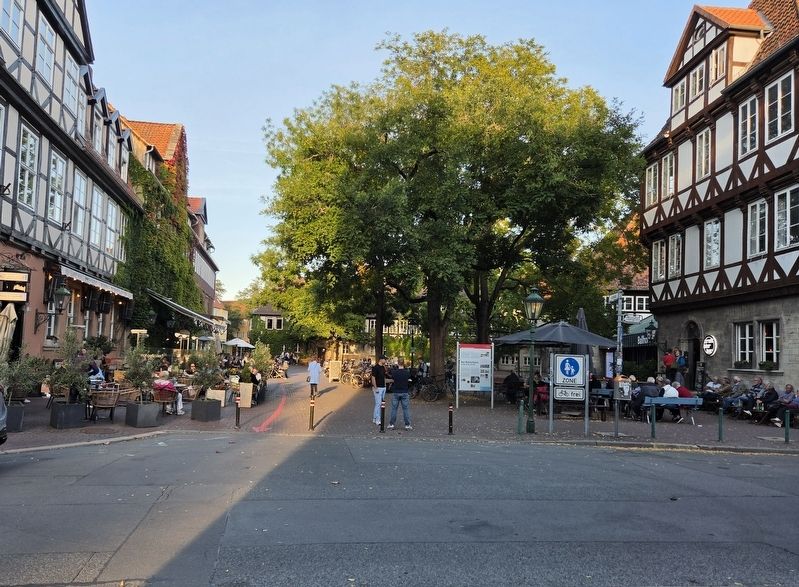
Photographed by James Hulse, October 7, 2026
5. Der Ballhofplatz Marker
Im Sommer 1939 konnte kurz vor Kriegsbeginn dieser Abschnitt der Alt- stadtsanierung abgeschlossen werden. Er umfasste die gesamte Ballhof- straße, die Kreuzstraße sowie Teile des Kreuzkirchhofs, der Burgstraße und der Knochenhauerstraße. Aus 310 Wohnungen waren 83 geworden, nun allerdings größer, heller und moderner. Der Vergleich der Adressbücher 1933 und 1940 zeigt einen radikalen Austausch: Wo vorher Arbeiter, Handwerker, alleinstehende Alte und kleine Dienstleistende wie Kellner oder Fahrer wohnten, zogen nun vorzugsweise städtische Beamte und Angestellte ein. Im Dreieck zwischen HJ-Heim, dem Traditionslokal der SA in der Kreuzstraße und einem neu gebauten Polizeirevier im Eckhaus Burgstraße/Ballhofstraße herrschten jetzt soziale Säuberung und politische Kontrolle. [6]
Bildunterschriften
1. Das königliche Ballspielhaus in Paris, 1632. Kupferstich aus dem Buch 'Le Jeu royal de la paume' von Charles Hulpeau.
2. Aufruf zur Maifeier 1914 im Ballhof, abgedruckt in: Sozialdemokratische Tageszeitung 'Volkswille'.
3. Ballhofstraße von der Knochenhauerstraße aus, 1932. Foto von Wilhelm Hauschild.
4. Küche einer sogenannten 'Elendswohnung' in der Ballhofstraße 7. Fotoserie des Wohnungsamts Hannover, um 1935.
5. Abbruch und Sanierung in der Ballhofstraße, Juli 1936. Foto von Wilhelm Hauschild.
6. Stand der Sanierung der Altstadt mit dem Ballhof, 1939. Rechts vorherige Situation.
Heime für 'Hitler-Jugend' und 'Bund Deutscher Mädel'
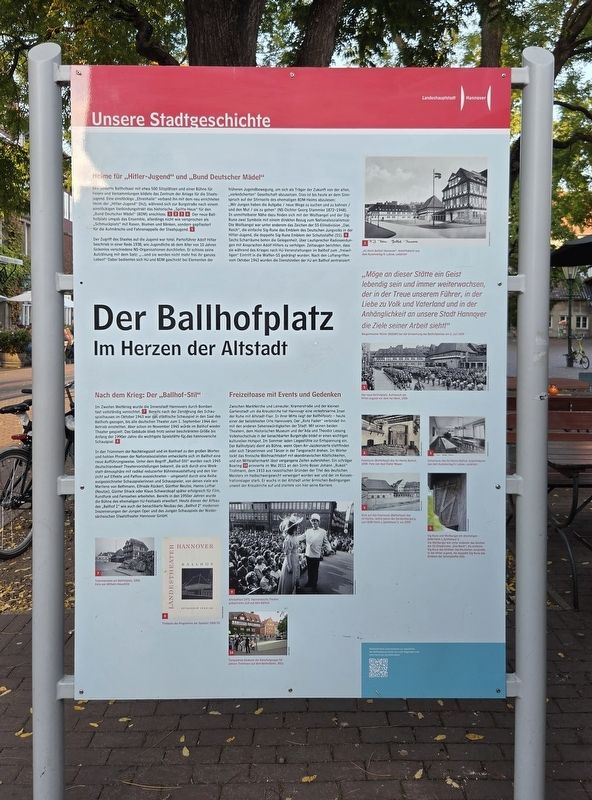
Der sanierte Ballhofsaal mit etwa 500 Sitzplätzen und einer Bühne für Feiern und Versammlungen bildete das Zentrum der Anlage für die Staats- jugend. Eine einstöckige 'Ehrenhalle' verband ihn mit dem neu errichteten Heim der 'Hitler-Jugend' (HJ), während sich zur Burgstraße nach einem einstöckigen Verbindungstrakt das historische 'Spitta-Haus' für den 'Bund Deutscher Mädel' (BDM) anschloss. [1–4] Der neue Ballhofplatz umgab das Ensemble, allerdings nicht wie versprochen als 'Schmuckplatz' mit Rasen, Blumen und Bänken, sondern gepflastert für die Aufmärsche und Fahnenappelle der Staatsjugend. [5]
Der Zugriff des Staates auf die Jugend war total. Parteiführer Adolf Hitler beschrieb in einer Rede 1938, wie Jugendliche ab dem Alter von 10 Jahren lückenlos verschiedene NS-Organisationen durchliefen. Er schloss seine Aufzählung mit dem Satz: '…und sie werden nicht mehr frei ihr ganzes Leben!' Dabei bedienten sich HJ und BDM geschickt bei Elementen der früheren Jugendbewegung, um sich als Träger der Zukunft von der alten, 'verknöcherten' Gesellschaft abzusetzen. Dies ist bis heute an dem Sinn- spruch auf der Stirnseite des ehemaligen BDM-Heims abzulesen: 'Wir Jungen haben die Aufgabe / neue Wege zu suchen und zu bahnen / und den Mut / sie zu gehen' (NS-Dichter Georg Stammler 1872–1948). In unmittelbarer Nähe dazu finden sich mit der Wolfsangel und der Sig- Rune zwei Symbole mit einem direkten Bezug zum Nationalsozialismus: Die Wolfsangel war unter anderem das Zeichen der SS-Elitedivision 'Das Reich', die einfache Sig-Rune das Emblem des Deutschen Jungvolks in der Hitler-Jugend, die doppelte Sig-Rune Emblem der Schutzstaffel (SS). [6] Sechs Scharräume boten die Gelegenheit, über Lautsprecher Radiosendun- gen mit Ansprachen Adolf Hitlers zu verfolgen. Zeitzeugen berichten, dass sie während des Krieges nach HJ-Veranstaltungen im Ballhof zum 'freiwil- ligen' Eintritt in die Waffen-SS gedrängt wurden. Nach den Luftangriffen vom Oktober 1943 wurden die Dienststellen der HJ am Ballhof zentralisiert.
'Möge an dieser Stätte ein Geist lebendig sein und immer weiterwachsen, der in der Treue unserem Führer, in der Liebe zu Volk und Vaterland und in der Anhänglichkeit an unsere Stadt Hannover die Ziele seiner Arbeit sieht!'
Bürgermeister Müller (NSDAP) bei der Einweihung des Ballhofplatzes am 2. Juli 1939.
Nach dem Krieg: Der 'Ballhof-Stil'
Im Zweiten Weltkrieg wurde die Innenstadt Hannovers durch Bomben fast vollständig vernichtet. [7] Bereits nach der Zerstörung des Schau- spielhauses im Oktober 1943 war das städtische Schauspiel in den Saal des Ballhofs gezogen, bis alle deutschen Theater zum 1. September 1944 den Betrieb einstellten. Aber schon im November 1945 wurde im Ballhof wieder Theater gespielt. Das Gebäude blieb trotz seiner beschränkten Größe bis Anfang der 1990er Jahre die wichtigste Spielstätte für das hannoversche Schauspiel. [8]
In den Trümmern der Nachkriegszeit und im Kontrast zu den großen Worten und hohlen Phrasen der Nationalsozialisten entwickelte sich im Ballhof eine neue Aufführungsweise. Unter dem Begriff 'Ballhof-Stil' wurden nach 1945 deutschlandweit Theatervorstellungen bekannt, die sich durch eine Werk- statt-Atmosphäre mit radikal reduzierter Bühnenausstattung und den Ver- zicht auf Effekte und Pathos auszeichneten – umgesetzt durch eine Reihe ausgezeichneter Schauspielerinnen und Schauspieler, von denen viele wie Marlene von Bethmann, Elfriede Rückert, Günther Neutze, Hanns Lothar (Neutze), Günter Strack oder Klaus Schwarzkopf später erfolgreich für Film, Rundfunk und Fernsehen arbeiteten. Bereits in den 1950er Jahren wurde die Bühne des ehemaligen HJ-Festsaals erweitert. Heute dienen der Altbau des 'Ballhof 1' wie auch der benachbarte Neubau des 'Ballhof 2' modernen Inszenierungen der Jungen Oper und des Jungen Schauspiels der Nieder- sächsischen Staatstheater Hannover GmbH.
Freizeitoase mit Events und Gedenken
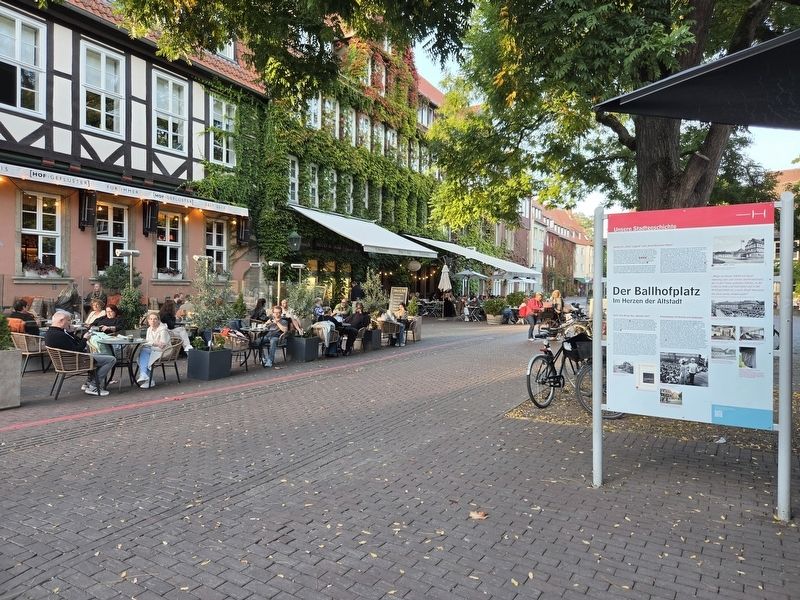
Zwischen Marktkirche und Leineufer, Kramerstraße und der kleinen Gartenstadt um die Kreuzkirche hat Hannover eine verkehrsarme Insel der Ruhe mit Altstadt-Flair. In ihrer Mitte liegt der Ballhofplatz – heute einer der beliebtesten Orte Hannovers. Der 'Rote Faden' verbindet ihn mit den anderen Sehenswürdigkeiten der Stadt. Mit seinen beiden Theatern, dem Historischen Museum und der Ada und Theodor Lessing Volkshochschule in der benachbarten Burgstraße bildet er einen wichtigen kulturellen Hotspot. Im Sommer laden Liegestühle zur Entspannung ein. Der Ballhofplatz dient als Bühne, wenn Open-Air-Jazzkonzerte stattfinden oder sich Tänzerinnen und Tänzer in der Tangonacht drehen. Im Winter lockt das finnische Weihnachtsdorf mit skandinavischen Köstlichkeiten, und ein Mittelaltermarkt lässt vergangene Zeiten auferstehen. Ein schräger Boxring [10] erinnerte im Mai 2011 an den Sinto-Boxer Johann 'Rukeli' Trollmann, dem 1933 aus rassistischen Gründen der Titel des deutschen Meisters im Halbschwergewicht verweigert worden war und der im Konzen- trationslager starb. Er wuchs in der Altstadt unter ärmlichen Bedingungen unweit der Kreuzkirche auf und startete von hier seine Karriere.
Bildunterschriften
1. 'HJ Heim Ballhof Hannover'. Ansichtskarte aus dem Kunstverlag H. Lukow, undatiert.
2. Feierraum (Ballhofsaal) des HJ-Heims Ballhof, 1939. Foto von Axel Dieter Mayen.
3. Scharraum des HJ-Heims Ballhof. Ansichtskarte aus dem Kunstverlag H. Lukow, undatiert.
4. Blick auf den Feierraum (Ballhofsaal) des HJ-Heims, rechts davon der Verbindungsgang zum BDM-Heim ('Spittahaus'), um 1939.
5. Der neue Ballhofplatz: Aufmarsch der Hitler-Jugend vor dem HJ-Heim, 1939.
6. Sig-Rune und Wolfsangel am ehemaligen BDM-Heim ('Spittahaus'). Die Wolfsangel war unter anderem das Zeichen der SS-Elitedivision 'Das Reich', die einfache Sig-Rune das Emblem des Deutschen Jungvolks in der Hitler-Jugend, die doppelte Sig-Rune das Emblem der Schutzstaffel (SS).
7. Trümmerreste am Ballhofplatz, 1956. Foto von Wilhelm Hauschild.
8. Titelseite des Programms der Spielzeit 1950/51.
9. Altstadtfest 1971: Hannoversche Theater präsentieren sich auf dem Ballhof.
10. Temporäres Denkmal der Künstlergruppe für Johann Trollmann auf dem Ballhofplatz, 2011.
Our City History
Ballhofplatz
In the Heart of the Old Town
The Ballhof: From Sports Hall to Theater
The Ballhof looks back on more than 350 years of varied history. It was built in 1649 for a ball game played by the nobility. The Leineschloss, now home to the Lower Saxony State Parliament, stood only a few hundred meters away. In an early form of modern tennis, players used the walls to play rebound shots. [1] This explains the building’s shape: four massive, windowless rubble stone walls topped by a timber-framed gallery with openings for light, all beneath a large roof. When the roof was uncovered during the 1938 renovation of the old town, it revealed a masterpiece of carpentry. The hall ceiling consisted of oak beams twelve meters long, resting on a longitudinal beam more than thirty meters long.
The Ballhof passed into private ownership shortly after it was built. Its owners and uses changed over time. The ball game soon fell out of fashion. Windows were installed to bring in more light so that celebrations and theatrical performances could take place. Venetian-style balls and masked processions were held during the carnival season between January and Ash Wednesday. The first documented theatrical performance at the Ballhof was given by a ‘Company of Italian Comedians’ on May 8, 1752. Equestrian displays, waxwork and magic shows, and animal exhibitions followed. Its good acoustics also made the Ballhof a popular concert venue. Subscription concerts attracted large audiences in the first half of the 19th century.
The Ballhof as a Place of Democracy
From around 1850, the Ballhof lost its role as the city’s main performance and entertainment venue to newer halls in more attractive locations. It became an important place for political meetings. During the March Revolution of 1848, a citizens’ assembly at the Ballhof drew up twelve ‘Demands of the People’. These were presented to King Ernst August and incorporated into a constitution. The political and economic reforms granted Jews full legal equality for the first time, until George V, Ernst August’s successor on the Hanoverian throne, revoked those rights a few years later.
After victorious Prussia annexed the Kingdom of Hannover in 1866, the city’s industrial development accelerated. Migration multiplied its population and created an industrial working class that quickly organized and continued to make democratic history at the Ballhof. Hannover’s Social Democratic movement began here in May 1867. In July 1890, the Factory Workers’ Union was founded here, bringing together mainly unskilled workers in mining and metals, chemicals and papermaking. Its successor is the IGBCE. Celebrations and meetings played an important role in the labor movement’s political struggle. Many, including winter festivities and May Day celebrations, took place at the Ballhof. [2] After World War I, the ‘Nationaltheater’ cinema and the ‘Aada’ social club made the Ballhof a center of gay and lesbian life. In 1929 it nearly faced demolition. By then reduced to an auction house and furniture warehouse, it was purchased by the city for renovation in 1936.
The Old Town in Need of Renovation
Before World War II, Hannover’s old town and Calenberger Neustadt contained Germany’s largest districts of timber-framed buildings. [3] Yet picturesque lanes and moonlight on the water around the Leine Island (‘Little Venice’) could not disguise the inhumane living conditions that had long existed behind the façades. Industrialization and rapid population growth had left these inner-city districts severely overcrowded. Buildings were erected in courtyards, and former storehouses, stables, attics and workshops were converted into rental housing. Sanitation was appalling. These impoverished districts [4] also became centers of social and political radicalization in the final phase of the Weimar Republic. Street violence was common. Near the Kreuzkirche, the ‘Kreuzklappe’, a former tavern in the red-light district, had become a meeting place for the Nazi SA, whose members sought confrontations with political opponents.
Plans to renovate the old town existed before the swastika flag flew over Hannover’s city hall. The Nazis, however, presented themselves as the driving force behind the changes. The construction of the Maschsee in 1934–1936, promoted by Nazi propaganda, came first. The so-called ‘rehabilitation of the old town’ was then to begin around the Kreuzkirche and Ballhof. The promised funding from Berlin had yet to arrive. Once it was provided in 1936, the project went ahead amid extensive propaganda coverage in the Nazi-controlled press.
‘The Pickaxe Brings Air and Light’
In July 1936, demolition began on the first houses along narrow Ballhofstraße. Removing the rear buildings from the blocks was meant to ‘air out’ the residential district. Almost all the street-facing buildings were redesigned with historical features. Demolition exposed the historic Ballhof, which had been hidden in a courtyard. [5] The space in front was planned as a tree-lined green. In late 1936, the press reported that a ceremonial hall for the Hitler Youth (HJ) would be set up in the Ballhof. In February 1937, the Nazi newspaper ‘Niedersächsische Tageszeitung’ declared: ‘Light, air and health for an aging district, and here of all places German youth is to have a home that will become a symbol of the will to renew and improve health.’
This phase of the old town renovation was completed in summer 1939, shortly before the war began. It covered all of Ballhofstraße and Kreuzstraße as well as parts of Kreuzkirchhof, Burgstraße and Knochenhauerstraße. The number of apartments fell from 310 to 83, although the new apartments were larger, brighter and more modern. The 1933 and 1940 directories show a drastic change in residents. Workers, tradespeople, elderly people living alone and service workers such as waiters and drivers were largely replaced by municipal officials and employees. The area between the Hitler Youth home, the SA’s longtime meeting place on Kreuzstraße and a newly built police station at the corner of Burgstraße and Ballhofstraße was now subject to social purging and political control. [6]
Image Captions
1. The royal tennis court in Paris, 1632. Copper engraving from Charles Hulpeau’s book ‘Le Jeu royal de la paume’.
2. Announcement for the 1914 May Day celebration at the Ballhof, printed in the Social Democratic daily newspaper ‘Volkswille’.
3. Ballhofstraße viewed from Knochenhauerstraße, 1932. Photo by Wilhelm Hauschild.
4. Kitchen of a so-called ‘slum dwelling’ at Ballhofstraße 7. Hannover Housing Office photo series, around 1935.
5. Demolition and renovation on Ballhofstraße, July 1936. Photo by Wilhelm Hauschild.
6. Progress of the old town renovation around the Ballhof in 1939. The previous layout is shown on the right.
Homes for the Hitler Youth and the League of German Girls
The renovated Ballhof hall, with about 500 seats and a stage for ceremonies and assemblies, was the center of the complex for the state youth organizations. A single-story ‘hall of honor’ connected it to the newly built Hitler Youth home. Toward Burgstraße, a single-story passage linked it to the historic Spitta House, which housed the League of German Girls (BDM). [1–4] The new Ballhofplatz surrounded the complex. Although it had been promised as a decorative square with lawns, flowers and benches, it was paved for youth marches and flag assemblies. [5]
The state’s control over young people was total. In a 1938 speech, Nazi Party leader Adolf Hitler described how, from age ten, young people passed from one Nazi organization to the next without interruption. He ended his list by saying: ‘…and they will never be free again for the rest of their lives!’ The Hitler Youth and the League of German Girls drew on elements of the earlier youth movement to set themselves apart from the old, ‘ossified’ society and present themselves as the generation of the future. This can still be seen in the inscription on the front of the former BDM home: ‘We young people have the task / of seeking and opening new paths / and the courage / to follow them’ (Nazi poet Georg Stammler, 1872–1948). Nearby are two symbols directly associated with National Socialism: the Wolfsangel and the Sig rune. The Wolfsangel was used, among other things, as the insignia of the elite SS division ‘Das Reich’. The single Sig rune was the emblem of the Deutsches Jungvolk, the junior branch of the Hitler Youth, and the double Sig rune was the emblem of the SS. [6] Six squad rooms were equipped with loudspeakers for listening to radio broadcasts of Hitler’s speeches. Witnesses recalled that, during the war, they were pressured to ‘volunteer’ for the Waffen-SS after Hitler Youth events at the Ballhof. After the air raids of October 1943, the Hitler Youth offices were consolidated at the Ballhof.
‘May a spirit live and continue to grow here, one that sees the goals of its work in loyalty to our Führer, in love of people and fatherland, and in attachment to our city of Hannover!’
Mayor Müller (Nazi Party), at the dedication of Ballhofplatz on July 2, 1939.
After the War: The ‘Ballhof Style’
Bombing almost completely destroyed central Hannover during World War II. [7] After the Schauspielhaus was destroyed in October 1943, the municipal theater company moved into the Ballhof hall. All German theaters closed effective September 1, 1944, but performances resumed at the Ballhof as early as November 1945. Despite its limited size, the building remained Hannover’s principal venue for drama until the early 1990s. [8]
Amid the ruins of the postwar years, and in contrast to the grand words and empty phrases of the Nazis, a new performance style emerged at the Ballhof. After 1945, the ‘Ballhof style’ became known across Germany for its workshop atmosphere, spare sets and avoidance of theatrical effects and grand gestures. It was developed by outstanding performers, many of whom later worked successfully in film, radio and television, including Marlene von Bethmann, Elfriede Rückert, Günther Neutze, Hanns Lothar (Neutze), Günter Strack and Klaus Schwarzkopf. The stage of the former Hitler Youth ceremonial hall was enlarged in the 1950s. Today, the historic Ballhof 1 and the neighboring, newer Ballhof 2 stage contemporary productions by the Young Opera and Young Drama divisions of the Lower Saxony State Theaters in Hannover.
A Place for Leisure, Events and Remembrance
Between the Market Church and the banks of the Leine, Kramerstraße and the small garden district around the Kreuzkirche, Hannover has a quiet pocket of the old town with little traffic. At its center is Ballhofplatz, now one of Hannover’s favorite places. The ‘Red Thread’ walking route connects it with the city’s other sights. Its two theaters, the Historical Museum and the Ada and Theodor Lessing Adult Education Center on nearby Burgstraße make it a cultural gathering place. In summer, deck chairs invite visitors to relax. The square becomes a stage for open-air jazz concerts and tango nights. In winter, the Finnish Christmas village offers Scandinavian specialties, and a medieval market brings the past to life. In May 2011, a tilted boxing ring [10] commemorated the Sinti boxer Johann ‘Rukeli’ Trollmann, who was denied the German light heavyweight title in 1933 on racist grounds and died in a concentration camp. He grew up in poverty in the old town near the Kreuzkirche and began his career here.
Image Captions
1. ‘Hitler Youth Home, Ballhof, Hannover’. Undated postcard published by H. Lukow.
2. Ceremonial hall (Ballhof hall) of the Ballhof Hitler Youth home, 1939. Photo by Axel Dieter Mayen.
3. Squad room in the Ballhof Hitler Youth home. Undated postcard published by H. Lukow.
4. View of the ceremonial hall of the Hitler Youth home, with the passage to the League of German Girls home (‘Spitta House’) on the right, around 1939.
5. The new Ballhofplatz: Hitler Youth parade in front of the Hitler Youth home, 1939.
6. Sig rune and Wolfsangel at the former League of German Girls home (‘Spitta House’). The Wolfsangel was used, among other things, as the insignia of the elite SS division ‘Das Reich’. The single Sig rune was the emblem of the Deutsches Jungvolk in the Hitler Youth, and the double Sig rune was the emblem of the SS.
7. Rubble at Ballhofplatz, 1956. Photo by Wilhelm Hauschild.
8. Cover of the 1950/51 season program.
9. Old Town Festival, 1971: Hannover’s theaters perform at the Ballhof.
10. Temporary memorial to Johann Trollmann by an artists’ group at Ballhofplatz, 2011.
Erected by City of Hannover, ZeitZentrum Zivilcourage.
Topics. This historical marker is listed in this topic list: Notable Places. A significant historical month for this entry is February 1937.
Location. 52° 22.344′ N, 9° 43.938′ E. Marker is in Hannover, Niedersachsen (Lower Saxony), in Region Hannover. It is in Mitte. It is at the intersection of Burgstraße and Ballhofpl., on the right when traveling north on Burgstraße. Touch for map. Marker is at or near this postal address: Burgstraße 23, Hannover NI 30159, Germany. Touch for directions.

Regionally, it is in Europe, the European Union, Atlantic Europe, Central Europe, the Schengen Area, Western Europe, and the Western World. Historically, it finds itself in what was once the Holy Roman Empire and also the former West Germany.
Other nearby markers. At least 8 other markers are within walking distance of this marker: Geschichte des Ballhofs / History of the Ballhof (a few steps from this marker); Karl Johann Philipp Spitta (a few steps from this marker); Hier lebte Herschel Grünspan (within shouting distance of this marker); Fachwerkhäuser der Altstadt / Half-timbered houses in the old town (within shouting distance of this marker); Ballhof (within shouting distance of this marker); Verband der Fabrikarbeiter Deutschlands / Association of Factory Workers of Germany (within shouting distance of this marker); Ballhofplatz / Ballhof Square (within shouting distance of this marker); Tor des Marstalls (within shouting distance of this marker). Touch for a list and map of all markers in Hannover.
Credits. This page was last revised on November 12, 2026. It was originally submitted on November 12, 2026, by James Hulse of Medina, Texas. This page has been viewed 5 times since then. Photos: 1, 2, 3, 4, 5. submitted on November 12, 2026, by James Hulse of Medina, Texas.
