Bremen-Mitte in Mitte, Germany — Central Europe
Altes Rathaus
⎯⎯⎯
Old Town Hall
Photographed by James Hulse, October 10, 2026
1. Altes Rathaus / Old Town Hall Marker

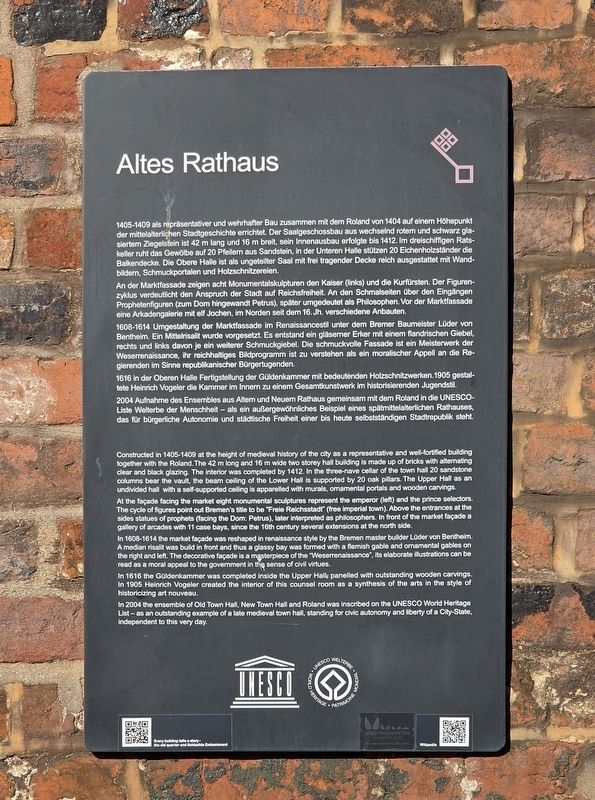
An der Marktfassade zeigen acht Monumentalskulpturen den Kaiser (links) und die Kurfürsten. Der Figurenzyklus verdeutlicht den Anspruch der Stadt auf Reichsfreiheit. An den Schmalseiten über den Eingängen Prophetenfiguren (zum Dom hingewandt Petrus), später umgedeutet als Philosophen. Vor der Marktfassade eine Arkadengalerie mit elf Jochen, im Norden seit dem 16. Jh. verschiedene Anbauten.
1608-1614 Umgestaltung der Marktfassade im Renaissancestil unter dem Bremer Baumeister Lüder von Bentheim. Ein Mittelrisalit wurde vorgesetzt. Es entstand
this page online
1616 in der Oberen Halle Fertigstellung der Güldenkammer mit bedeutenden Holzschnitzwerken. 1905 gestaltete Heinrich Vogeler die Kammer im Innern zu einem Gesamtkunstwerk im historisierenden Jugendstil.
2004 Aufnahme des Ensembles aus Altem und Neuem Rathaus gemeinsam mit dem Roland in die UNESCO-Liste Welterbe der Menschheit – als ein außergewöhnliches Beispiel eines spätmittelalterlichen Rathauses, das für bürgerliche Autonomie und städtische Freiheit einer bis heute selbstständigen Stadtrepublik steht.
Photographed by James Hulse, October 10, 2026
2. Altes Rathaus / Old Town Hall Marker
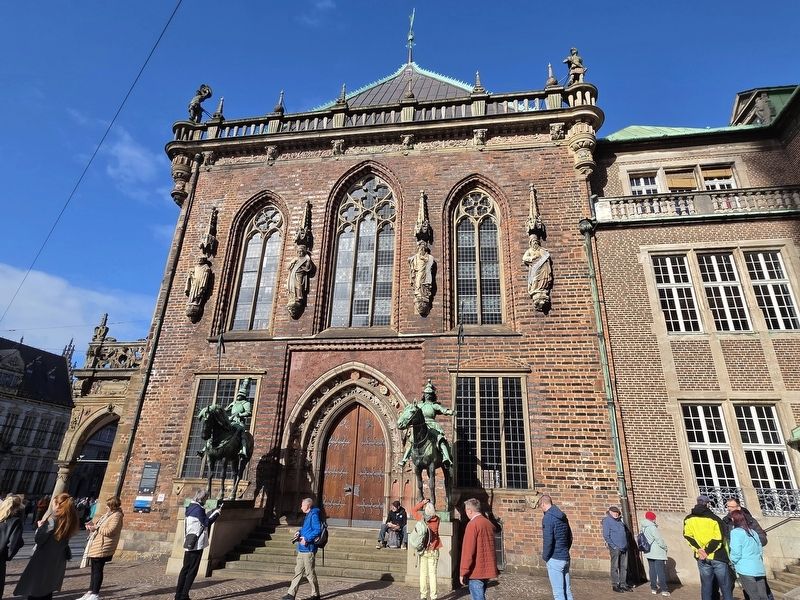
The view of the marker on the south side of the building.
At the façade facing the market eight monumental sculptures represent the emperor (left) and the prince selectors. The cycle of figures point out Bremen’s title to be “Freie Reichsstadt” (free imperial town). Above the entrances at the sides statues of prophets (facing the Dom: Petrus), later interpreted as philosophers. In front of the market façade a gallery of arcades with 11 case bays, since the 16th century several extensions at the north side.
In 1608-1614 the market façade was reshaped in renaissance style by the Bremen master builder Lüder von Bentheim. A median risalit was build in front and thus a glassy bay was formed with a flemish gable and ornamental gables on the right and left. The decorative façade is a masterpiece of the “Weserrenaissance”, its elaborate illustrations can be read as a moral appeal to the government in the sense of civil virtues.
In 1616 the
Photographed by James Hulse, October 10, 2026
3. Altes Rathaus / Old Town Hall Marker
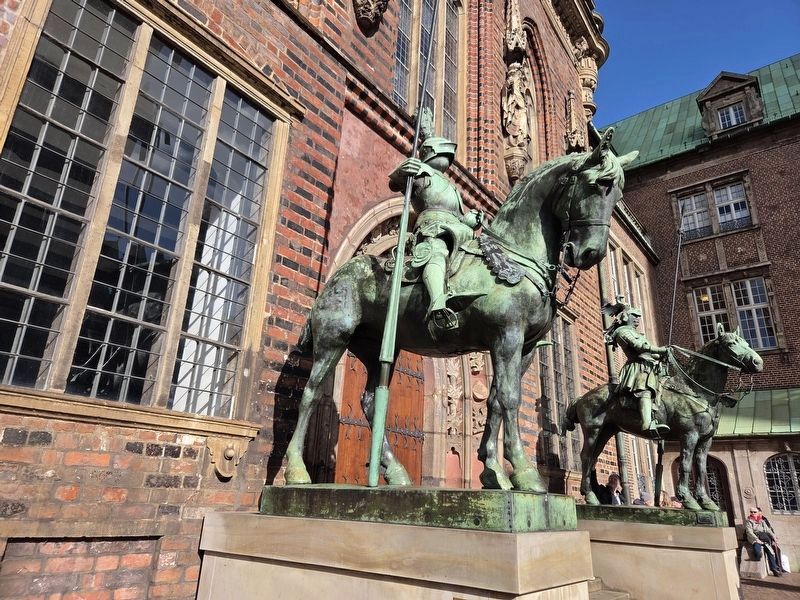
Two bronze equestrian statues flank a doorway at Bremen’s Old Town Hall (Altes Rathaus).
In 2004 the ensemble of Old Town Hall, New Town Hall and Roland was inscribed on the UNESCO World Heritage List – as an outstanding example of a late medieval town hall, standing for civic autonomy and liberty of a City-State, independent to this very day.
Erected by Bremen.
Topics and series. This historical marker is listed in this topic list: Notable Buildings. In addition, it is included in the Bremen Red Key series list. A significant historical year for this entry is 1404.
Location. 53° 4.547′ N, 8° 48.466′ E. Marker is in Bremen, in Mitte. It is in Bremen-Mitte. It is at the intersection of Am Markt and Am Dom, on the right when traveling north on Am Markt. Touch for map. Marker is at or near this postal address: Am Markt 21, Bremen 28195, Germany. Touch for directions.

Regionally, it is in Europe, the European Union, Atlantic Europe, Central Europe, the Schengen Area, Western Europe, and
Photographed by James Hulse, October 10, 2026
4. Altes Rathaus / Old Town Hall Marker
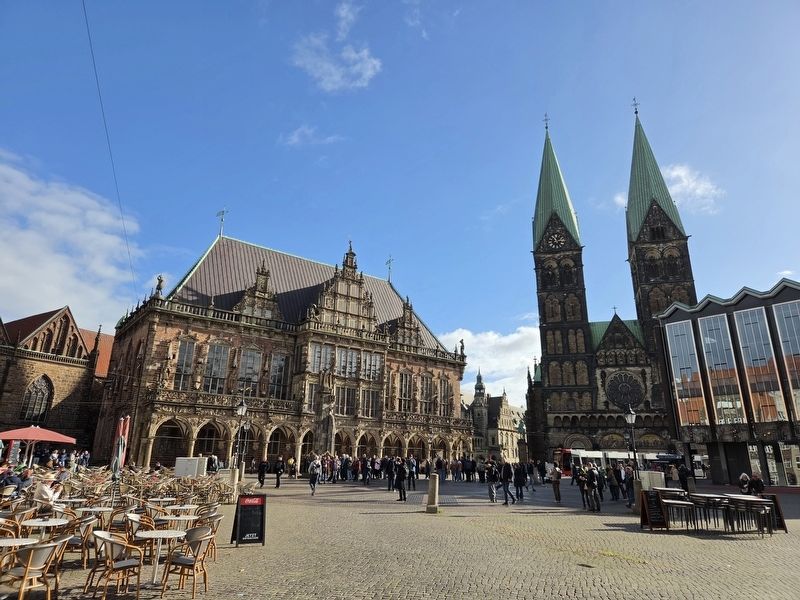
Looking northeast toward the Altes Rathaus, with Bremen Cathedral on the right.
Other nearby markers. At least 8 other markers are within walking distance of this marker: Ehrenfried Günther v. Hünefeld (within shouting distance of this marker); Neues Rathaus / New Town Hall (within shouting distance of this marker); a different marker also named Altes Rathaus / Old Town Hall (within shouting distance of this marker); St. Petri-Dom / St. Peter’s Cathedral (within shouting distance of this marker); Bismarck-Denkmal / Bismarck Monument (within shouting distance of this marker); Deutsches Haus (within shouting distance of this marker); a different marker also named St. Petri-Dom / St. Peter’s Cathedral (within shouting distance of this marker); Haus der Bürgerschaft / Parliament Building (within shouting distance of this marker). Touch for a list and map of all markers in Bremen.
Regarding Altes Rathaus / Old Town Hall. Two identical markers are mounted on the building, one on the north side and one on the south side.
Also see . . . Bremen City Hall. Wikipedia
Bremen City Hall (German: Bremer Rathaus) is the seat of the President of the Senate and Mayor of Bremen, Germany. It is one of the most important examples of Brick Gothic and Weser Renaissance architecture in Europe. Since 1973, it has been a protected historical building. In July 2004, along with the Bremen Roland statue, the building was added to the list of UNESCO World Heritage Sites because of its outstanding architecture and its testimony to the development of civic autonomy in the Holy Roman Empire.(Submitted on November 14, 2026, by James Hulse of Medina, Texas.)
Credits. This page was last revised on November 14, 2026. It was originally submitted on November 14, 2026, by James Hulse of Medina, Texas. This page has been viewed 6 times since then. Photos: 1, 2, 3, 4. submitted on November 14, 2026, by James Hulse of Medina, Texas.
