Bremen-Mitte in Mitte, Germany — Central Europe
St. Petri-Dom
⎯⎯⎯
St. Peter’s Cathedral
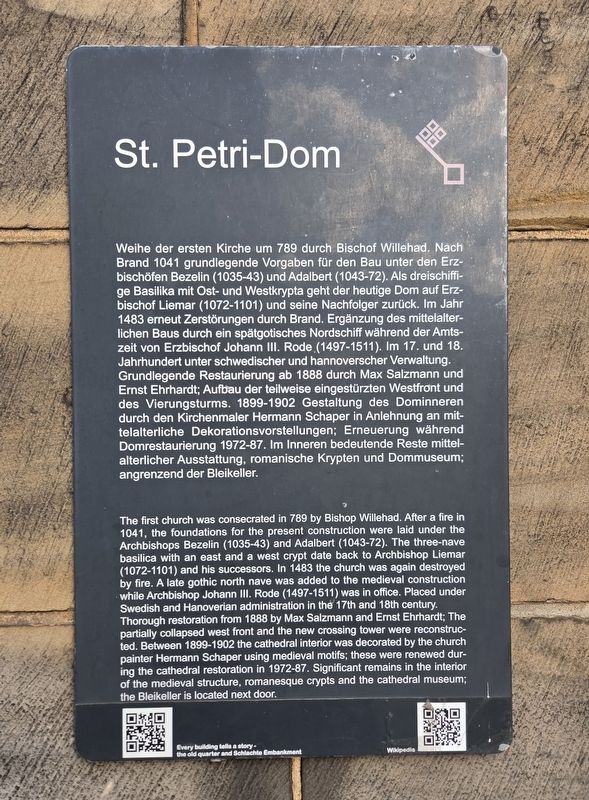
Photographed by James Hulse, October 10, 2026
1. St. Petri-Dom / St. Peter’s Cathedral Marker

this page online
Erected by Bremen.
Topics and series. This historical marker is listed in this topic list: Religion & Religious Structures. In addition, it is included in the Bremen Red Key series list.
Location. 53° 4.524′ N, 8° 48.504′ E. Marker is in Bremen, in Mitte. It is in Bremen-Mitte. It is on Am Dom just east of Am Markt, on the right when traveling north. Touch for map. Marker is at or near this postal address: Am Dom 5, Bremen 28195, Germany. Touch for directions.

Regionally, it is in Europe, the European Union, Atlantic Europe, Central Europe, the Schengen Area, Western Europe, and the Western World. Historically, it finds itself in what was once the Holy Roman Empire and also the former West Germany.
Other nearby markers. At least 8 other markers are within walking distance of this marker: Die Domportale mahnen uns / The Cathedral Doors Serve as a Reminder (here, next to this marker); Börsenhof / Stock Exchange (within shouting distance of this marker); a different marker also named St. Petri-Dom / St. Peter’s Cathedral (within shouting distance of this marker); Bismarck-Denkmal / Bismarck Monument (within shouting distance of this marker);
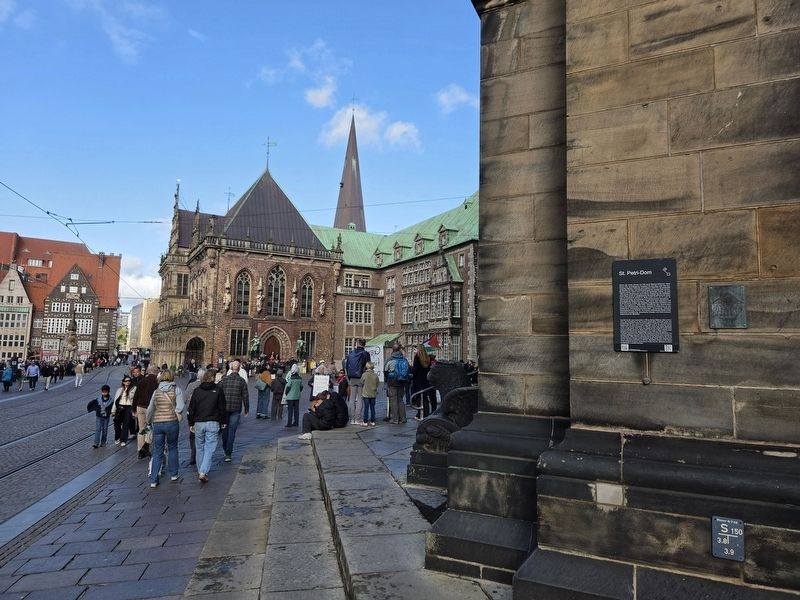
Photographed by James Hulse, October 10, 2026
2. St. Petri-Dom / St. Peter’s Cathedral Marker
The marker is located on the south corner of the cathedral.
More about this marker. Two identical markers are mounted on the cathedral, one on the north side and one on the south side.
Also see . . . Bremen Cathedral. Wikipedia
Bremen Cathedral (German: Bremer Dom or St. Petri Dom zu Bremen), named after St. Peter, is a church situated in the market square in the center of Bremen. The cathedral belongs to the Bremian Evangelical Church, a member of the umbrella organization Evangelical Church in Germany. It is the previous cathedral of the former Roman Catholic Prince-Archbishopric of Bremen. Since 1973, it is protected by the monument protection act.(Submitted on November 14, 2026, by James Hulse of Medina, Texas.)
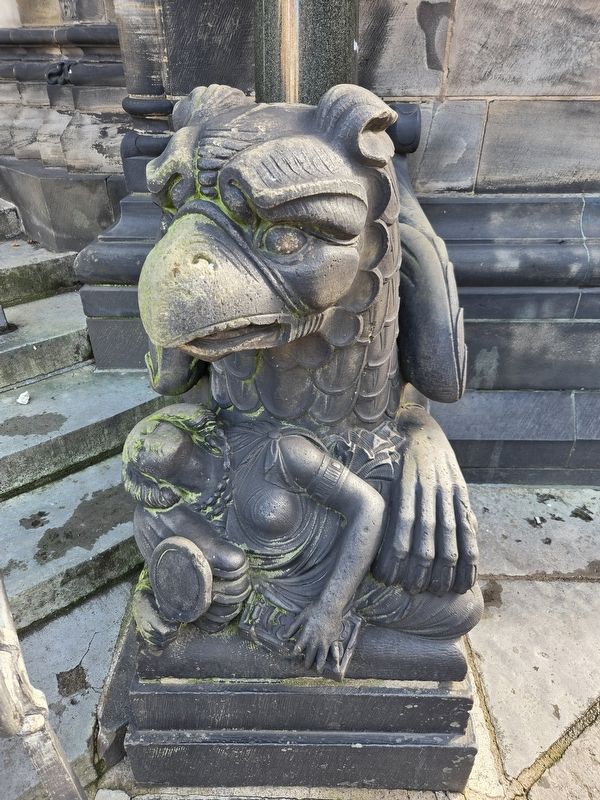
Photographed by James Hulse
3. St. Petri-Dom / St. Peter’s Cathedral Marker
A stone griffin crouches over a human figure beside the entrance steps of the cathedral.
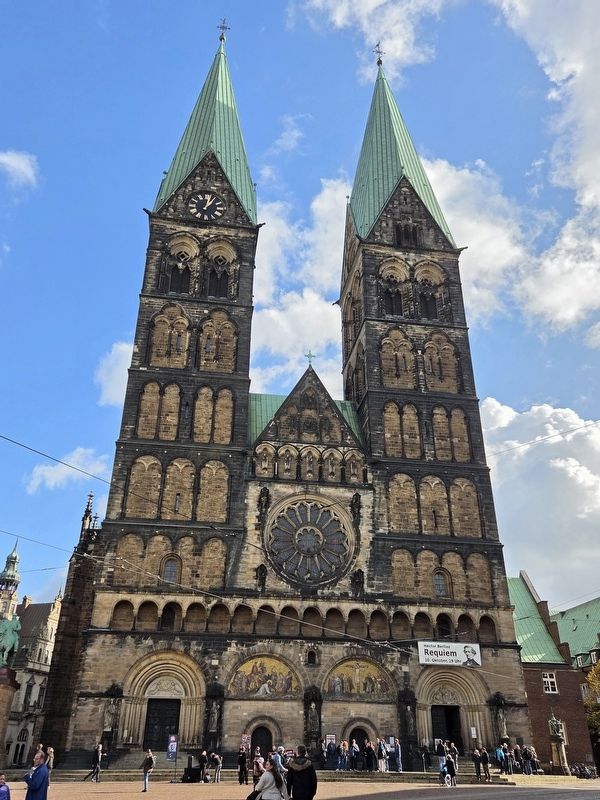
Photographed by James Hulse
4. St. Petri-Dom / St. Peter’s Cathedral Marker
The west façade with its twin spires and central rose window, as seen from the Marktplatz.
Photographed by James Hulse
5. St. Petri-Dom / St. Peter’s Cathedral Marker
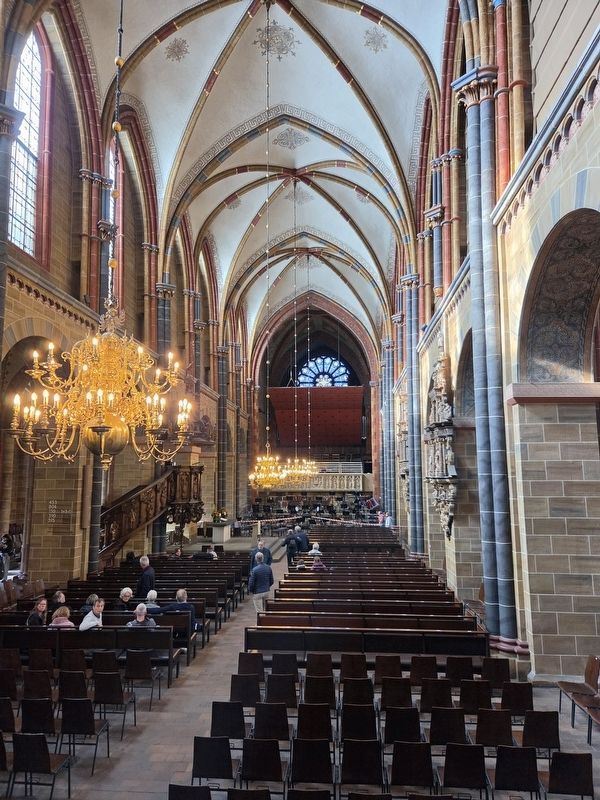
A view down the nave showing its ribbed vaults, chandeliers, and carved wooden pulpit.
Photographed by James Hulse
6. St. Petri-Dom / St. Peter’s Cathedral Marker
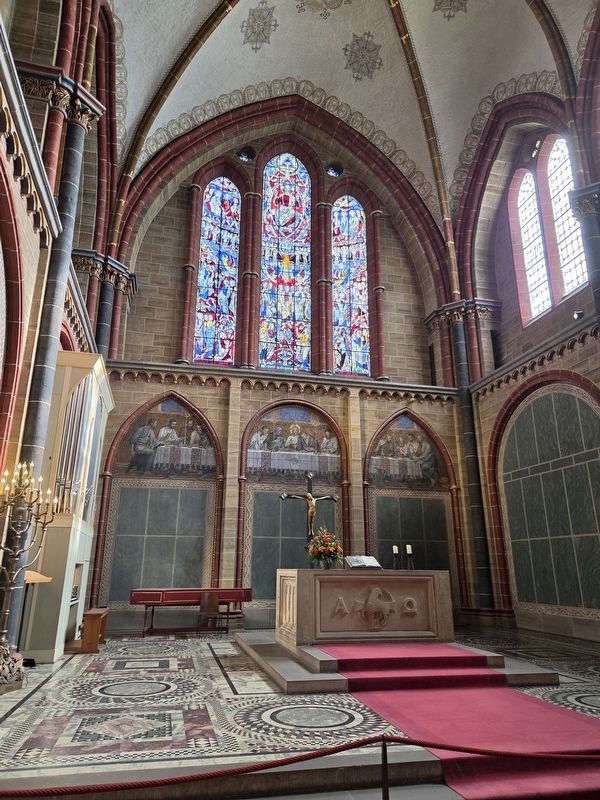
An altar beneath three stained-glass windows.
Credits. This page was last revised on November 14, 2026. It was originally submitted on November 14, 2026, by James Hulse of Medina, Texas. This page has been viewed 2 times since then. Photos: 1, 2, 3, 4, 5, 6. submitted on November 14, 2026, by James Hulse of Medina, Texas.
