
Old Montreal in Montréal, Québec — Central Canada (French-Canadian)
Un lieu désigné pour accueillir le Parlement : Le Marché Sainte-Anne
The Ideal Site for the Parliament: Sainte-Anne Market
| — | 1833 | — |

Photographed by Cosmos Mariner, May 20, 2024
1. Un lieu désigné pour accueillir le Parlement : Le Marché Sainte-Anne Marker

Construit en 1833 en pierre de taille, le marché Sainte-Anne est localisé entre la ville et un quartier en pleine expansion. Son architecture de style néoclassique est imposante. C'est dans cet édifice majestueux qu'on installera le parlement après avoir relocalisé les marchands.
Le plus grand édifice public de son époque et le premier marché intérieur de Montréal!
Inspirations
L'architecture monumentale du marché Sainte-Anne s'inspire des grands édifices civiques internationaux comme le Quincy Market à Boston. On désire donner à la cité une stature d'envergure en construisant un bâtiment imposant, une affirmation symbolique de l'importance de la ville.
Un projet majeur d'ingénierie et d'urbanisme
Le marché Sainte-Anne est édifié à cheval sur l'égout collecteur canalisant la rivière Saint-Pierre. Des celliers sont construits au sous-sol pour profiter du refroidissement engendré par la rivière. Les bouchers ont directement accès à une voie d'eau pour disposer des déchets.
Le marché est construit pour répondre aux besoins pressants en alimentation, liés à une augmentation rapide de la population : 9 000 en
this page online
[légendes d'images ]
• Quincy Market [Bibliothèque publique de Boston Digital Commonwealth]
• Égout collecteur [Photo: Andrew Emond] Tout en pierre, le premier d’égout collecteur de Montréal est aussi le premier en Amérique du Nord. Une œuvre de génie civil étonnante !
St. Ann's Market, built of cut stone in 1833, was located between downtown and a quickly expanding neighbourhood. Its imposing neoclassical architecture made for a majestic building, where the Parliament was installed after the merchants were relocated.
The largest public building of its time and Montréal's first indoor market!
Inspiration
The monumental architecture of St. Ann's Market was inspired by large civic buildings in other countries, like Quincy Market in Boston. City authorities wanted to enhance Montréal's stature with this imposing building, a symbolic statement reflecting the city's importance.
A major engineering & urban planning project
St. Ann's Market sat astride the St. Pierre River, channelled into a collector sewer. Cellars were built in the basement to take advantage of the natural refrigeration from the
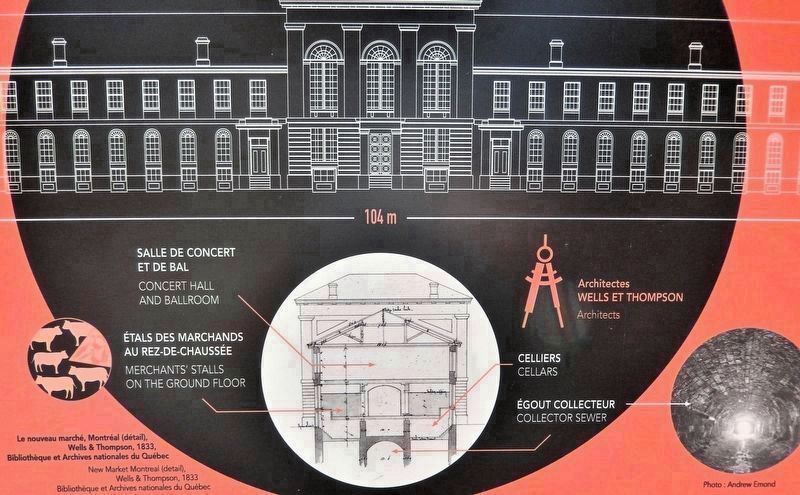
Wells & Thompson, 1833, Bibliothèque et Archives nationales du Québec
2. Marker detail: Le nouveau marché, Montréal/
New Market Montreal
New Market Montreal
The market was built to meet the urgent need to feed the quickly growing population: 9,000 in 1800; 25,000 in 1825; 40,290 in 1842.
[image captions]
• Quincy Market Boston [Public Library Digital Commonwealth]
• Collector sewer [Photo: Andrew Emond] Montreal’s stone collector sewer, an impressive feat of engineering, was the city’s first collector sewer and also the first in North America.
Topics. This historical marker is listed in these topic lists: Architecture • Industry & Commerce. A significant historical year for this entry is 1833.
Location. 45° 30.024′ N, 73° 33.361′ W. Marker is in Montréal, Québec. It is in Old Montreal. It is at the intersection of Place d'Youville and Rue Normand, on the left when traveling north on Place d'Youville. The marker is in the St Anne's Market and Parliament of the Province of Canada archaeological site at Youville Square. Touch for map. Marker is at or near this postal address: 406 Place d'Youville, Montréal QC H2Y 2E9, Canada. Touch for directions.

Regionally, this marker is in Central Canada. Globally, it

Photographed by Cosmos Mariner, May 20, 2024
3. Un lieu désigné pour accueillir le Parlement : Le Marché Sainte-Anne Marker
Looking east across Youville Square. Rue Normand is in the left background. This marker is the leftmost of three panels on the east side of this interpretive kiosk.
Other nearby markers. At least 8 other markers are within walking distance of this marker: L'Acte d'Union — 1840 / Montréal devient capitale de la province du Canada — 1843 (here, next to this marker); Bienvenue aux parlementaires ! / Welcoming the Members of Parliament! (here, next to this marker); À l'heure des réformes / A Time of Reforms (here, next to this marker); Sous vos pieds se trouvent les vestiges de la bibliothèque de l'Assemblée législative (here, next to this marker); Savais-tu que... / Did you know... (a few steps from this marker); Un Joyau Patrimonial / A Heritage Gem (within shouting distance of this marker); Site archéologique du Marché-Sainte-Anne-et-du-Parlement-de-la-province-du-Canada (within shouting distance of this marker); Maison de Mère d'Youville (within shouting distance of this marker). Touch for a list and map of all markers in Montréal.
Related markers. Click here for a list of markers that are related to this marker. St Anne's Market and Parliament of the Province of Canada Archaeological Site
Also see . . . St. Anne's Market (Wikipedia).
Excerpt: The original St. Anne's Market was built in 1832 to accommodate produce stalls in Old Montreal. Merchants sold fruit, vegetables, grains, meat, and fish in approximately 60 stalls. The two-storey, 100-metre-long Georgian building was designed by John Wells and Francis Thompson and was built atop a section of the Little River.(Submitted on November 15, 2026, by Cosmos Mariner of Cape Canaveral, Florida.)
Credits. This page was last revised on November 20, 2026. It was originally submitted on November 14, 2026, by Cosmos Mariner of Cape Canaveral, Florida. This page has been viewed 10 times since then. Photos: 1, 2, 3. submitted on November 15, 2026, by Cosmos Mariner of Cape Canaveral, Florida.
