
Old Montreal in Montréal, Québec — Central Canada (French-Canadian)
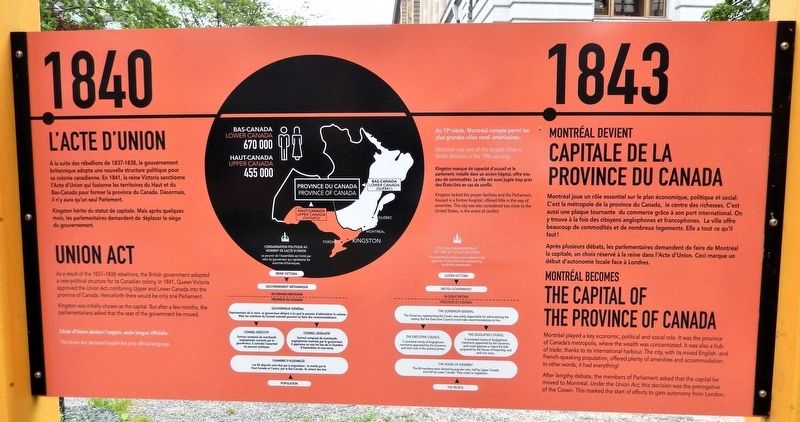
L'Acte d'Union — 1840
Union Act — 1840
⎯⎯⎯
Montréal devient capitale de la province du Canada — 1843
Montréal Becomes the Capital of the Province of Canada — 1843
Photographed by Cosmos Mariner, May 21, 2024
1. L'Acte d'Union — 1840 / Montréal devient capitale de la province du Canada — 1843 Marker

L'Acte d'Union
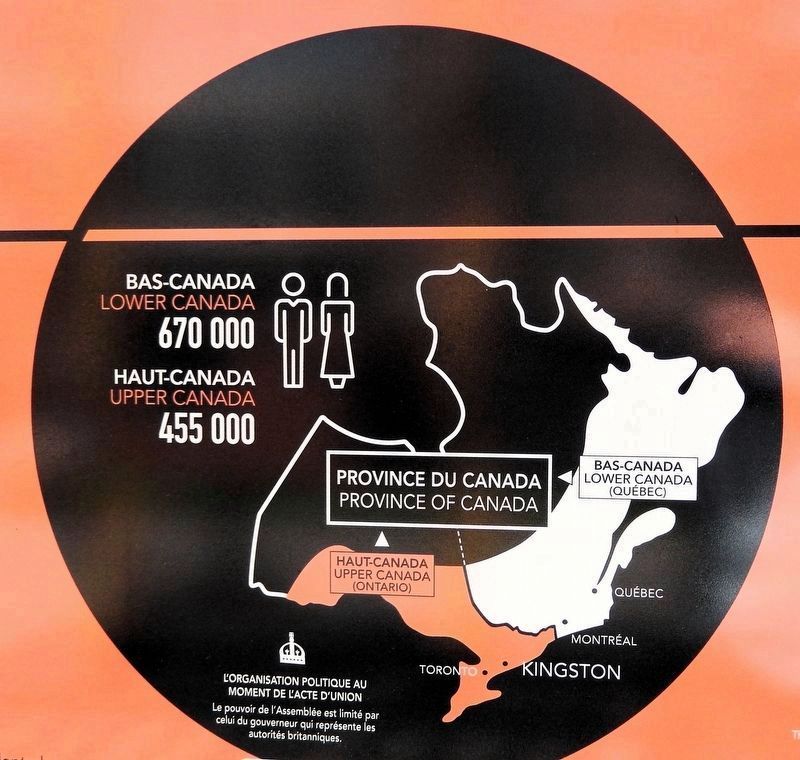
À la suite des rébellions de 1837-1838, le gouvernement britannique adopte une nouvelle structure politique pour sa colonie canadienne. En 1841, la reine Victoria sanctionne l'Acte d'Union qui fusionne les territoires du Haut et du Bas-Canada pour former la province du Canada. Désormais, il n'y aura qu'un seul Parlement.
Kingston hérite du statut de capitale. Mais après quelques mois, les parlementaires demandent de déplacer le siège du gouvernement.
L'Acte d'Union déclare l’anglais, seule langue officielle.
Montréal devient capitale de la province du Canada
Montréal joue un rôle essentiel sur le plan économique, politique et social. C'est la métropole de la province du Canada, le centre des richesses. C'est aussi une plaque tournante du commerce grâce à son port international. On y trouve à la fois des citoyens anglophones et francophones. La ville offre beaucoup de commodités et de nombreux logements. Elle a tout ce qu'il faut !
Après plusieurs débats, les parlementaires demandent de faire de Montréal la capitale, un choix réservé à la reine dans l'Acte d'Union. Ceci marque un début d'autonomie
this page online
Au 19e siècle, Montréal compte parmi les plus grandes villes nord-américaines.
Kingston manque de capacité d'accueil et le parlement, installé dans un ancien hôpital, offre très peu de commodités. La ville est aussi jugée trop près des États-Unis en cas de conflit.
L'organisation politique au moment de l'Acte d'Union
Le pouvoir de l'Assemblée est limité par celui du gouverneur qui représente les autorités britanniques.
Reine Victoria
Gouvernement Britannique
Gouverneur Général
Représentant de la reine, le gouverneur détient à lui seul le pouvoir d'administrer la colonie. Mais les membres du Conseil exécutif peuvent lui faire des recommandations.
Conseil exécutif
Surtout composé de marchands anglophones nommés par le gouverneur, il contrôle l'essentiel du pouvoir politique.
Conseil législatif
Surtout composé de marchands anglophones nommés par le gouverneur, il approuve ou non les lois de la Chambre d'Assemblée et vice-versa.
Chambre d'Assemblée
Les 84 députés sont élus par la population : la moitié par le Haut-Canada et l'autre, par le Bas-Canada. Ils votent des lois.
Union Act
As a result of the 1837-1838 rebellions,
2. Marker detail: Province of Canada — 1840
Kingston was initially chosen as the capital. But after a few months, the parliamentarians asked that the seat of the government be moved.
The Union Act declared English the only official language.
Montréal becomes the capital of the province of Canada
Montréal played a key economic, political and social role. It was the province of Canada's metropolis, where the wealth was concentrated. It was also a hub of trade, thanks to its international harbour. The city, with its mixed English- and French-speaking population, offered plenty of amenities and accommodation. In other words, it had everything!
After lengthy debate, the members of Parliament asked that the capital be moved to Montréal. Under the Union Act, this decision was the prerogative of the Crown. This marked the start of efforts to gain autonomy from London.
Montreal was one of the largest cities in North America in the 19th century.
Kingston
3. Marker detail: Political organization at the time of the Act of Union
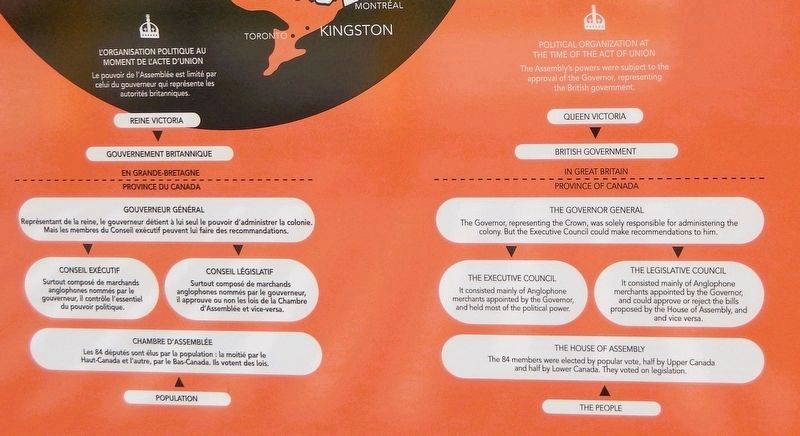
Political organization at the time of the Act of Union
The Assembly's powers were subject to the approval of the Governor, representing the British government.
Queen Victoria
British Government
The Governor General
The Governor, representing the Crown, was solely responsible for administering the colony. But the Executive Council could make recommendations to him.
The Executive Council
It consisted mainly of Anglophone merchants appointed by the Governor, and held most of the political power.
The Legislative Council
It consisted mainly of Anglophone merchants appointed by the Governor, and could approve or reject the bills proposed by the House of Assembly, and vice versa.
The House of Assembly
The 84 members were elected by popular vote, half by Upper Canada and half by Lower Canada. They voted on legislation.
Topics. This historical marker is listed in this topic list: Government & Politics. A significant historical year for this entry is 1840.
Location. 45° 30.024′ N,

Photographed by Cosmos Mariner, May 20, 2024
4. L'Acte d'Union — 1840 / Montréal devient capitale de la province du Canada — 1843 Marker
Looking east across Youville Square. Rue Normand is in the background. This marker is the center one of three panels on the east side of this interpretive kiosk.

Regionally, this marker is in Central Canada. Globally, it is in North America, the Western Hemisphere, and the Western World. Historically, it finds itself in what was once a British colony, the Viceroyalty of New France, the Haudenosaunee (Iroquois) Confederacy, and Rupert’s Land.
Other nearby markers. At least 8 other markers are within walking distance of this marker: Un lieu désigné pour accueillir le Parlement : Le Marché Sainte-Anne (here, next to this marker); Bienvenue aux parlementaires ! / Welcoming the Members of Parliament! (here, next to this marker); À l'heure des réformes / A Time of Reforms (here, next to this marker); Sous vos pieds se trouvent les vestiges de la bibliothèque de l'Assemblée législative (here, next to this marker); Savais-tu que... / Did you know... (a few steps from this marker); Un Joyau Patrimonial / A Heritage Gem (within shouting distance of this marker); Site archéologique du Marché-Sainte-Anne-et-du-Parlement-de-la-province-du-Canada (within shouting distance of this marker); Maison de Mère d'Youville (within shouting distance of this marker). Touch for a list and map of all markers in Montréal.
Related markers. Click here for a list of markers that are related to this marker. St Anne's Market and Parliament of the Province of Canada Archaeological Site
Also see . . . History of Montreal (Wikipedia).
Excerpt: Montreal was incorporated as a city in 1832. The city's growth was spurred by the opening of the Lachine Canal and Montreal was the capital of the United Province of Canada from 1844 to 1849. Growth continued and by 1860 Montreal was the largest city in British North America and the undisputed economic and cultural centre of Canada. Annexation of neighbouring towns between 1883 and 1918 changed Montreal back to a mostly Francophone city.(Submitted on November 15, 2026, by Cosmos Mariner of Cape Canaveral, Florida.)
Credits. This page was last revised on November 20, 2026. It was originally submitted on November 15, 2026, by Cosmos Mariner of Cape Canaveral, Florida. This page has been viewed 13 times since then. Photos: 1, 2, 3, 4. submitted on November 15, 2026, by Cosmos Mariner of Cape Canaveral, Florida.
