
Hamburg-Mitte in Hamburg-Mitte, Germany — Central Europe
Zwangsarbeit
⎯⎯⎯
Forced Labor
Photographed by James Hulse, October 10, 2026
1. Zwangsarbeit / Forced Labor Marker

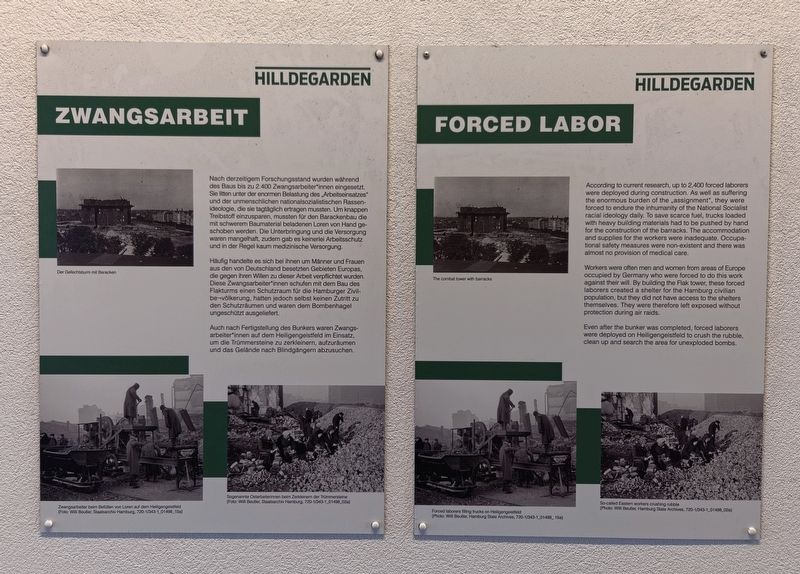
Häufig handelte es sich bei ihnen um Männer und Frauen aus den von Deutschland besetzten Gebieten Europas, die gegen ihren Willen zu dieser Arbeit verpflichtet wurden. Diese Zwangsarbeiter*innen schufen mit dem Bau des Flakturms einen Schutzraum für die Hamburger Zivilbevölkerung, hatten jedoch selbst keinen Zutritt zu den Schutzräumen und waren dem Bombenhagel ungeschützt ausgeliefert.
Auch nach Fertigstellung des Bunkers waren Zwangsarbeiter*innen auf dem Heiligengeistfeld im Einsatz, um die Trümmersteine zu zerkleinern, aufzuräumen und das Gelände nach Blindgängern abzusuchen.
Der Gefechtsturm mit Baracken
Zwangsarbeiter beim Befüllen von Loren auf dem Heiligengeistfeld
(Foto: Willi Beutler, Staatsarchiv Hamburg, 720-1/343-1_01498_15a)
Sogenannte Ostarbeiterinnen beim Zerkleinern der Trümmersteine
(Foto: Willi Beutler, Staatsarchiv Hamburg, 720-1/343-1_01498_02a)
this page online
Workers were often men and women from areas of Europe occupied by Germany who were forced to do this work against their will. By building the Flak tower, these forced laborers created a shelter for the Hamburg civilian population, but they did not have access to the shelters themselves. They were therefore left exposed without protection during air raids.
Even after the bunker was completed, forced laborers were deployed on Heiligengeistfeld to crush the rubble, clean up and search the area for unexploded bombs.
The combat tower with barracks
Forced laborers filling trucks on Heiligengeistfeld
(Photo: Willi Beutler, Hamburg State Archives, 720-1/343-1_01498_15a)
So-called Eastern workers crushing rubble
(Photo: Willi Beutler, Hamburg State Archives, 720-1/343-1_01498_02a)
Erected by Hilldegarden
Photographed by James Hulse, October 10, 2026
2. Zwangsarbeit / Forced Labor Marker
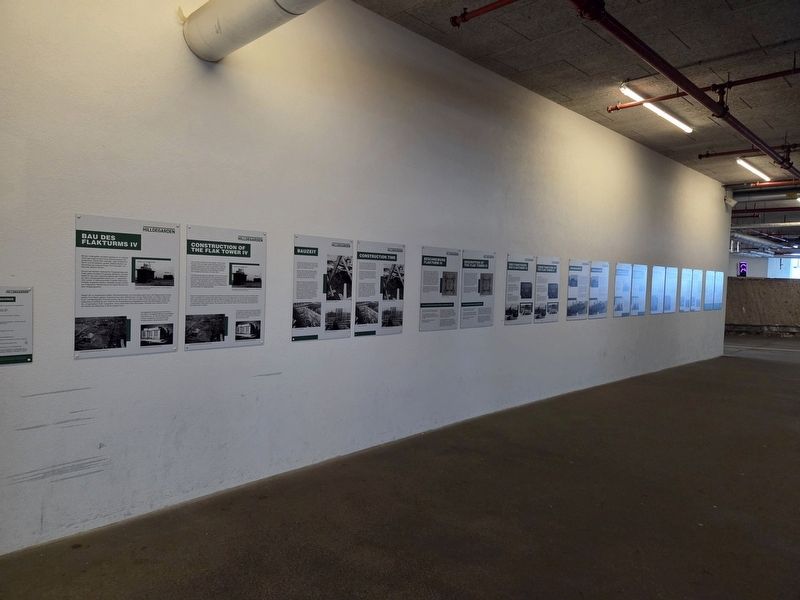
The fifth double marker from the left side.
Topics. This historical marker is listed in these topic lists: Forts and Castles • War, World II.
Location. 53° 33.383′ N, 9° 58.203′ E. Marker is in Hamburg, in Hamburg-Mitte. It is in Hamburg-Mitte. It can be reached from Feldstraße just west of Heiligengeistfeld, on the left when traveling west. Touch for map. Marker is at or near this postal address: Feldstraße 66e, Hamburg 20357, Germany. Touch for directions.

Regionally, it is in Europe, the European Union, Atlantic Europe, Central Europe, the Schengen Area, Western Europe, and the Western World. Historically, it finds itself in what was once the Holy Roman Empire, the Hanseatic League, and the former West Germany.
Other nearby markers. At least 8 other markers are within walking distance of this marker: Drei Funktionen des Flakturms IV / Three Functions of the Flak Tower IV (here, next to this marker); Flakhelfer auf dem Gefechtsturm / Anti-Aircraft Auxiliaries on the Combat Tower (here, next to this marker); Beschreibung Flakturm IV / Description of the Flak Tower IV (a few steps from this marker); Bau des Flakturms IV / Construction of the Flak Tower IV
Photographed by James Hulse, October 10, 2026
3. Zwangsarbeit / Forced Labor Marker
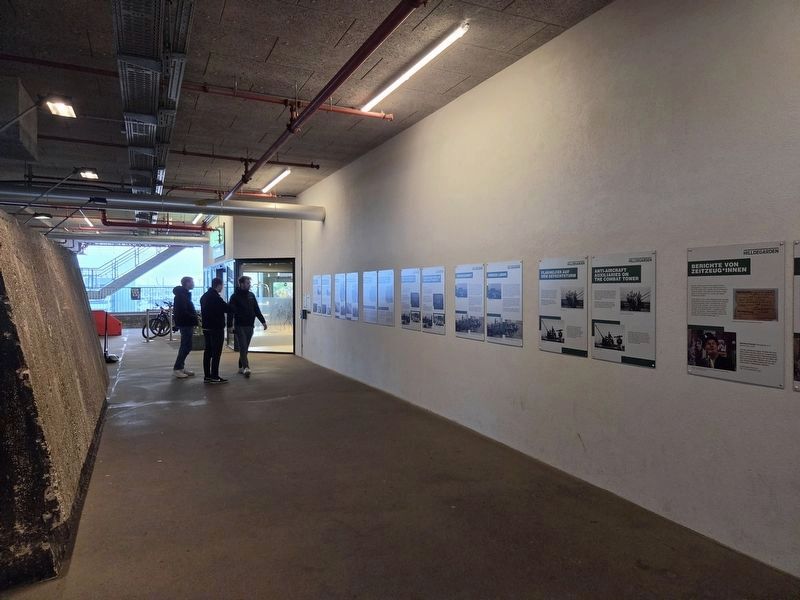
The marker stands beside a wall on the open-air rooftop terrace of the Hamburg Bunker. The terrace sits atop the original concrete bunker, below the hotel added during the building’s redevelopment.
More about this marker. The former flak tower is now the Hamburg Bunker, a complex with a hotel, restaurants, music and event spaces, and a rooftop garden. An exterior walkway leads upward past historical panels explaining its wartime history.
Photographed by James Hulse, October 10, 2026
4. Flak Tower
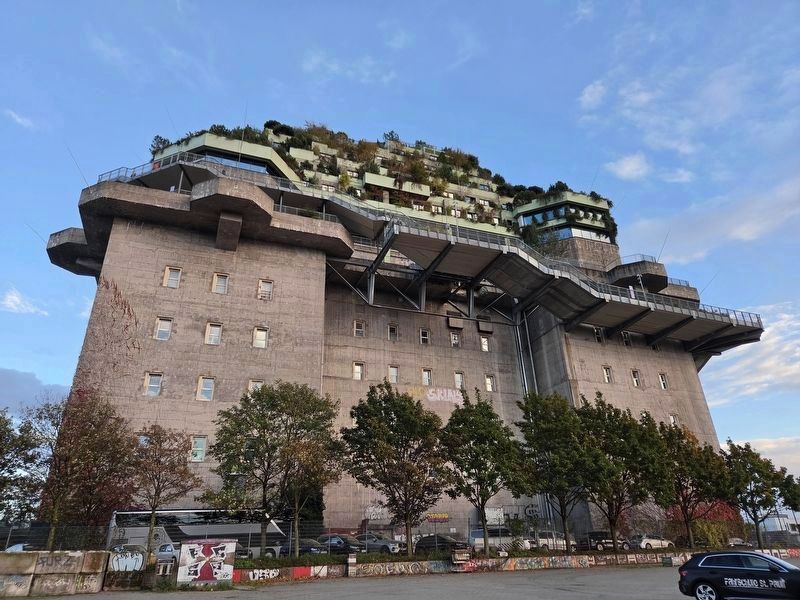
A street-level view of the former flak tower, with the hotel complex built above it.
Credits. This page was last revised on November 17, 2026. It was originally submitted on November 16, 2026, by James Hulse of Medina, Texas. This page has been viewed 4 times since then. Photos: 1, 2, 3, 4. submitted on November 17, 2026, by James Hulse of Medina, Texas.
