
Marker Logo
THE HISTORICAL
MARKER DATABASE
“Bite-Size Bits of Local, National, and Global History”
Hamburg-Mitte in Hamburg-Mitte, Germany — Central Europe
 

Unmittelbare Nachkriegsnutzung
⎯⎯⎯
Immediate Post-War Use
 
 
Unmittelbare Nachkriegsnutzung / Immediate Post-War Use Marker image. Click for full size.
Photographed by James Hulse, October 10, 2026
1. Unmittelbare Nachkriegsnutzung / Immediate Post-War Use Marker
Inscription.  
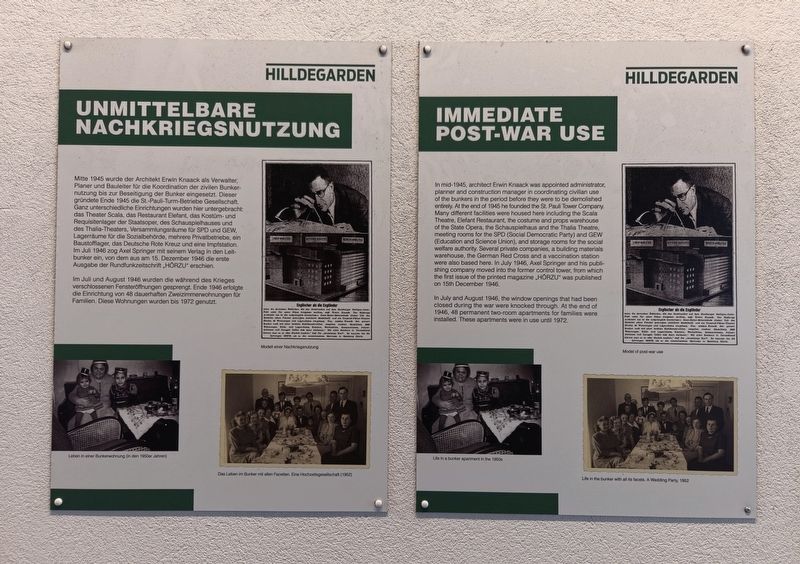
Mitte 1945 wurde der Architekt Erwin Knaack als Verwalter, Planer und Bauleiter für die Koordination der zivilen Bunkernutzung bis zur Beseitigung der Bunker eingesetzt. Dieser gründete Ende 1945 die St.-Pauli-Turm-Betriebe Gesellschaft. Ganz unterschiedliche Einrichtungen wurden hier untergebracht: das Theater Scala, das Restaurant Elefant, das Kostüm- und Requisitenlager der Staatsoper, des Schauspielhauses und des Thalia-Theaters, Versammlungsräume für SPD und GEW, Lagerräume für die Sozialbehörde, mehrere Privatbetriebe, ein Baustofflager, das Deutsche Rote Kreuz und eine Impfstation. Im Juli 1946 zog Axel Springer mit seinem Verlag in den Leitbunker ein, von dem aus am 15. Dezember 1946 die erste Ausgabe der Rundfunkzeitschrift „Hörzu“ erschien.

Im Juli und August 1946 wurden die während des Krieges verschlossenen Fensteröffnungen gesprengt. Ende 1946 erfolgte die Einrichtung von 48 dauerhaften Zweizimmerwohnungen für Familien. Diese Wohnungen wurden bis 1972 genutzt.

Modell einer Nachkriegsnutzung

Leben in einer Bunkerwohnung (in den 1950er Jahren)

Das Leben im Bunker mit allen Facetten. Eine Hochzeitsgesellschaft (1952)

In mid-1945, architect Erwin Knaack was appointed administrator, planner and construction manager in coordinating civilian use of the bunkers in the period before they were to be demolished entirely. At the end of 1945 he founded the St. Pauli Tower Company. Many different facilities were housed here including the Scala Theatre, Elefant Restaurant, the costume and props warehouse of the State Opera, the Schauspielhaus and the Thalia Theatre, meeting rooms for the
Paid Advertisement
Click or scan to see
this page online
SPD (Social Democratic Party) and GEW (Education and Science Union), and storage rooms for the social welfare authority. Several private companies, a building materials warehouse, the German Red Cross and a vaccination station were also based here. In July 1946, Axel Springer and his publishing company moved into the former control tower, from which the first issue of the printed magazine “Hörzu” was published on 15th December 1946.

In July and August 1946, the window openings that had been closed during the war were knocked through. At the end of 1946, 48 permanent two-room apartments for families were installed. These apartments were in use until 1972.

Model of post-war use

Life in a bunker apartment in the 1950s

Life in the bunker with all its facets. A Wedding Party, 1952

 
Erected by Hilldegarden e.V.
 
Topics. This historical marker is listed in these topic lists: Forts and Castles • War, World II. A significant historical month for this entry is July 1946.
 
Location. 53° 33.381′ N, 9° 58.183′ E. Marker is in Hamburg, in Hamburg-Mitte. It is in Hamburg-Mitte. It can be reached from Feldstraße just west of Heiligengeistfeld, on the left when traveling west. Touch for map. Marker is at or near this postal address: Feldstraße 66, Hamburg 20357, Germany. Touch for directions.

Regionally, it is in Europe, the European Union, Atlantic Europe, Central Europe, the Schengen Area, Western Europe, and the Western World. Historically, it finds itself in what was once the Holy Roman Empire, the Hanseatic League, and the former West Germany.

Other nearby markers. At least 8 other markers are within walking distance
Unmittelbare Nachkriegsnutzung / Immediate Post-War Use Marker image. Click for full size.
Photographed by James Hulse, October 10, 2026
2. Unmittelbare Nachkriegsnutzung / Immediate Post-War Use Marker
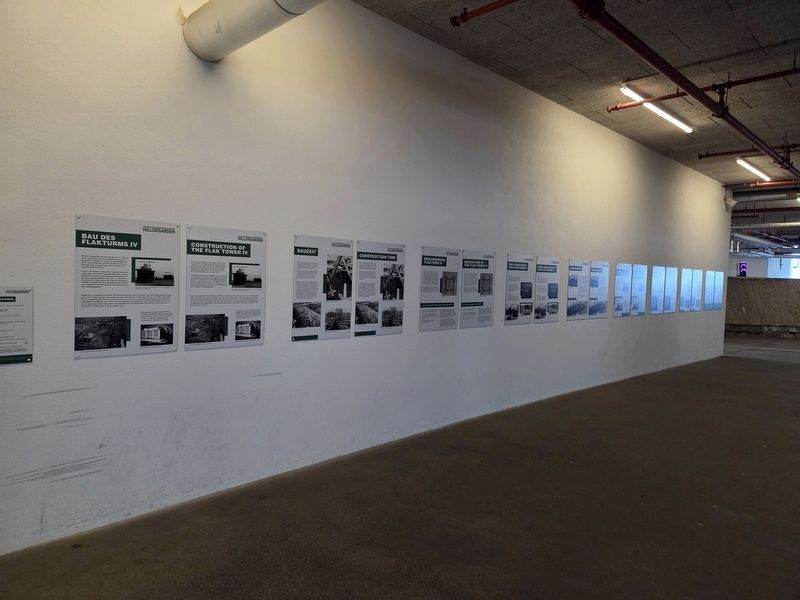
The second double marker from the right side.
of this marker: Bauzeit / Construction Time (a few steps from this marker); Berichte von Zeitzeug*innen / Reports from Contemporary Witnesses (a few steps from this marker); Hier entsteht der Informations- und Erinnerungsort zur Geschichte des Bunkers (a few steps from this marker); Beschreibung Flakturm IV / Description of the Flak Tower IV (a few steps from this marker); Bau des Flakturms IV / Construction of the Flak Tower IV (a few steps from this marker); Drei Funktionen des Flakturms IV / Three Functions of the Flak Tower IV (a few steps from this marker); Flakhelfer auf dem Gefechtsturm / Anti-Aircraft Auxiliaries on the Combat Tower (a few steps from this marker); Zwangsarbeit / Forced Labor (a few steps from this marker). Touch for a list and map of all markers in Hamburg.
 
More about this marker. The former flak tower is now the Hamburg Bunker, a complex with a hotel, restaurants, music and event spaces, and a rooftop garden. An exterior walkway leads upward past historical panels explaining its wartime history.
 
Unmittelbare Nachkriegsnutzung / Immediate Post-War Use Marker image. Click for full size.
Photographed by James Hulse, October 10, 2026
3. Unmittelbare Nachkriegsnutzung / Immediate Post-War Use Marker
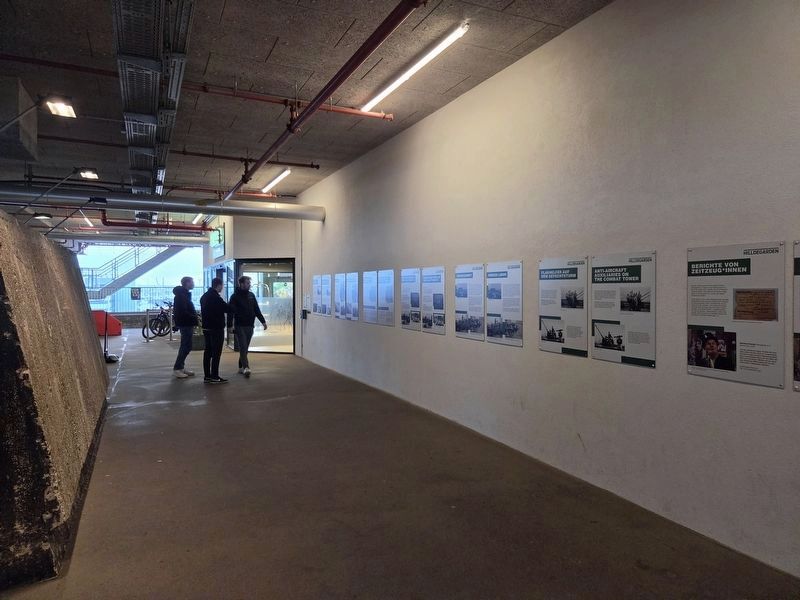
The marker stands beside a wall on the open-air rooftop terrace of the Hamburg Bunker. The terrace sits atop the original concrete bunker, below the hotel added during the building’s redevelopment.
Flak Tower image. Click for full size.
Photographed by James Hulse, October 10, 2026
4. Flak Tower
A street-level view of the former flak tower, with the hotel complex built above it.
 
 
Credits. This page was last revised on November 17, 2026. It was originally submitted on November 16, 2026, by James Hulse of Medina, Texas. This page has been viewed 5 times since then. Photos:   1, 2, 3, 4. submitted on November 17, 2026, by James Hulse of Medina, Texas.

m=316820

CeraNet Cloud Computing sponsors the Historical Marker Database.
This website earns income from purchases you make after using our links to Amazon.com. We appreciate your support.
Paid Advertisement
Nov. 18, 2026