
Old Montreal in Montréal, Québec — Central Canada (French-Canadian)
À l'heure des réformes
⎯⎯⎯
A Time of Reforms
1847
Photographed by Cosmos Mariner, May 21, 2024
1. À l'heure des réformes / A Time of Reforms Marker

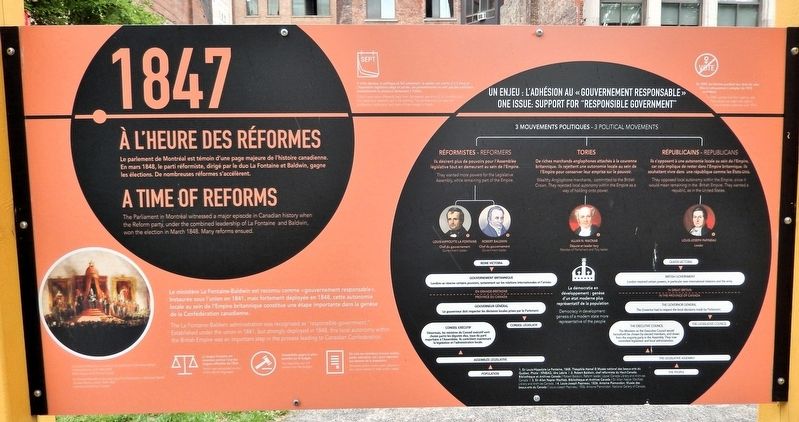
Le parlement de Montréal est témoin d'une page majeure de l'histoire canadienne. En mars 1848, le parti réformiste, dirigé par le duo La Fontaine et Baldwin, gagne les élections. De nombreuses réformes s'accélèrent.
Le ministère La Fontaine-Baldwin est reconnu comme « gouvernement responsable ». Instaurée sous l'union en 1841, mais fortement déployée en 1848, cette autonomie locale au sein de l'Empire britannique constitue une étape importante dans la genèse de la Confédération canadienne.
La langue française est reconnue comme l’une des langues officielles de l’État.
L’Assemblée gagne le plein contrôle sur le budget.
On crée les ministères (travaux publics, poste, éducation, etc.) pour répondre aux besoins de la population.
A cette époque, la politique se fait autrement : la session est courte (2 à 3 mois) et l’Assemblée législative siège en soirée. Les parlementaires ne sont pas des politiciens professionnels et plusieurs demeurent à l’hôtel.
In 1849, les femmes perdent leur droit de vote. Elles le retrouveront à compter de 1918 au fédéral.
Un enjeu : l'adhésion AU « gouvernement responsable »
3 Mouvements politiques
Réformistes
Ils
this page online
• Louis-Hippolyte la Fontaine, Chef du gouvernement
• Robert Baldiwn, Chef du gouvernement
Tories
De riches marchands anglophones attachés à la couronne britannique. Ils rejettent une autonomie locale au sein de l'Empire pour conserver leur emprise sur le pouvoir.
• Allan N. Macnab, Député et leader tory
Républicains
Ils s'opposent à une autonomie locale au sein de l'Empire, car cela implique de rester dans l'Empire britannique. Ils souhaitent vivre dans une république comme les États-Unis.
• Louis-joseph Papineau, Leader
La démocratie en développement : genèse d'un état moderne plus représentatif de la population
Gouvernement britannique
Londres se réserve certains pouvoirs, notamment sur les relations internationales et l'armée.
Province du Canada
Gouverneur général
Le gouverneur dort respecter les décisions locales prises par le Parlement.
Conseil Exécutif
Désormais, les ministres du Conseil exécutif sont choisis parmi les députés élus, issus du parti majoritaire à l'Assemblée. Ils contrôlent maintenant la législation et l'administration locale.
Conseil Législative
Assemblée Législative
Population
Photographed by Cosmos Mariner, May 21, 2024
2. À l'heure des réformes / A Time of Reforms Marker
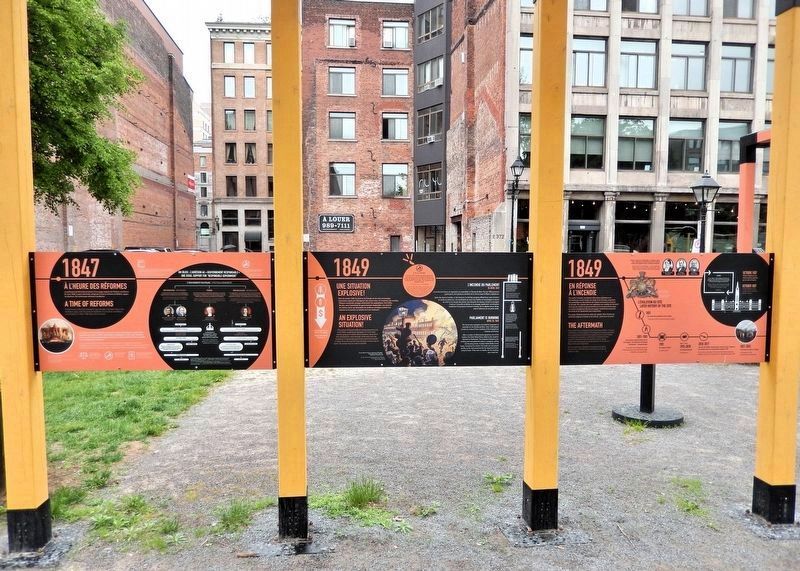
Looking west across Youville Square. This marker is the leftmost of three panels on the east side of this interpretive kiosk.
[légendes d'images ]
• Sir Charles Metcalfe a l’ouverture du parlement a Montréal (détail)
Andrew Morris, actif 1844-1852, Bibliothèque et Archives Canada
• Sir Louis-Hippolyte La Fontaine, 1848
Théophile Hamel, Musée national des beaux-arts du Québec, photo : Idra Labrie
• Robert Baldwin, chef réformiste du Haut-Canada
Bibliothèque et Archives Canada
• Sir Allan Napier MacNab
Bibliothèque et Archives Canada
• Louis-Joseph Papineau, 1836
Antoine Plamondon, Musée des-beaux arts du Canada
The Parliament in Montreal witnessed a major episode in Canadian history when the Reform party, under the combined leadership of La Fontaine and Baldwin, won the election in March 1848. Many reforms ensued.
The La Fontaine-Baldwin administration was recognized as “responsible government.” Established under the union in 1841, but strongly deployed in 1848, this local autonomy within the British Empire was an important step in the process leading to Canadian Confederation.
French was recognized as one of the official languages.
The Assembly won full control over the budget.
Ministries (public works, post, education, etc.) were created to meet public needs.
Politics were done differently back then: the session was short (2 to 3 months) and the Legislative Assembly sat in the evening. The parliamentarians were not professional politicians, and many of them stayed in hotels.
In 1849, women lost their right to vote. They would not regain the right to vote in federal elections until 1918.
One issue: support for “responsible government”
3 Political Movements
Reformers
They wanted more powers for the Legislative Assembly, while remaining part of the Empire.
• Louis-Hippolyte La Fontaine, Government Leader
• Robert Baldwin, Government Leader
Tories
Wealthy Anglophone merchants, committed to the British crown. They rejected local autonomy within the Empire as a way of holding onto power.
• Allan N. MacNab, Member of Parliament and Tory leader
Republicans
They opposed local autonomy within the Empire, since it would mean remaining in the British Empire. They wanted a republic, as in the United States.
• Louis-Joseph Papineau, Leader
Democracy in development: genesis of a modern state more representative of the people
British Government
London retained certain powers, in particular over international relations and the army.
In the Province of Canada
The Governor General
The governor had to respect local decisions made by Parliament.
The Executive Council
The ministers on the Executive Council would henceforth be chosen by elected members, and drawn from the majority party in the Assembly. They now controlled legislation and local administration.
The Legislative Council
The Legislative Assembly
The People
[Image captions ]
• Sir Charles Metcalfe at the opening of Parliament in Montréal (detail)
Andrew Morris, active 1844-1852, Library and Archives Canada
• Sir Louis-Hippolyte La Fontaine, 1848
Théophile Hamel, Musée national des beaux-arts du Québec, photo: Idra Labrie
• Robert Baldwin, Reform leader, Upper Canada
Library and Archives Canada
• Sir Allan Napier MacNab
Library and Archives Canada
• Louis-Joseph Papineau, 1836
Antoine Plamondon, National Gallery of Canada
Topics. This historical marker is listed in this topic list: Government & Politics. A significant historical year for this entry is 1847.
Location. 45° 30.025′ N, 73° 33.362′ W. Marker is in Montréal, Québec. It is in Old Montreal. It is at the intersection of Place d'Youville and Rue Normand, on the left when traveling south on Place d'Youville. The marker is in the St Anne's Market and Parliament of the Province of Canada archaeological site at Youville Square. Touch for map. Marker is at or near this postal address: 406 Place d'Youville, Montréal QC H2Y 2E9, Canada. Touch for directions.

Regionally, this marker is in Central Canada. Globally, it is in North America, the Western Hemisphere, and the Western World. Historically, it finds itself in what was once a British colony, the Viceroyalty of New France, the Haudenosaunee (Iroquois) Confederacy, and Rupert’s Land.
Other nearby markers. At least 8 other markers are within walking distance of this marker: L'Acte d'Union — 1840 / Montréal devient capitale de la province du Canada — 1843 (here, next to this marker); Un lieu désigné pour accueillir le Parlement : Le Marché Sainte-Anne (here, next to this marker); Bienvenue aux parlementaires ! / Welcoming the Members of Parliament! (here, next to this marker); Sous vos pieds se trouvent les vestiges de la bibliothèque de l'Assemblée législative (here, next to this marker); Savais-tu que... / Did you know... (a few steps from this marker); Un Joyau Patrimonial / A Heritage Gem (within shouting distance of this marker); Site archéologique du Marché-Sainte-Anne-et-du-Parlement-de-la-province-du-Canada (within shouting distance of this marker); Maison de Mère d'Youville (within shouting distance of this marker). Touch for a list and map of all markers in Montréal.
Related markers. Click here for a list of markers that are related to this marker. St Anne's Market and Parliament of the Province of Canada Archaeological Site
Credits. This page was last revised on November 20, 2026. It was originally submitted on November 18, 2026, by Cosmos Mariner of Cape Canaveral, Florida. This page has been viewed 7 times since then. Photos: 1, 2. submitted on November 20, 2026, by Cosmos Mariner of Cape Canaveral, Florida.
