
Echternach, Echternach, Luxembourg — Western Europe
Itinéraire en souvenir de la résistance
⎯⎯⎯
An itinerary in memory of the Resistance
Photographed by Andrew Ruppenstein, October 21, 2026
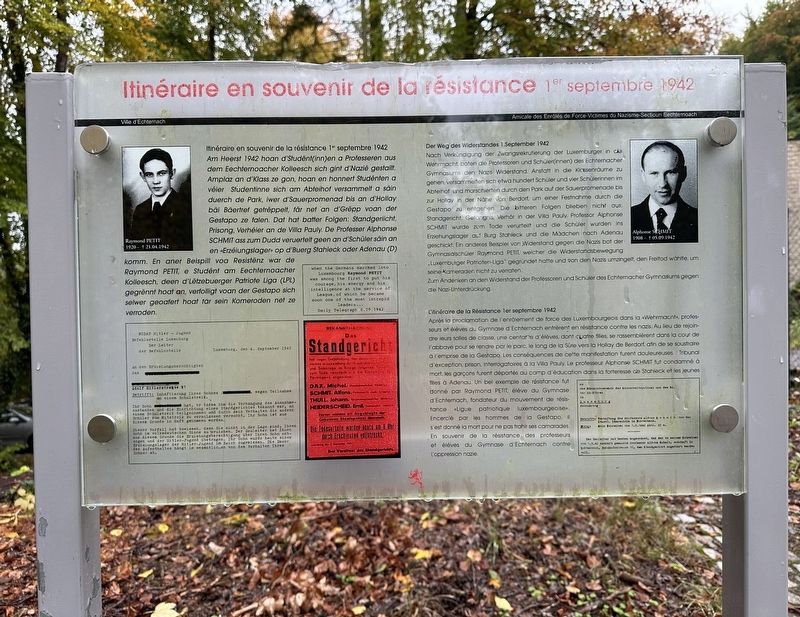
1. Itinéraire en souvenir de la résistance / An itinerary in memory of the Resistance Marker

Itinéraire en souvenir de la résistance 1er septembre 1942
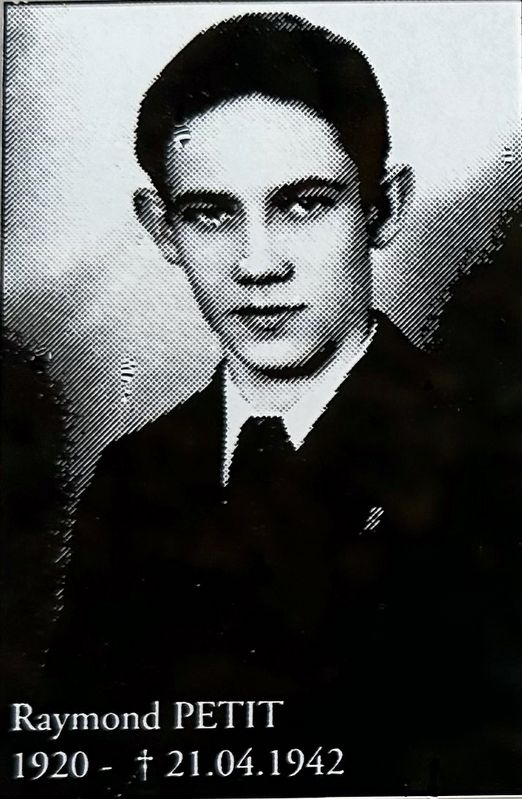
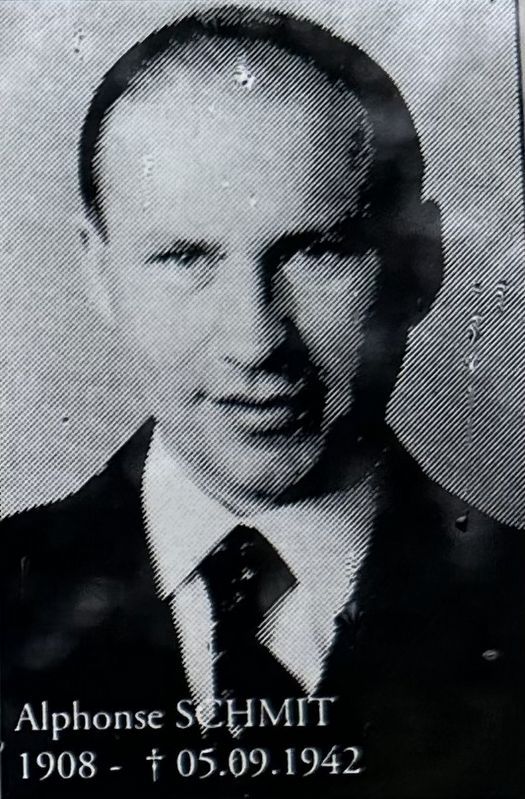
Am Heerst 1942 hoan d'Student(inn)en a Professeren aus dem Eechternoacher Kolleesch sich gint d'Nazië gestallt. Amplaz an d'Klass ze gon, hoan en honnert Studenten a véier Studentinne sich am Abteihof versammelt a säin duerch de Park, iwer d'Sauerpromenad bis an d'Hollay bäi Bäertref getrëppelt, fär net an d'Grepp voan der Gestapo ze falen. Dat hat batter Folgen: Standgericht, Prisong, Verhéier an de Villa Pauly. De Professer Alphonse SCHMIT ass zum Dudd veruertelt geen an d'Schüler säin an en «Erzéiungslager» op d'Buerg Stahleck oder Adenau (D) komm. En aner Beispill voa Resistenz war de Raymond PETIT, e Student am Eechternacher Kolleesch, deen d'Lëtzebuerger Patriote Liga (LPL) gegrënnt hoat an, verforligt voan der Gestapo sich selwer geoafert hoat fär sein Komeroden net ze verroden.
Der Weg des Widerstandes 1.September 1942
Nach Verkündigung der Zwangsrekrutierung der Luxemburger in die Wehrmacht, boten die Professoren und Schüler(innen) des Echternacher Gymnasiums den Nazis Widerstand. Anstatt in
this page online
Zum Andenken an den Widerstand der Professoren und Schüler des Echternacher Gymnasiums gegen die Nazi-Unterdrückung.
L'itinéraire de la Résistance 1er septembre 1942
Après la proclamation de l'enrôlement de force des Luxembourgeois dans la «Wehrmacht, professeurs et élèves du Gymnase d'Echternach entrèrent en résistance contre les nazis. Au lieu de rejoindre leurs calles
Photographed by Andrew Ruppenstein, October 21, 2026
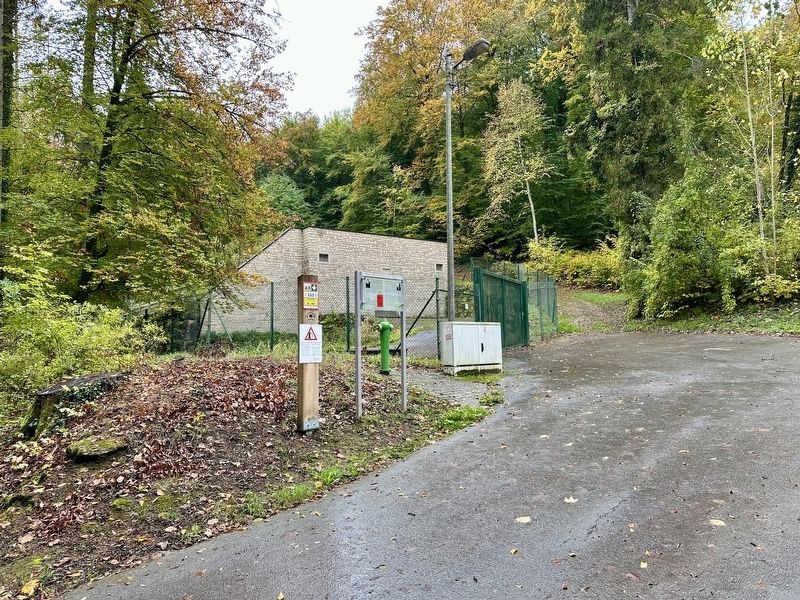
2. An itinerary in memory of the Resistance Marker - wide view
The Path of Resistance – September 1, 1942
Following the announcement of the forced conscription of Luxembourgers into the Wehrmacht, the teachers and students of the Echternach Gymnasium (secondary school) offered resistance against the Nazis. Instead
circa 1940
3. Marker photo: Raymond Petit
In memory of the resistance shown by the teachers and students of the Echternach Gymnasium against Nazi oppression.
Erected by Ville d’Echternach, Amicale des Enrôlés de Force-Victimes du Nazisme-Sectioun Eechternoach.
Topics. This memorial is listed in this topic list: War, World II. A significant historical date for this entry is September 1, 1942.
Location. 49° 49.148′ N, 6° 23.949′ E. Memorial is in Echternach, Iechternach (Echternach). It can be reached from CR364, on the right when traveling east. From 364, follow the Camp Scout Echternach sign (warning, single lane road). Touch for map. Memorial is at or near this postal address: CR364 2, Echternach, Iechternach 6496, Luxembourg. Touch for directions.

Regionally, this memorial is in the Guttland and in the Mullerthal. Globally, it is in Europe, the European Union, the Benelux Low Countries, the Schengen Area, Western Europe, and the Western World. Historically, it finds itself in what was once the Roman Empire and specifically also the
circa 1940
4. Marker photo: Alphonse Schmit
Other nearby markers. At least 8 other markers are within 3 kilometers of this marker, measured as the crow flies: Chapelle Notre-Dame / Muttergotteskappelle / Chapel of Notre Dame (approx. 1.5 kilometers away); Ancien palais de justice / Ehemaliges Gerichtsgebäude / Former courthouse (approx. 1.7 kilometers away); Ancienne Abbaye Saint-Willibrord / Ehemalige Abtei Sankt Willibrord / Former Abbey of St. Willibrord (approx. 1.7 kilometers away); Victor Hugo (approx. 1.8 kilometers away); Hospice St Georges (approx. 1.8 kilometers away); Fontaine Saint-Willibrord / Sankt Willibrordus-Brunnen / Saint Willibrord Fountain (approx. 1.8 kilometers away); Berthold Kahn (approx. 1.8 kilometers away); Herbert Kerngut (approx. 1.8 kilometers away). Touch for a list and map of all markers in Echternach.
Regarding Itinéraire en souvenir de la résistance / An itinerary in memory of the Resistance. An identical marker is located in Berdorf on Rue Raymond Petit.
Also see . . .
1. Alphonse Schmit (Wikipedia, in Luxembourgish). Excerpt (in translation):
…the strike of August 31, 1942 would have fatal consequences for Professor Schmit. While strikes were taking place elsewhere in the country, there was significant unrest at the Echternach Kolléisch that morning, and very little academic work was done in the classrooms. In response, the German principal, Josef Dijong, convened a meeting for 10:00 a.m., during which Prof. ...Schmit expressed his opinion regarding the introduction of compulsory military service, for which the director accused him of claiming that the "Führer" and the "Gauleiter" had lied.(Submitted on November 20, 2026.)
On September 1, 1942, the students in Echternach did arrive at school at 8 a.m.; however, those in the upper and middle grades left the schoolyard and marched in a procession along the Sûre river toward Berdorf. That same afternoon, Dijong demanded that Schmit be arrested—which subsequently happened. On September 2, teachers Michel Delleré, Antoine Weis, and Jos Hoffmann were also arrested. On September 3, all four appeared before a summary court-martial. Teachers Delleré, Weis, and Hoffmann were released, while Schmit’s trial continued the following day (September 4), resulting in a death sentence. On September 5, 1942, he was executed by firing squad at Hinzert.
2. Raymond Petit (Resistenzler) (Wikipedia, in Luxembourgish). Excerpt (in translation):
…Following further arrests on April 16 and 17, his friends mobilized once again to find him a safe hiding place. But Raymond Petit—who had returned to Berdorf—was unwilling to continue; on the evening of April 21, 1942, he was cornered by the Gestapo. He opened fire, hitting two or three of them, before using his final bullet on himself. According to Jean Aimé Stoll, he had decided to sacrifice himself so that the others could shift all the blame onto him, thereby preventing the wave of arrests from continuing on the same scale.(Submitted on November 20, 2026.)
To this day, there is no definitive answer as to whether he was betrayed — and if so, by whom — or whether he gave himself up. Regardless, Raymond Petit kept his word and fought until his death. The Germans subsequently buried his ashes in Germany to prevent his burial site from becoming a memorial for a martyr.…
Credits. This page was last revised on November 20, 2026. It was originally submitted on November 20, 2026, by Andrew Ruppenstein of Lamorinda, California. This page has been viewed 3 times since then. Photos: 1, 2, 3, 4. submitted on November 20, 2026, by Andrew Ruppenstein of Lamorinda, California.
