Sullivan's Island in Charleston County, South Carolina — The American South (South Atlantic)
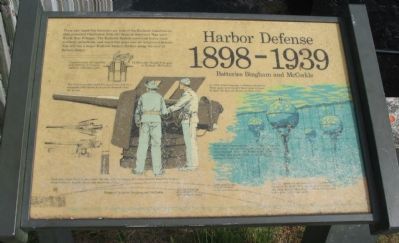
Harbor Defense 1898-1939
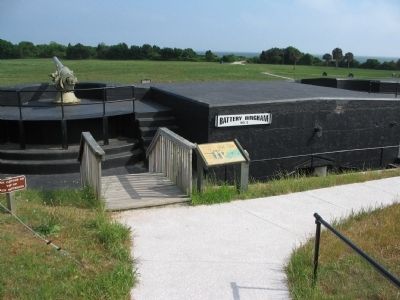
Batteries Bingham and McCorkle
Photographed by Craig Swain, May 3, 2010
1. Harbor Defense 1898-1939 Marker
15-Pounder Rapid-Fire gun in Battery McCorkle.
Gunners aimed the rapid-fire guns directly, with open sights or telescopic sights.
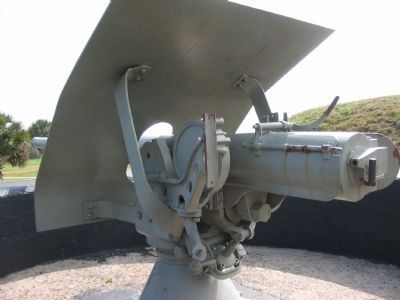
The fifteen-pounder rapid-fire gun is mounted on a balanced pillar mount so it can be lowered when not in use.
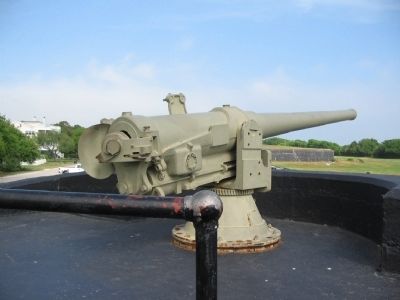
4.7-inch Armstrong gun in Battery Bingham.
These guns were bought from Great Britain to meet the Spanish American War crisis.
Both guns fired fixed ammunition like big rifle cartridges. Principal targets would have been minesweepers, torpedo-boats, and small warships.
(other text at bottom is illegible)
Topics. This historical marker is listed in these topic lists: War, Spanish-American • War, World I • War, World II.
Location. 32° 45.553′ N, 79° 51.439′ W. Marker is on Sullivan's Island, South
this page online

Regionally, this marker is in Historic Charleston and in the Lowcountry. It is also in the American South, specifically in the Deep South, and on the Eastern Seaboard. Globally, it is in the North Atlantic Region, North America, the Western Hemisphere, the Western World, and the Anglosphere. Historically, it finds itself in what was once the territory of the Mississippian Culture, one of the original Thirteen Colonies, one of the Confederate States of America, and the Antebellum South.
Other nearby markers. At least 8 other markers are within walking distance of this marker: Harbor Vigilance (a few steps from this marker); H.L. Hunley Disappears (within shouting distance of this marker); The Hunley Recovery Project (within shouting distance of this marker); Discovering the Hunley (within shouting distance
Photographed by Craig Swain, May 3, 2010
2. Harbor Defense 1898-1939 Marker
Another marker is no longer nearby. Civil War Armament (was within shouting distance of this marker but has been permanently removed).
Photographed by Craig Swain, May 3, 2010
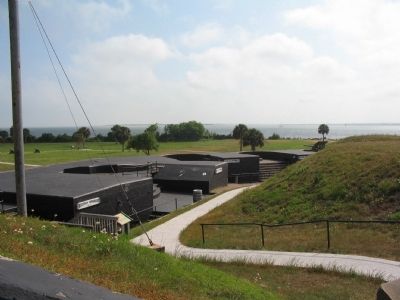
3. Battery Bingham (left) and Battery McCorkle (right)
Photographed by Craig Swain, May 3, 2010
4. 4.7-inch Armstrong Gun at Battery Bingham
Photographed by Craig Swain, May 3, 2010
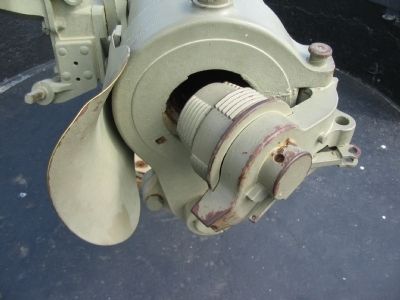
5. Breech of Armstrong
Note the interrupted screw type breech. Markings over the breech are:
Sir W.G. Armstrong, Whitworth & Company
4.7 in. B.L.
Weight 4676 lbs.
1898 No. 12124
Sir W.G. Armstrong, Whitworth & Company
4.7 in. B.L.
Weight 4676 lbs.
1898 No. 12124
Photographed by Craig Swain, May 3, 2010
6. 3-inch Rapid Fire Gun
This particular 3-inch, 15-pounder Model 1911 Rapid Fire gun is a training gun. It has no rifling and was used for crew training only. The real guns used at the battery were generally similar, but of different model numbers.
Credits. This page was last revised on June 16, 2016. It was originally submitted on June 15, 2010, by Craig Swain of Leesburg, Virginia. This page has been viewed 1,514 times since then and 34 times this year. Photos: 1, 2, 3, 4, 5, 6. submitted on June 15, 2010, by Craig Swain of Leesburg, Virginia.
