Sonora in Tuolumne County, California — The American West (Pacific Coastal)
Sonora Opera Hall
Photographed by Syd Whittle, June 13, 2010
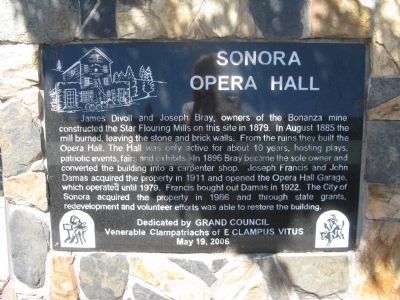
1. Sonora Opera Hall Marker
Erected 2006 by Grand Council, E Clampus Vitus.
Topics and series. This historical marker is listed in these topic lists: Arts, Letters, Music • Notable Buildings. In addition, it is included in the E Clampus Vitus series list. A significant historical year for this entry is 1879.
Location. 37° 58.905′ N, 120° 22.925′ W. Marker is in Sonora, California, in Tuolumne County. It is on South Washington Street (State Highway
this page online

Regionally, this marker is in the Sierra Nevada. It is also in the American Mountain West. Globally, it is in North America, on the Ring of Fire, on the Pacific Rim, in the Western Hemisphere, in the Western World, and in the Anglosphere. Historically, it finds itself in what was once New Spain and also Mexico’s Alta California.
Other nearby markers. At least 8 other markers are within walking distance of this marker: Sonora (within shouting distance of this marker); Sonora Fountain (within shouting distance of this marker); First Two-Story House in Sonora (within shouting distance of this marker); Site of the Sonora Plaza Well (about 400 feet away, measured in a direct line); Sonora Inn (about 500 feet away); City Hotel (about 600 feet away); Rehm Building (about 700 feet away); Sugg House (about 700 feet away). Touch for a list and map of
Photographed by Syd Whittle, June 13, 2010
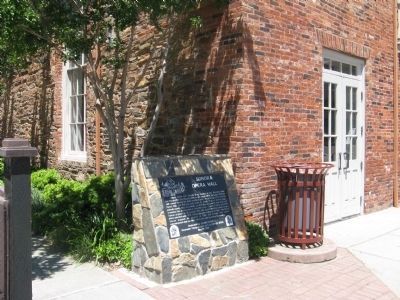
2. Sonora Opera Hall Marker
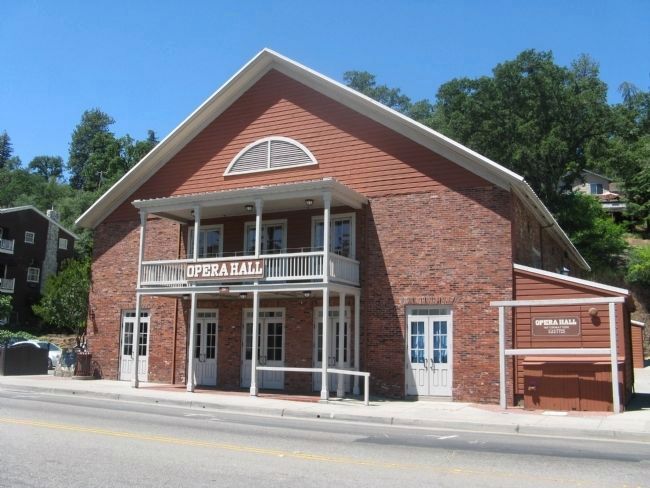
Regarding Sonora Opera Hall. It was constructed from the ruins of the Star Flouring Mill that was originally on the site. James Divoll and Joseph Bray who owned the Bonanza gold mine, which was located close to where Sonora High School is today, had built the mill in 1879. Some thought that gold from the Bonanza was stored at the flourmill until it could be transported by wagon to Stockton. In August 1885, some men broke into the flourmill, probably searching for gold. A fire was started which destroyed much of the flourmill. Jacob Bray, the night watchman, and Joseph’s brother were killed in the fire. Instead of rebuilding the flourmill, Divoll and Bray decided to use the remaining brick walls in the construction of the Opera Hall. On Christmas Eve 1885, a roller skating party was held as the inaugural event. At that time roller-skating was very popular with adults and children. The City of Sonora acquired the building in 1985 and was able to restore it with grants from the State of California and donations from private individuals.
Source: Tuolumne County Historical Society - http://www.tchistory.org/TCHISTORY/Sonora.htm
Also see . . . Welcome to Historic Sonora.
Photographed by Syd Whittle, June 13, 2010
3. Sonora Opera Hall
Credits. This page was last revised on June 16, 2016. It was originally submitted on June 16, 2010, by Syd Whittle of Mesa, Arizona. This page has been viewed 1,543 times since then and 36 times this year. Photos: 1, 2, 3. submitted on June 16, 2010, by Syd Whittle of Mesa, Arizona.
