Civic Center in San Francisco City and County, California — The American West (Pacific Coastal)
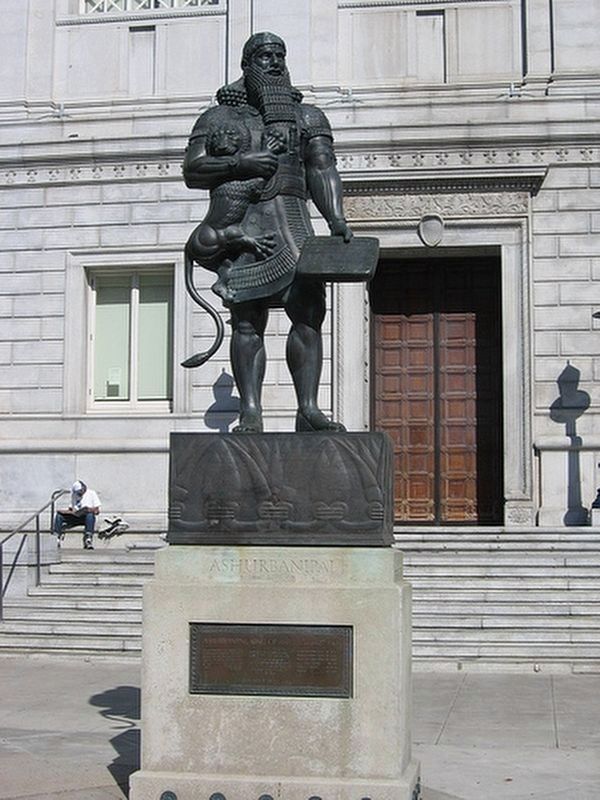
Ashurbanipal Monument
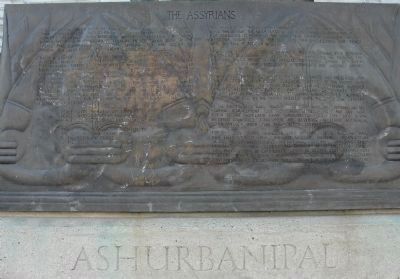
The Assyrians
Photographed by Grace Corpuz, June 13, 2010
1. Ashurbanipal Monument Marker
The Assyrians formed one of the earliest great empires in the world. Their civilization dates from 2700 B.C. with the important cultural centers at Ashur and Nineveh north of modern Baghdad. Beginning as a river civilization in Mesopotamia between the Tigris and Euphrates, the empire spread east and west to touch the lives of all Near Eastern people.
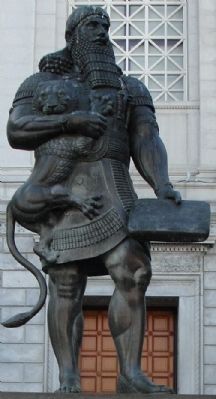
This is a statue of Ashurbanipal, one of the great kings of Assyria. A noted patron of the arts, he helped to build a culture that inspired nations from Persia to the Mediterranean Sea. The bas-reliefs in his palace are among the finest examples of ancient sculpture. Ashurbanipal ruled during the 7th century B.C. At a time when both Egypt and Babylon were under the Assyrian banner. Ashurbanipal had a personal love of learning which prompted him to collect existing knowledge of the known world in cuneiform tablets. His capital, Nineveh is distinguished for its vast collection, recorded as the world’s first great library. The statue shows the king grasping a lion cub and holding a clay tablet which bears this dedication in cuneiform:
Peace unto heaven and earth
Peace
this page online
Peace unto the dwellers in all lands
This is the statue presented to the City of San Francisco by the Assyrian people in the 210th year of America’s sovereignty.
The language of the Assyrians, Aramaic was spoken by Christ and widely used throughout the Near East by Israelites, Arabs, Persians and others for centuries. It remained the spoken and written language of the Assyrians down to the present time. Their empire lasted 1000 years until the fall of Nineveh in 612 B.C.
During the ensuing centuries of chaotic political struggle, first between the Persians and Romans, and later between Christians and Muslims, the Assyrians sought refuge in the difficult mountainous terrain of their ancient empire where succeeding governments and warring armies passed them by.
Among the first converts to Christianity, they preserved and transmitted the culture of classical Greece to the Moors who advanced it during the Dark Ages in Europe. Assyrians authored exquisite religious literature and spread Christianity to the Asiatic east as far as India and to China where their alphabet remained in use by the
Photographed by Grace Corpuz, June 13, 2010
2. Ashurbanipal
In the First World War two-thirds of the Assyrians perished in the fighting. Displacement cost them their homes, wealth and any hope for a secure homeland. Many survivors left to begin life again in other countries. Today there are Assyrians in Europe, Australia, South America, India and the United States
. For over 2000 years since the loss of their empire, Assyrians have kept their identity and language without political organization or any of the institutions of national security, passing their heritage on to new generations through the strength of family ties and a spirit of community which is deeply felt. Their rich cultural heritage binds Assyrians worldwide to each other. Their contribution to civilization will continue to enrich world culture.
Erected 1985 by The Assyrian People.
Topics. This historical marker and monument is listed in these topic lists: Arts, Letters, Music • Notable Places • War, World I.
Location. 37° 46.766′ N, 122° 24.952′ W. Marker is in San Francisco, California, in San Francisco City and
Photographed by Grace Corpuz, June 13, 2010
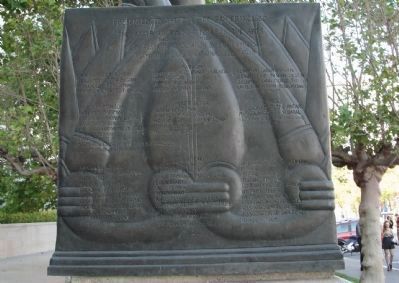
3. Ashurbanipal Monument: inscriptions on east face of the statue's base:
by
the Assyrian Foundation for the Arts
through donations of
American Assyrian Association of San Francisco
Assyrian American National Federation
. . . [Lists of Names:]
Patron ... Sponsor...Benefactor...Donor...Friend...

Regionally, this marker and monument is on California’s Coast Ranges. It is also on the American Pacific Coast. Globally, it is in North America, on the Ring of Fire, in the Pacific Rim, in the Western Hemisphere, in the Western World, and in the Anglosphere. Historically, it finds itself in what was once New Spain and also Mexico’s Alta California.
Other nearby markers. At least 8 other markers are within walking distance of this marker: Pioneer Monument / California Native Americans (within shouting distance of this marker); Hotel Whitcomb (about 500 feet away, measured in a direct line); McAllister Tower (about 800 feet away); 220 Golden Gate Ave. (approx. 0.2 miles away);
Photographed by Grace Corpuz, June 13, 2010
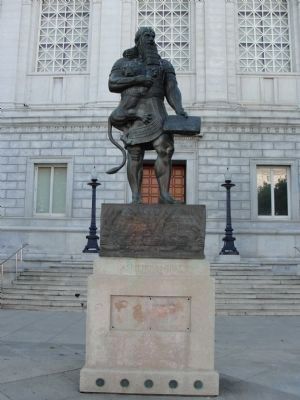
4. Ashurbanipal Monument
Note: Panel now missing from pedestal contained inscription in Aramaic.
More about this marker. The presently missing marker plaque read as follows:
"Ashurbanipal, King of Assyria, 669-627 B.C.
Peace unto heaven and earth
Peace unto countries and cities
Peace unto dwellers in all lands
This is the statue presented to
the City of San Francisco
by the Assyrian people in the
210th year of America's sovereignty."
Dedicated May 29, 1988
[Translations in Akkadian cuneinform and Aramaic.]
Also see . . .
1. Statue of Ashurbanipal (San Francisco). Wikipedia entry, includes photo of missing plaque. (Submitted on September 11, 2020, by Larry Gertner of New York, New York.)
2. 1933: The Simele Genocide. (Submitted on June 17, 2010, by Richard E. Miller of Oxon Hill, Maryland.)
3. Assyrians in the United States. A Wikipedia article on the Assyrians in the US. (Submitted on June 21, 2010, by Richard E. Miller of Oxon Hill, Maryland.)
Additional keywords. Chaldean;
Photographed by Xenohistorian.faithweb.com, unknown
5. Ashurbanipal Monument
With the missing plaque.
Credits. This page was last revised on February 7, 2023. It was originally submitted on June 17, 2010, by Richard E. Miller of Oxon Hill, Maryland. This page has been viewed 3,950 times since then and 94 times this year. Last updated on June 21, 2010, by Richard E. Miller of Oxon Hill, Maryland. Photos: 1, 2, 3, 4. submitted on June 17, 2010, by Richard E. Miller of Oxon Hill, Maryland. 5. submitted on September 11, 2020, by Larry Gertner of New York, New York. • Syd Whittle was the editor who published this page.
