Near Parker in La Paz County, Arizona — The American Mountains (Southwest)
Poston Memorial Monument
Photographed by Bill Kirchner, June 6, 2010
1. Poston Marker
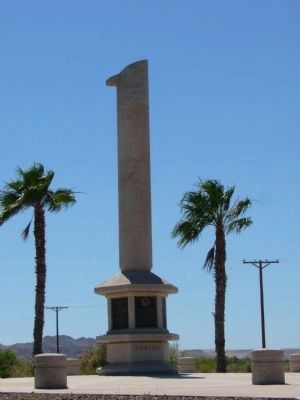
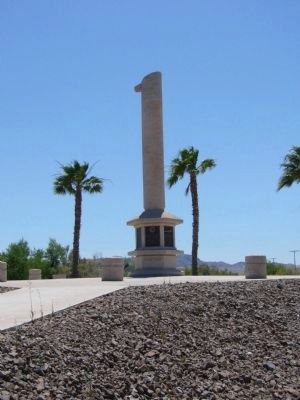
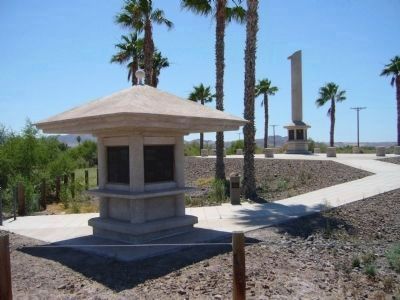
Inscription. [ The single 30 foot concrete pillar of the monument symbolizes "unity of spirit". The hexagonal base represents a Japanese stone lantern. The 12 small pillars situated around the monument make it a working sundial. Mounted on the 30 foot pillar base are six plaques and on a nearby kiosk are four additional plaques ]
[ Plaques mounted on Monument Base: ]
[ Photo Number 1 ]
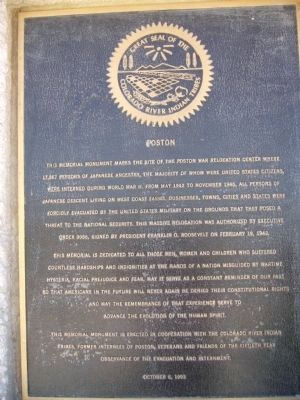
Poston
This memorial monument marks the site of the Poston War Relocation Center where 17,867 persons of Japanese ancestry, the majority of whom were United States Citizens, were interned during World War II. From May 1942 to November 1945, all persons of Japanese descent living on west coast farms, businesses, towns, cities and states were forcibly evacuated by the United States Military on the grounds that they posed a threat to the National Security. This massive relocation was authorized by executive order 9066, signed by President Franklin D. Roosevelt on February 19, 1942.
This memorial is dedicated to all those men, women and children who suffered countless hardships and indignities at the hands of a nation misguided by wartime hysteria,
Click or scan to see this page online
racial prejudice and fear. May it serve as a constant reminder of our past so that Americans in the future will never again be denied their constitutional rights and may the remembrances of that experience serve to advance the evolution of the human spirit.
[ Plaque Number 2 – See Photo #5: ]
Poston
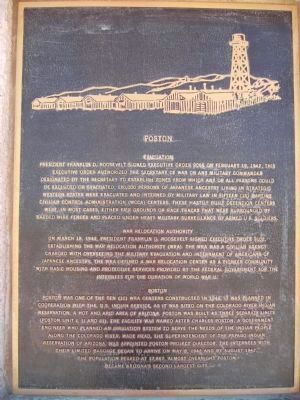
Evacuation
President Franklin D. Roosevelt signed Executive Order 9066 on February 19, 1942. This executive order authorized the Secretary of War or any military commander designated by the Secretary to establish zones from which any or all persons could be excluded or evacuated. 120,000 persons of Japanese ancestry living in strategic western states were evacuated and interned by military law in fifteen (15) wartime Civilian Control Administration (WCCA) Centers. These hastily built detention centers were, in most cases, either fair grounds or race tracks that were surrounded by barbed wire fences and placed under heavy surveillance by armed U.S. soldiers.
War Relocation Authority
On March 18, 1942, President Franklin D. Roosevelt signed Executive Order 9102, establishing the War Relocation Authority (WRA). The WRA was a civilian
Photographed by Bill Kirchner, June 6, 2010
2. Poston Monument
agency charged with overseeing the military evacuation and internment of Americans of Japanese ancestry. The WRA defined a war relocation center as a pioneer community with basic housing and protective services provided by the Federal Government for the internees for the duration of World War II.
Poston
Poston was one of the ten (10) WRA Centers constructed in 1942. It was planned in cooperation with the, U.S. Indian Service, as it was sited on the Colorado River Indian Reservation, a hot and arid area of Arizona. Poston was built as three separate units (Poston Unit I, II and III). The facility was named after Charles Poston, a government engineer who planned an irrigation system to serve the needs of the Indian People along the Colorado River. Wade Head, the Superintendent of the Papago Indian Reservation of Arizona, was appointed Poston Project Director. The internees with their limited baggage began to arrive on May 8, 1942 and by August 1942, the population peaked at 17,867. Almost overnight Poston became Arizona’s second largest city.
[ Plaque Number 3 - Photo # 6 ]
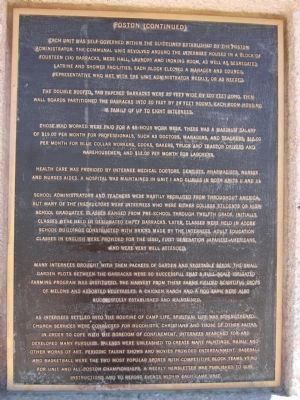
Poston (Continued)
Each unit was self-governed within
Photographed by Bill Kirchner, June 6, 2010
3. Poston Monument
the guidelines established by the Poston Administrator. The communal unit revolved around the internees housed in a block of fourteen (14) barracks, mess hall, laundry and ironing room, as well as segregated latrine and shower facilities. Each block elected a manager and council representative who met with the unit administrator weekly, or as needed.
The double roofed tar papered barracks were 20 feet wide by 100 feet long. Thin wall boards partitioned the barracks into 20 feet by 24 feet rooms, each room housing a family of up to eight internees.
Those who worked were paid for a 48-hour work week. There was a maximum salary of $19.00 per month for professionals, such as doctors, managers, and teachers: $16.00 per month for blue collar workers, cooks, bakers, truck and tractor drivers and warehousemen; and $12.00 per month for laborers.
Health care was provided by internee medical doctors, dentists, pharmacists, nurses and nurses aides. A hospital was maintained in Unit I and clinics in both Units II and III.
School administrators and teachers were hastily recruited from throughout America, but many of the instructors were
Photographed by Bill Kirchner, June 6, 2010
4. Poston Monument
internees who were either college students or high school graduates. Classes ranged from pre-school through twelfth grade. Initially, classes were held in designated empty barracks. Later, classes were held in adobe school buildings constructed with bricks made by the internees. Adult education classes in English were provided for the Issei, first generation Japanese-Americans and were very well attended.
Many internees brought with them packets of garden and vegetable seeds. The small garden plots between the barracks were so successful that a full-scale irrigated farming program was instituted. The harvest from these farms yielded bountiful crops of melons and assorted vegetables. A chicken ranch and hog farm were also successfully established and maintained.
As internees settled into the routine of camp life, spiritual life was strengthened. Church services were conducted for Buddhists, Christians and those of other faiths. In order to cope with the boredom of confinement, internees searched for and developed many pursuits. Talents were unleashed to create many paintings, haiku, and other works of art. Periodic talent shows
Photographed by Bill Kirchner, June 6, 2010
5. Poston - Plaque Number 2
and movies provided entertainment. Baseball and basketball were the two most popular sports with competitive block teams vying for unit and all-position championships. A weekly newsletter was published to give instructions and to report events within each camp unit.
[ Plaque Number 4 – Photo #7 ]
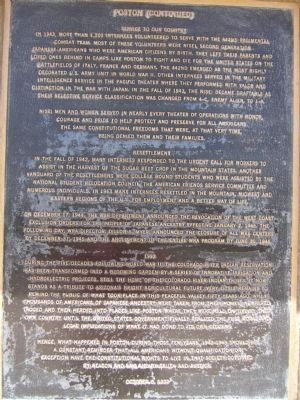
Poston (Continued)
Service to Our Country
In 1943, more than 1,200 internees volunteered to serve with the 442nd Regimental Combat Team. Most of these volunteers were Nisei, second generation Japanese-Americans who were American citizens by birth. They left their parents and loved ones behind in camps like Poston to fight and die for the United States on the battlefields of Italy, France and Germany. The 442nd emerged as the most highly intelligence service in the Pacific Theater where they performed with valor and distinction in the war with Japan. In the fall of 1943, the Nisei became draftable as their selective service classification was changed from 4-C, enemy alien, to A-1.
Nisei men and women served in nearly every theater of operations with honor, courage and pride to help protect and preserve for all Americans the same
Photographed by Bill Kirchner, June 6, 2010
6. Poston - Plaque Number 3
constitutional freedoms that were, at that very time, being denied them and their families.
Resettlement
In the Fall of 1942, many internees responded to the urgent call for workers to assist in the harvest of the sugar beet crop in the mountain states. Another vanguard of the resettlement were college bound students who were assisted by the National Student Relocation Council, The American Friends Service Committee and numerous individuals. In 1943 many internees resettled in the Mountain, Midwest and Eastern regions of the U.S. for employment and a better way of life.
On December 17, 1944, the War Department announced the revocation of the West Coast Exclusion Orders for the people of Japanese ancestry effective January 2, 1945. The following day, WRA Director, Dillon S. Myer, announced the closure of all WRA centers by December 31, 1945 and the abolishment of the entire WRA Program by June 30, 1946.
1992
During the five decades following World War II, the Colorado River Indian Reservation has been transformed into a blooming garden by a series of innovative irrigation and hydroelectric projects. Still the home of the
Photographed by Bill Kirchner, June 6, 2010
7. Poston - Plaque Number 4
Colorado River Indian Tribes, it now stands as a tribute to Arizona’s bright agricultural future. Very little remains to remind the public of what took place in this peaceful valley fifty years ago, when thousands of Americans of Japanese ancestry were taken from their homes. Numbered, tagged and then herded into places like Poston where they were held captive by their own country until the United States Government finally realized the full moral and legal implications of what it had done to its own citizens.
Hence, what happened in Poston during those few years, 1942-1945, should be a constant reminder that all Americans without qualification or exception have the Constitutional rights to live in that society governed by reason and laws and by truth and justice.
December 6, 1992
Plaque Number 5 – Photo #8
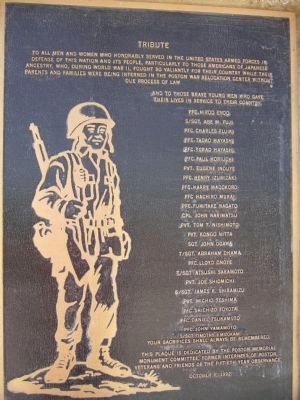
Tribute
To all men and women who honorably served in the United States Armed Forces in defense of this nation and its people, particularly to those Americans of Japanese ancestry, who, during World War II, fought so valiantly for their country while their parents and families were being interned in the Poston War Relocation
Photographed by Bill Kirchner, June 6, 2010
8. Poston - Plaque Number 5
Center without due process of Law.
And to those brave young men who gave their lives in service to their country
PFC Hiroo Endo • S/SGT. Abe M. Fuji • PFC. Charles Fujiki • PFC. Tadao Hayashi • PFC. Torado Hayashi • PFC. Paul Horiuchi • PVT. Eugene Inouye • PFC. Henry Izumizaki • PFC. Harry Madokoro • PFC. Hachiro Mukai • PFC. Fumitake Nagato • CPL. John Narimatsu • PVT. Kongo Nitta • SGT. John Ogawa • T/SGT. Abraham Ohama • PFC. Lloyd Onoye • T/SGT. Atsushi Sakamoto • PVT. Joe Shiomichi • S/SGT. James K. Shiramizu • PVT. Michio Teshima • PFC. Shichizo Toyota • PFC. Daniel Tsukamoto • PFC. John Yamamoto • S/SGT. Timothy I. Mizokami
Your sacrifices will always be remembered.
This plaque is dedicated by the Poston Memorial Monument Committee, former internees of Poston, Veterans and Friends of the Fiftieth Year Observance
October 6, 1992
[ Plaque Number 6 – Photo #9 ]
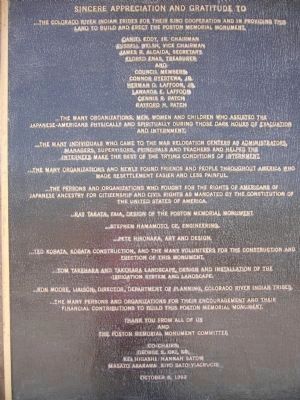
Sincere Appreciation and Gratitude To:
…The Colorado River Indian Tribes for their kind cooperation an in providing this land to build and erect the Poston Memorial Monument.
Daniel Eddy, Jr., Chairman • Russell Welsh, Vice Chairman • James R. Alcaida,
Photographed by Bill Kirchner, June 6, 2010
9. Poston - Plaque Number 6
Secretary • Eldred Enas, Treasurer
And
Council Members
Connor Byestewa, Jr. • Herman D. Laffoon, Jr, • Lawanda E. Laffoon • Dennis R. Patch • Rayford H. Patch
...Organizations , men, women and children who assisted the Japanese-Americans physically and spiritually during those dark hours of evacuation and internment.
…the many individuals who came to the War Relocation Centers as administrators, managers, supervisors, principals and teachers and helped the internees make the best of the trying conditions of internment.
…the many organizations and newly found friends and people throughout America who made resettlement easier and less painful.
…the persons and organizations who fought for the rights of Americans of Japanese ancestry for citizenship and civil rights as mandated by the Constitution of the United States of America.
…Ray Takata, FAIA, design of the Poston Memorial Monument.
…Stephen Hamamoto, CE, Engineering.
…Pete Hironaka, Art and Design.
…Ted Kobata Kobata Construction, and the many volunteers for the construction and erection of this monument.
…Tom Takehara and Takehara Landscape, design and installation
Photographed by Bill Kirchner, June 6, 2010
10. Kiosk Plaque Number 1
Poston - 1942-1945
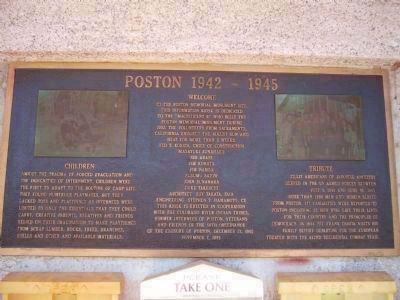
Welcome and Tribute plaque to the monument. Two photos are displayed; children playing and Frank Oshita with his family.
of the irrigation system and landscape.
…Ron Moore, liaison, Director, Department of Planning, Colorado River Indian Tribes.
…The many persons and organizations for their encouragement and their financial contributions to build this Poston Memorial Monument.
Thank You From All of Us
and
The Poston Memorial Monument Committee
Co-Chairs
George S. Oki, SR
Kei Higashi, Hanna Satow
Masato Asarawa, Kiyo Sato-Viacrucis
October 6, 1992
[ Plaques Located on Kiosk ]
Kiosk Plaque Number 1 – See Photo #10:
Poston 1942 – 1945
Welcome
To the Poston Memorial Monument site. This information is dedicated to the “Magnificent 8” who built the Poston Memorial Monument during 1992. The volunteers from Sacramento, California endured the August sun and heat for more than 3 weeks.
Ted T. Kobata – Chief of Construction • Masayuki Sunahara • Sid Arase • Jim Kobata • Jim Namba • Susumu Satow • Duke Takeuchi • Architect Ray Takata, FAIA • Engineering Stephen T. Hamamoto, CE
This kiosk is erected in cooperation with the Colorado River Indian Tribes, former internees of Poston, Veterans and Friends of the 50th Observance of the Closure
Photographed by Bill Kirchner, June 6, 2010
11. Kiosk Plaque Number 2
Poston 1942 - 1945
of Poston, December 31, 1945
November 7, 1995
Children
Amidst the trauma of forced evacuation and indignities of internment, children were the first to adapt to the routine of camp life. They found numerous playmates, but they lacked toys and playthings as internees were limited to only essentials that they could carry. Creative parents, relatives and friends relied on their imagination to make playthings from scrap lumber, rocks, trees, branches, shells and other available materials.
Tribute
22,532 Americans of Japanese ancestry served in the US Armed Forces between July 1, 1940 and June 30, 1945. More than 1200 men and women served from Poston. 117 casualties were reported to Poston including 25 men who gave their lives for their country and the principles of democracy. In 1944 PFC Frank Oshita visits his family before departing for the European Theater with the 442nd Regimental Combat Team.
[ Displayed on the marker are two faded photos; One is of children playing with home made toys and the second is of Frank Oshita and his family. ]
[ Kiosk Plaque Number 2 – See Photo #11: ]
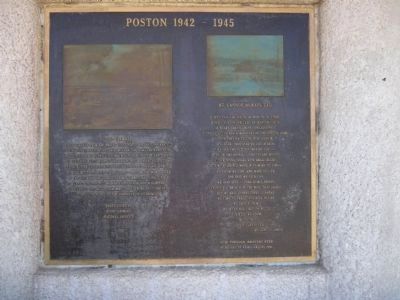
Poston 1942 – 1945
The Climate
17,867
Photographed by Bill Kirchner, June 6, 2010
12. Kiosk Plaque Number 3
Poston 1942 - 1945
evacuees from the Pacific Coast states and Arizona arrived from May through August 1942. Most of the evacuees were from California. The relentless summer sun scorched the earth and the frequent winds whipped the sands into blinding dust storms. In the winter chilling winds easily penetrated the walls of the flimsily built tar paper barracks and through the wide cracks in the flooring. The infrequent but torrential rains quickly turned the parched walkways and roads into a slippery, treacherous and muddy quagmire. The extreme environmental conditions added to the hardships of internment.
We Cannot Always Fail
When tears are wrung in worlds of strife;
When lives are wrecked by wanton greed;
A weary throng, bent, disillusioned,
turned to dull black barracks in the dust as home;
Then they faced the world anew,
and here, they started life afresh.
We are the outcast, making life -
with dreams ahead – and dreams behind;
confronting trials with small relief;
But we’ve gained much with more to find -
and now we live, and make of life;
the best we ever can.
We have left – some homes behind,
crushed – broken in the wind that passed
but
Photographed by Bill Kirchner, June 6, 2010
13. Kiosk Plaque Number 4
The Sovereignty of Colorado River Indian Tribes
we have others there – ahead.
We come to trails and ruts in life;
We tackle them;
We often fail – but on we go
for well we know
by faith.
We cannot always fail.
By Lloyd Fujimoto
From Through Innocent Eyes published by Keiro Services 1990
[ Kiosk Plaque Number 3 – See Photo #12: ]
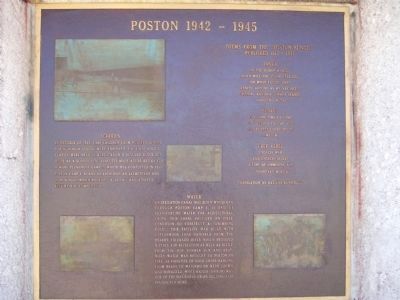
Poston 1942 - 1945
Schools
In October of 1942, 5,300 children from nursery school through high school were enrolled. The first school classes were held in barracks in a regular block set aside as a school site. Evacuees made adobe bricks for a more permanent campus which was completed in 1943. Poston Camp I, II and III each had an elementary and high school which provided academic and athletic rivalry and competition.
Water
An irrigation canal was built which ran through Poston Camp I, II and III transporting water for agricultural crops. This canal provided an ideal condition to construct a “swimming hole”. This facility was built with cottonwood logs gathered from the nearby Colorado River which provided a place for recreation as well as relief from the hot summer sun and heat. When water was brought to Poston in 1943, 34 varieties of food crops ranging from beans to watermelon were grown and harvested. White radish (daikon) was one of the successful crops yielding 9,149 pounds per acre.
Poems From the “Poston Bungei
Published 1943 – 1945
Tanka
In the human world,
when will the storm ever end
on what future day?
Fenced around as we are here,
Greeting another summer season.
- Shizuko Muta
Senryu
For some time to come
I’ve decided to stay here
and planted some seeds.
- Masumi
Free Verse
Endless war
and endless desert
a line of simmering air.
- Yoshitake Morita
Translation by Katsumi Kunitsugu
[ Kiosk Plaque Number 4 – See Photo #13 ]
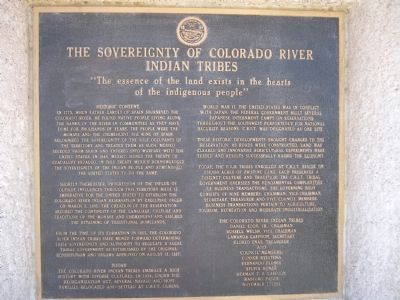
The Sovereignty of Colorado River
Indian Tribes
“The essence of the land exists in the hearts
of the indigenous people”
Historic Content
In 1775, when Father Garces of Spain journeyed the Colorado River, he found native people living along the banks of the river in communities as they have done for thousands of years. The people were the Mohave and the Chemehuevi. The King of Spain recognized the sovereignity of the sole occupants the territory and treated them as such. Mexico seceded from Spain and entered into warfare with the United States. In 1848, Mexico signed the Treaty of Guadalupe Hidalgo. In this treaty Mexico acknowledged the sovereignity of the Indian People and admonished the United States to do the same.
Shortly thereafter, progression of the influx of outside influences through the territory made it imperative for the United States to establish the Colorado River Indian Reservation by Executive Order on March 3, 1865. The creation of the Reservation secured the continuity of the language, culture and traditions of the Mohave and Chemehuevi and assured the retaining of traditional homelands.
From the time of its formation in 1865, the Colorado River Indian Tribes have moved forward determining their sovereignity and authority to regulate a legal tribal government as established by the original constitution and bylaws approved August 13, 1937.
Today
The Colorado River Indian Tribes embrace a rich history with diverse cultures. In 1934, under the Reorganization Act, several Navajo and Hopi families relocated and settled at C.R.I.T. During World War II, the United States was in conflict with Japan. The Federal Government built several Japanese Internment Camps on reservations throughout the Southwest purportedly for national security reasons. C.R.I.T. was designated as one site.
These historic developments brought changes to the reservation. As roads were constructed, land was cleared and innovated agricultural experiments were tested and results successfully raised the economy.
Today, the four tribes enrolled at C.R.I.T. reside on 278,000 acres of pristine land. Each preserves a distinct culture and tradition. The C.R.I.T. Tribal Government oversees the fundamental complexities of business transactions. The governing body consists of nine members: Chairman, Vice-Chairman, Secretary, Treasurer and five council members. Business transactions pertain to agriculture, tourism, recreation, and moderate industrialization.
The Colorado River Indian Tribes
Daniel Eddy, Jr., Chairman • Russell Welsh, Vice Chairman • Lawanda Laffoon, Secretary • Eldred Enas, Treasurer
and
Council Members:
Conner Byestewa • Fernando Flores • Sylvia Homer • Herman T. J. Laffoon • Rayford Patch
November 7, 1995
Erected 1992 by Colorado River Indian Tribes, Former Internees of Poston, Veterans and Friends of the Fiftieth Year Observance of the Evacuation and Internment.
Location. 33° 59.258′ N, 114° 24.073′ W. Marker is near Parker, Arizona, in La Paz County. It is on Mohave Road 11.7 miles south of Arizona Route 95, on the right when traveling north. Touch for map. Marker is in this post office area: Parker AZ 85344, United States of America. Touch for directions.
Regionally, this marker and monument is in the Colorado River Valley, in the Sonoran Desert, and in the Yuma Area. It is also in the American Southwest. Globally, it is in North America, the Western Hemisphere, the Western World, and the Anglosphere. Historically, it finds itself in what was once New Spain and also Mexico’s Alta California.
Other nearby markers. At least 3 other markers are within 15 miles of this marker, measured as the crow flies: Earp Cottage (approx. 11 miles away in California); Wyatt Earp (approx. 13.4 miles away in California); Giant Desert Figures (approx. 14.9 miles away in California).
Also see . . . 1. Poston Internment Camp. Historical information about the wartime imprisonment of the people of Japanese ancestry at the Colorado River Relocation Center. (Submitted on June 13, 2010, by Bill Kirchner of Tucson, Arizona.)
2. Colorado River Indian Tribes Web Page. The tribal information bubble at the right side of the page often features the Poston Monument in its tourism spotlight. (Submitted on January 7, 2011.)
Credits. This page was last revised on June 28, 2025. It was originally submitted on June 13, 2010, by Bill Kirchner of Tucson, Arizona. This page has been viewed 9,353 times since then and 311 times this year. Last updated on June 25, 2010, by William J. Toman of Green Lake, Wisconsin. It was the Marker of the Week May 25, 2025. Photos:1, 2, 3, 4, 5, 6, 7, 8, 9, 10, 11, 12, 13. submitted on June 13, 2010, by Bill Kirchner of Tucson, Arizona. • Syd Whittle was the editor who published this page.