South Slope Brewing District in Asheville in Buncombe County, North Carolina — The American South (South Atlantic)
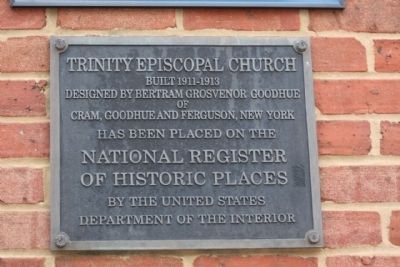
Trinity Episcopal Church
Built 1911 - 1913
Photographed by Mike Stroud, May 22, 2010
1. Trinity Episcopal Church Marker
of
Cram, Goodhue and Ferguson, New York
Has been placed on the
National Register
Of Historic Places
By the United States
Department of the Interior
Topics. This historical marker is listed in these topic lists: Notable Buildings • Religion & Religious Structures.
Location. 35° 35.576′ N, 82° 33.17′ W. Marker is in Asheville, North Carolina, in Buncombe County. It is in the South Slope Brewing District. It is on Aston Street near Church Street, on the left when traveling east. Trinity Episcopal Church stands on the southeastern corner of Church and Aston streets. Touch for map. Marker is in this post office area: Asheville NC 28801, United States of America. Touch for directions.

Regionally, this marker is in the Mountains. It is also in the American South, specifically in the Upper South, in Appalachia, and specifically in Southern Appalachia. Globally, it is in North America, the Western Hemisphere, the Western World, and the Anglosphere. Historically, it finds itself in what was once the original Cherokee Nation,
this page online
Other nearby markers. At least 8 other markers are within walking distance of this marker: Oscar Wong (about 500 feet away, measured in a direct line); Hotel District (about 600 feet away); Cornerstone of Culture (about 600 feet away); Immortal Image (about 600 feet away); O. Henry (about 600 feet away); Coleman Zageir (about 700 feet away); Stepping Out (about 700 feet away); Elizabeth Blackwell, M.D. (about 700 feet away). Touch for a list and map of all markers in Asheville.
Another marker is no longer nearby. Asheville (was about 600 feet away but has been permanently removed).
Regarding Trinity Episcopal Church. The Episcopal Church in Downtown Asheville Since 1849 -
Trinity Church is a nurturing Christian community providing opportunities for worship, spiritual growth and commitment in a supportive and open atmosphere.
In 1847, Asheville was a small community of about 800 people. Biltmore Avenue, then called Main Street, was still a dirt road. The closest established
Photographed by Mike Stroud, May 22, 2010
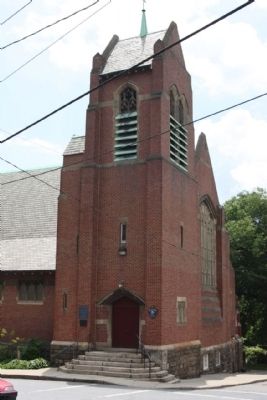
2. Trinity Episcopal Church and Marker along Aston Street
Nationally known architect Bertram Goodhue of the New York-based firm of Cram, Goodhue and Ferguson designed the building in 1912. The Tudor Gothic Revival style brick building with granite trim features a simple, gable-roofed sanctuary with transepts and a short corner tower. The interior opens to an attractive hammer beam ceiling and panel tracery fills the stained glass windows. A compatible parish house and hall were added later around the church.
Initially, services were held in buildings around town, but by 1849, property had been donated and the first church building was erected on this site, at the corner of Church and Aston Streets. The congregation quickly outgrew the first church and a second was built in its place. That building tragically burned in the fall of 1910, but the third, and present, church was begun the next year. Over the years, members of Trinity helped found Mission Hospital, build Asheville's public library and initiate various educational opportunities for mountain children. Parishioners stepped forward to act as godparents for orphans and children of unchurched mill workers, and then made sure they had enough to eat and taught them to read. Public leaders, home makers, physicians, attorneys and business owners, movers and shakers, community activists and volunteers, all have called Trinity home. And, over the years, they have reached out to the community with energy, vision and talents to improve the lives of those who have touched theirs.
For over 150 years, Trinity has been instrumental in the growth of Episcopal churches in Asheville and the surrounding area, with local missions having found their initial support and inspiration from this congregation. As a result, Trinity is central to the history and formation of the Diocese of Western North Carolina, and today continues to offer a guiding hand in the journey of faith within the church and within the community at large. (Trinity Episcopal Church)
Credits. This page was last revised on June 1, 2025. It was originally submitted on June 27, 2010, by Mike Stroud of Bluffton, South Carolina. This page has been viewed 1,133 times since then and 48 times this year. Photos: 1, 2. submitted on June 27, 2010, by Mike Stroud of Bluffton, South Carolina.
