Greenville in Greenville County, South Carolina — The American South (South Atlantic)
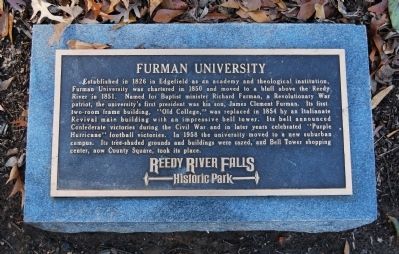
Furman University
Reedy River Falls Historic Park
Photographed by Brian Scott, December 7, 2008
1. Furman University Marker
Topics. This historical marker is listed in these topic lists: Architecture • Education • Religion & Religious Structures. A significant historical year for this entry is 1826.
Location. 34° 50.6′ N,
this page online

Regionally, this marker is in Upstate. It is also in the American South, specifically in the Deep South, in Appalachia, and specifically in Southern Appalachia. Globally, it is in North America, the Western Hemisphere, the Western World, and the Anglosphere. Historically, it finds itself in what was once the original Cherokee Nation, the territory of the Mississippian Culture, one of the original Thirteen Colonies, one of the Confederate States of America, and the Antebellum South.
Other nearby markers. At least 10 other markers are within walking distance of this marker: Mill Village (here, next to this marker); River Lodge (within shouting distance of this marker); Old Mill Ruins (within shouting distance of this marker); Vardry Mill (within shouting distance of this marker); Reedy River Falls (within shouting distance of this marker); The Cherokees
Photographed by Brian Scott, December 7, 2008
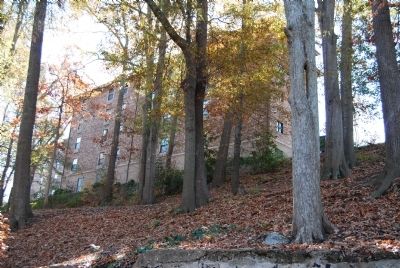
2. Former Site of Furman University, Now Home to the South Carolina Governor's School for the Arts
Another marker is no longer nearby. Falls Reclaimed and the Liberty Bridge 2004 (was about 500 feet away but has been replaced with another marker now near it).
Also see . . .
1. Furman University. Official website of Furman University. (Submitted on December 20, 2008, by Brian Scott of Anderson, South Carolina.)
2. Furman University. Furman University is a private, coeducational, non-sectarian university in Greenville, South Carolina, United States. (Submitted on April 13, 2009, by Brian Scott of Anderson, South Carolina.)
Additional commentary.
1. About James Clement Furman
Born in Charleston, James Furman’s legacy is the service and devotion he gave to his namesake university, which is actually named for his father, Dr. Richard Furman, a Baptist
Special Collections, South Carolina Library, USC Columbia
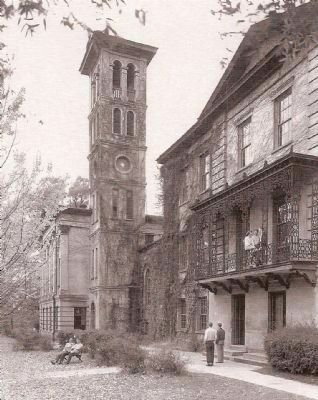
3. Furman University (1854)
Furman Campus was designed by Edward C. Jones of Charleston. The Italian-style bell tower was rung each time there was a southern victory during the Civil War. The campus was demolished in 1961 but the bell tower was recreated on Furman's current campus. It now chimes each time there is a Furman athletic victory.
Furman, an ardent states’ rights supporter, was heavily involved in politics, as well. In 1860, he secured an appointment as one of the Greenville delegates to attend the Secession Convention, a meeting that would eventually lead South Carolina to become the first Southern state to secede from the Union. On December 20, 1860, Furman was one of the signers of the Ordinance of Secession. (Source: G: The Magazine of Greenville, Jan/Feb 09 pg 70.)
— Submitted April 13, 2009, by Brian Scott of Anderson, South Carolina.
2. James Clement Furman: History in Brief
At a Glance James Furman became an influential political figure in the community
Special Collections, Greenville County Library, Greenville, 1901
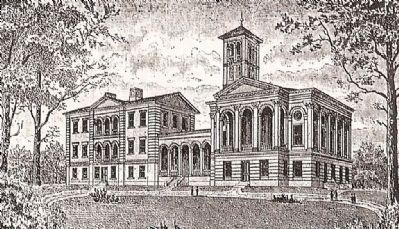
4. Furman University (1854)
The music building to the left of the bell tower and the right building make up the entire Furman campus. This engraving comes from a 1901 Greenville city directory.
Claim to Fame Furman is best known for his efforts to have Furman University moved from Fairfield, South Carolina, to Greenville in 1851, where it opened in McBee Hall on the corner of Main Street and McBee Avenue. He was chairman of the faculty before later becoming president.
Did You Know? Furman University closed during the Civil War, so Furman became president of the Greenville Women’s College instead. Initial efforts to reopen the school after the war’s conclusion were unsuccessful, but Furman was quoted as saying, “I have resolved, if the university should go down, to sink with it.”
An Impressive Eulogy At an 1870 commemoration of the death of Confederate General Robert E. Lee, Furman was a featured speaker. (Source: G: The Magazine of Greenville, Jan/Feb 09, pg 70.)
— Submitted April 13, 2009, by Brian Scott of Anderson, South Carolina.
Credits. This page was last revised on December 13, 2019. It was originally submitted on December 20, 2008, by Brian Scott of Anderson, South Carolina. This page has been viewed 1,737 times since then and 46 times this year. Last updated on July 12, 2010. Photos: 1, 2. submitted on December 20, 2008, by Brian Scott of Anderson, South Carolina. 3, 4. submitted on April 13, 2009, by Brian Scott of Anderson, South Carolina. • Kevin W. was the editor who published this page.
